
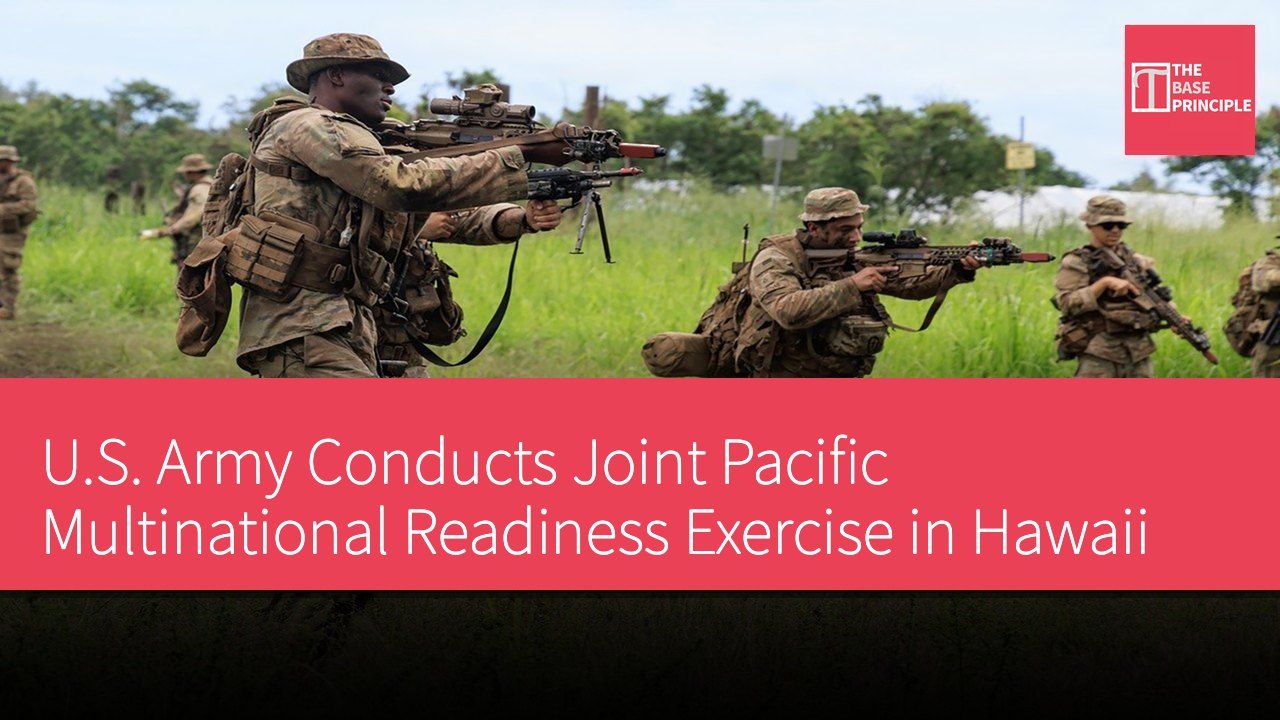
- The U.S. Army's 25th Infantry Division is conducting a multinational joint exercise in Hawaii.
- Participating countries include South Korea, Singapore, France, New Zealand, and others.
- The 11th Airborne Division airlifted approximately 300 troops from Alaska to Hawaii.
- Advanced communication network technologies were validated during the exercise.
The U.S. Army's 25th Infantry Division and its partner forces have commenced training in Hawaii, ranging from airborne landings to multi-battalion ground operations, with infantry conducting long-range aerial assaults across the Pacific via helicopters, according to Army reports. All training is aimed at simulating enemy scenarios rather than actual combat. This exercise, named Joint Pacific Multinational Readiness Center Rotation 27-01 (JPMRC 27-01), is a combat training rotation taking place in the Hawaiian Islands. The division reported that thousands of U.S. and multinational forces are participating.
Multinational Joint Exercise Participation
Army photo captions listed South Korea, Singapore, France, New Zealand, Japan, and the Maldives as participating countries. Subsequent reports described a 14-day participation, during which opposing forces played the role of enemy troops.
Before the ground phase, the 11th Airborne Division airlifted approximately 300 paratroopers from Alaska, flying about 3,000 miles (4,800 kilometers) to Hawaii in an operation dubbed "Arctic Aloha." According to reports, the troops began operations at night and strictly controlled electronic emissions, indicating limitations on radio and other transmissions. The reports noted that modern battlefields are filled with electronic surveillance, making it a domain of electronic warfare. Aviation and logistics teams set up dispersed armaments and refueling stations across the island chain to maintain supply for joint forces without exposing their locations.
South Korean Army reconnaissance teams arrived on the Big Island aboard New Zealand aircraft to observe the airdrop zones.
The division's deputy commander, Colonel Aidan Shattock of the New Zealand Army, stated that the troops are operating "within the area we hope to deter." According to the division's report on November 9, the 25th Combat Aviation Brigade subsequently inserted part of the 2nd Stryker Brigade into contested terrain, with significant supply airdrops conducted by the 8th Theater Sustainment Command. The report also indicated that this assault relied on conditions set several days in advance. Aerial photographs in the report were dated November 8.
Application of Advanced Communication Technologies
Meanwhile, the "Lightning Raid 6" exercise, conducted alongside JPMRC, continued to validate the division's communication networks. A report from November 7 noted that soldiers used tactical mesh radios and secure but unclassified data layers. Mesh radios can relay signals to each other without a central tower. The division's commanding general, Major General Jeff VanAntwerp, stated that the division is one of two units equipped with next-generation command and control (C2) systems. He mentioned that its cloud design allows significant computing power to be pushed down from brigade level to company level. The report noted several limitations.
These reports come from Army releases rather than independent observers or measurements. The reports did not specify how many aircraft or troops participated in the assault, how opposing forces responded, or the performance of the network. Additionally, the reports did not describe the decision-support tools that the division indicated it is adding.
The division described the insertion operation as successful, based on its own assessment. The division stated that combat operations are still ongoing on the islands of Hawaii and Oahu. The earlier Arctic Aloha airborne operation involved conducting parachute equipment operations during flight. The division released related reports on November 7 and 9.
Strategic Significance of U.S. Army Exercises
This joint exercise by the U.S. Army in Hawaii underscores its strategic emphasis on the Asia-Pacific region and highlights the importance of multinational cooperation. The diversity of participating countries reflects the U.S. military alliances globally, aimed at enhancing interoperability among nations. Furthermore, the advanced communication technologies used in the exercise demonstrate the U.S. military's developments in electronic warfare and information warfare, which are crucial for future military operations, especially in the face of complex modern warfare environments.