
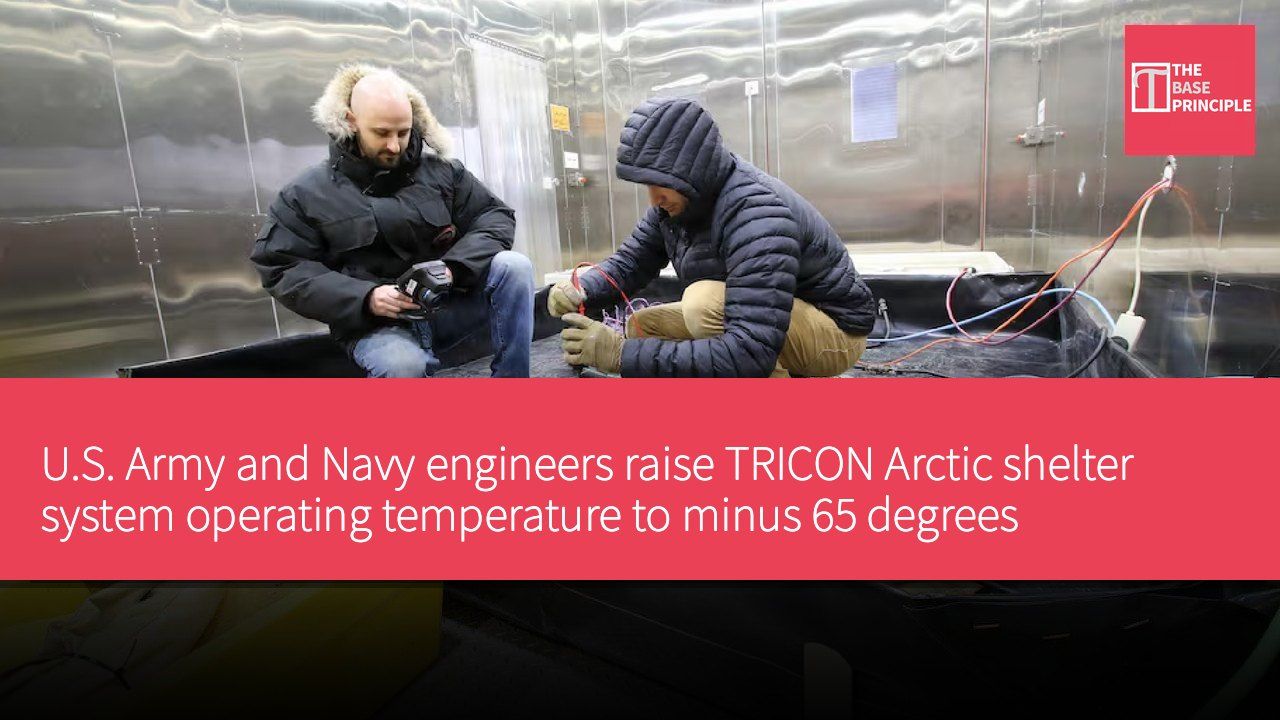
- TRICON system operates at minus 65 degrees Fahrenheit, exceeding original target.
- Equipment prone to freezing in extreme cold, affecting basic sanitation.
- Upgrade expands military operational range, strengthens basing capability.
- Arctic readiness requires ensuring personnel health and facility functionality.
U.S. Army and Navy engineers have advanced a deployable shelter system based on three container units (Triple Container, or TRICON) that can operate in environments of minus 65 degrees Fahrenheit, far exceeding its original target and significantly improving on the existing version's minus 15 degrees Fahrenheit. According to a report by Defense News, the work was jointly completed by the Army's Cold Regions Research and Engineering Laboratory (CRREL) and the Naval Facilities Engineering and
Expeditionary Warfare Center (NAVFAC EXWC).
Impact of extreme cold on equipment
In the Arctic, the equipment that keeps troops healthy is just as susceptible to freezing as any other gear. The report notes that pipes, valves, bladders and pumps are particularly prone to cracking and icing, which can cause toilets, laundry and shower facilities to fail. Basic sanitation has long influenced the outcome of military operations, and in extreme cold, ice becomes the primary adversary. Rather than redesigning the entire system, the team tested different layouts of thermal wraps, insulation and other components to reinforce these weak points. The ultimate goal was to develop a shelter system capable of operating at minus 50 degrees Fahrenheit; the result proved capable of maintaining functionality at minus 65 degrees Fahrenheit.
Testing took place in CRREL's cold chamber in New Hampshire, a 288-square-foot room capable of reaching minus 90 degrees Fahrenheit. Researchers Dan Tague and James Pilkington conducted the cold-weather trials there. Military units typically have to wait for the peak of winter in Alaska to simulate such conditions, but the cold chamber allows the team to reproduce them on demand in a controlled environment.
According to the Department of Defense's 2024 Arctic Strategy, Russia's full-scale invasion of Ukraine, the accession of Finland and Sweden to NATO, deepening China-Russia cooperation and accelerating climate change are all reasons for rethinking its approach. The strategy describes the region as an arena of strategic competition and states that the United States intends to establish a more persistent presence there.
Expanding military operational range
Beyond the obvious creature comforts of toilets, laundry and showers for personnel, these improvements expand the military's operational envelope, said Pilkington, a project manager with NAVFAC EXWC's Expeditionary Technology Directorate: "This extends the operational reach of a base camp, whether geographically or in duration." That, in turn, enhances the military's basing capability. Tague, a research chemist at CRREL, said troops live and work in extreme cold and difficult conditions. He noted that functional facilities are critical to their physical and mental well-being in the Arctic and other high-north environments.
This shelter upgrade is a small, unglamorous piece of Arctic readiness. Defense News describes it as the kind of system that must work to keep personnel warm, clean and healthy before any advanced weaponry can matter in the High North.
Importance of Arctic readiness efforts
In the current geopolitical environment, military preparedness in the Arctic is increasingly critical. The U.S. Arctic Strategy emphasizes a persistent presence in the region and confronts the challenges posed by Russia and China-Russia cooperation. Raising the TRICON system's operating temperature is not only a technical breakthrough but also key to ensuring troops can effectively execute missions in extreme environments. Adequate facilities safeguard personnel's physical and mental health, thereby enhancing overall combat capability — a crucial factor for future military operations.