
- Argonne National Laboratory utilizes salt additives to enhance the stability of perovskite crystals.
- The new technology reduces structural defects in perovskite crystals, extending the lifespan of devices.
- This technology enables solar cells to achieve high energy conversion efficiency.
- The salt mechanism promotes consistency in crystal growth, facilitating large-scale production.
Scientists at the U.S. Department of Energy's Argonne National Laboratory are addressing issues with perovskite crystals by applying the basic principle of salting icy roads. These lab-grown crystals are widely used in solar panels, displays, and lens sensors. Under normal conditions, these crystals develop microscopic defects during formation, which trap charges, leading to energy loss and reduced device lifespan. Now, by employing a novel low-melting-point volatile mechanism using salt additives, the formation of perovskite crystals can be controlled at the atomic scale. The resulting perovskite crystal layers exhibit fewer defects and greater stability.
This advancement propels the development of optoelectronic devices that convert light into electrical energy.
Addressing Perovskite Defect Issues
Ruan Qi, a researcher in the X-ray Science Division at Argonne National Laboratory, stated, "Defects have been a bottleneck for perovskites for nearly a decade. If we can eliminate the major defects, we can finally start building more durable and reliable devices." In perovskite thin films, the crystals melt and reorganize into a more uniform structure.
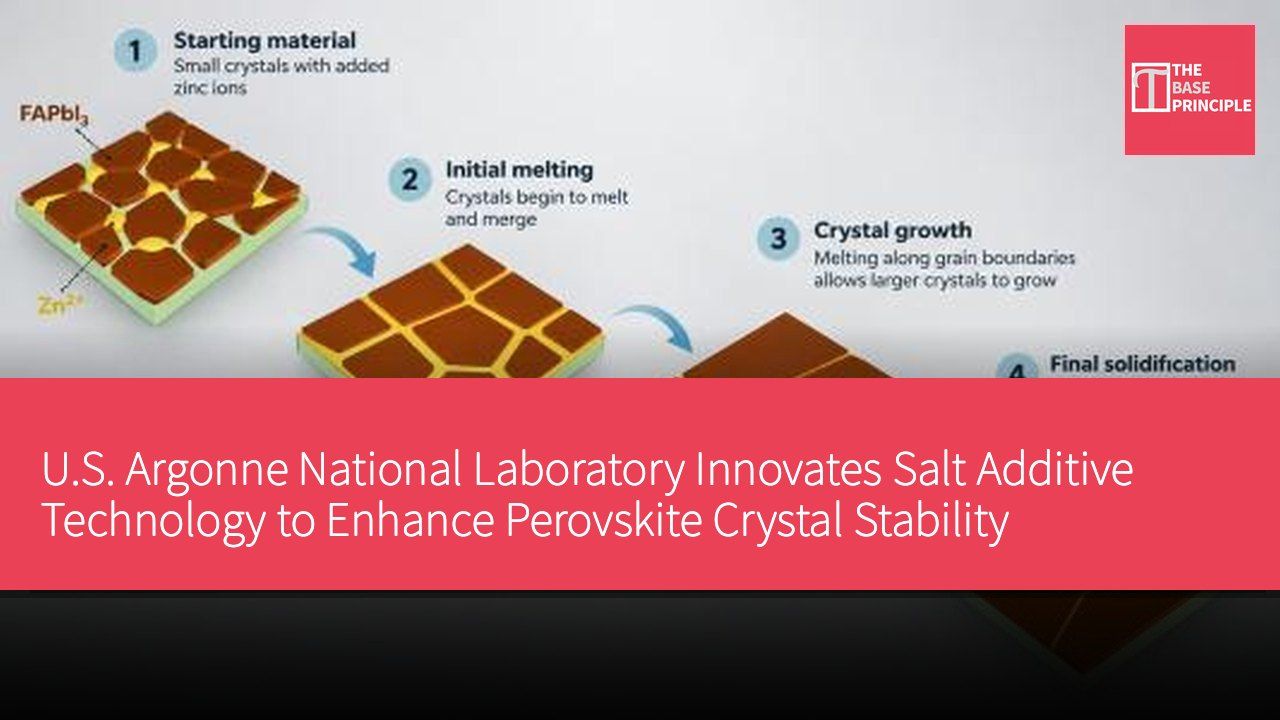
Perovskite is a synthetic crystal composed of repeating atomic patterns that can absorb light and transport charges. However, a major structural defect has nearly hindered its commercial application for almost a decade. When perovskite thin films settle onto surfaces, small atomic defects form like pits, trapping charges and leading to energy loss and shortened device lifespan. In this new study, the team proposed a volatile low-melting-point process known as the eutectic method to address this issue. Scientists added two specific salt additives, zinc bromide and methylammonium chloride, to guide crystal formation.
Just as road salt lowers the freezing point of water, these additives also lower the melting point of the perovskite components.
When heated, the mixture instantaneously transforms into a liquid slurry. This brief liquid state allows atoms time to arrange uniformly rather than rapidly freezing into a chaotic and defect-laden pattern. As heat continues, the added salts completely evaporate, leaving behind a pure and highly stable crystal layer without structural traps. Meanwhile, the remaining zinc atoms drift to the remaining defect lines, smoothing out the defects and preventing performance impacts.
Production Potential of the New Technology
Validating this mechanism requires extraordinary tools. Utilizing the Advanced Photon Source (APS) in Argonne and the Center for Nanoscale Materials (CNM) with high-intensity X-ray probes, the team simultaneously mapped composition and optical performance while observing in real-time how zinc atoms actively moved to repair defect lines. The research report noted that solar cells constructed using the volatile eutectic method achieved a certified 25.9% energy conversion efficiency, while larger-sized perovskite mini-modules reached 23.9%. Small-area cells maintained 85.8% of their initial efficiency after continuous operation at 85°C (185°F) for 1,400 hours.
This process also enabled light-emitting diodes to achieve an impressive 26.1% external quantum efficiency. This achievement not only succeeded theoretically but also advanced manufacturing. Manufacturers can now scale up production of large areas without compromising quality control, as the salt mechanism allows for smoother and more consistent crystal growth. With the recent upgrade of the Advanced Photon Source to produce X-ray beams up to 500 times brighter, scientists plan to shift from snapshot analyses to continuous, movie-like observations of crystal growth. The research findings were published in the journal Science.
Item Specification Solar Cell Energy Conversion Efficiency 25.9% Perovskite Mini-Module Energy Conversion Efficiency 23.9% Small Area Cell Initial Efficiency Retention 85.8% Operating Temperature 85°C Operating Time 1,400 hours External Quantum Efficiency 26.1%
Commercial Potential of Salt Additive Technology
Perovskite materials have significant applications in optoelectronic devices, but their structural defects have been a barrier to commercialization. The salt additive technology proposed in the new research shows significant performance improvements by lowering melting points to enhance crystal structure. This not only increases the energy conversion efficiency of solar cells but also facilitates large-scale production, which is crucial for the future development of renewable energy technologies. As the technology matures, the market demand for high-performance optoelectronic devices will further drive growth in related industries.