
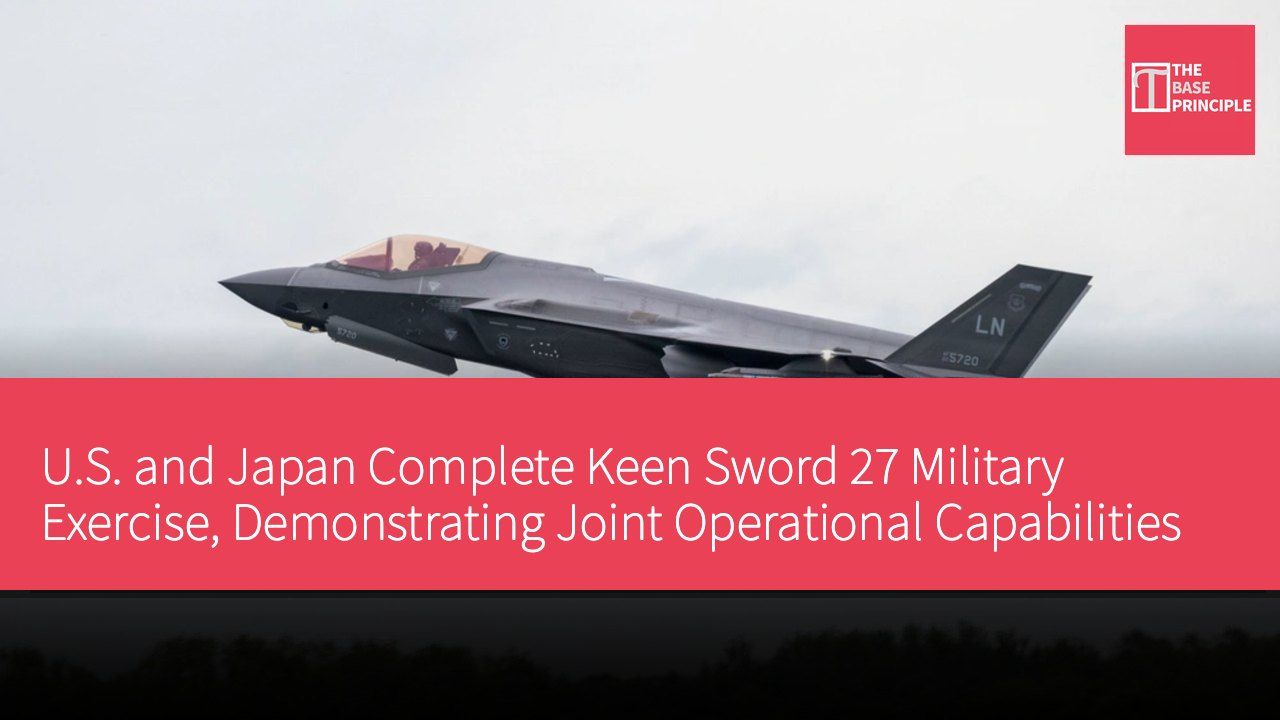
- The Keen Sword 27 exercise lasted 11 days, with about 56,000 participants, testing joint land, sea, and air operational capabilities.
- Seven other countries participated in the exercise, showcasing a growing multinational dimension covering the waters and airspace around Japan.
- The 366 flight missions conducted during the exercise provided opportunities for practical air operations, along with approximately 130 parachute jumps.
- The exercise emphasized the importance of space, cyber, and electronic warfare in modern military planning, and tested the coordination capabilities of multinational forces.
Japan and the United States have completed the 11-day Keen Sword 27 military exercise, with approximately 56,000 personnel participating, utilizing 200 aircraft and 40 vessels. The exercise tested the allied capabilities of both nations in joint operations across land, sea, and air, integrating space, cyber, electronic warfare, and logistical training. The exercise concluded on October 29, during which 161 training activities were conducted, including eight live-fire drills where Japanese and U.S. forces launched munitions from ships, aircraft, and helicopters.
Multinational Participation Shows Enhanced Cooperation
Pilots executed 366 flight missions, while military personnel conducted approximately 130 parachute jumps. Seven other countries also participated, demonstrating the exercise's increasing multinational dimension. Australia, Canada, France, Germany, the Netherlands, New Zealand, and the Philippines joined in operations around Japan, including the waters and airspace of Okinawa and the Sakishima Islands.
The Japan Self-Defense Forces contributed approximately 45,000 personnel, while around 11,000 U.S. troops participated in the exercise. The exercise involved about 200 aircraft and 40 naval vessels, including the U.S. Navy's USS Theodore Roosevelt Carrier Strike Group. During the 161 training activities, the two nations' militaries practiced coordinated operations using naval vessels, aircraft, and helicopters. Eight activities involved live-fire operations, providing personnel with the opportunity to train with real munitions rather than relying solely on simulations. The 366 flight missions executed during the exercise offered practical air operations and coordination opportunities among participating forces.
Approximately 130 parachute jumps added an airborne element to the training. Activities spanned Japan and its surrounding waters, including Okinawa, the Sakishima Islands, and Tanegashima, with training extending to the Sea of Japan and the East China Sea, allowing participating forces to gain experience in various maritime and geographical environments.
Challenges in Modern Military Planning
The participation of the USS Theodore Roosevelt Carrier Strike Group added significant naval aviation components, incorporating carrier-based aircraft and accompanying warships into the overall exercise. Keen Sword 27 was designed not only to test the capabilities of Japanese and U.S. forces in conventional military operations but also to cover space, cyber, electronic, and information warfare, as well as logistics and sustainment support—areas that have become increasingly important in modern military planning as forces rely on satellite communications, digital networks, intelligence systems, and electronic warfare capabilities to coordinate operations. The exercise also focused on maintaining communication and logistical support among multinational forces, testing how participating militaries coordinate operational, medical, and sustainment needs while conducting actions at multiple locations.
Rear Admiral Jay Clark, the head of the exercise's bilateral exercise control group, stated that this exercise demonstrated the capability to provide support for participating nations' operations, medical, logistics, and sustainment activities. He also emphasized the importance of strengthening resilient communication channels among Japan, the United States, and their partners. Since 1986, Japan and the United States have conducted the Keen Sword exercise approximately every two years, and this exercise has become a crucial component in enhancing interoperability and ensuring that forces can operate together under real conditions.
Impact of Keen Sword 27 on U.S.-Japan Military Cooperation
The Keen Sword 27 exercise not only showcased the military cooperation capabilities of the U.S. and Japan but also highlighted the trend of multinational participation, reflecting the increasingly complex global security environment. As geopolitical tensions rise, military forces around the world need to enhance their joint operational capabilities to address potential threats. The emphasis on space, cyber, and electronic warfare during the exercise reflects the characteristics of modern warfare, where forces must rely on advanced technologies to improve operational efficiency. Such exercises not only strengthen interoperability among participating nations but also lay the groundwork for future joint operations.