
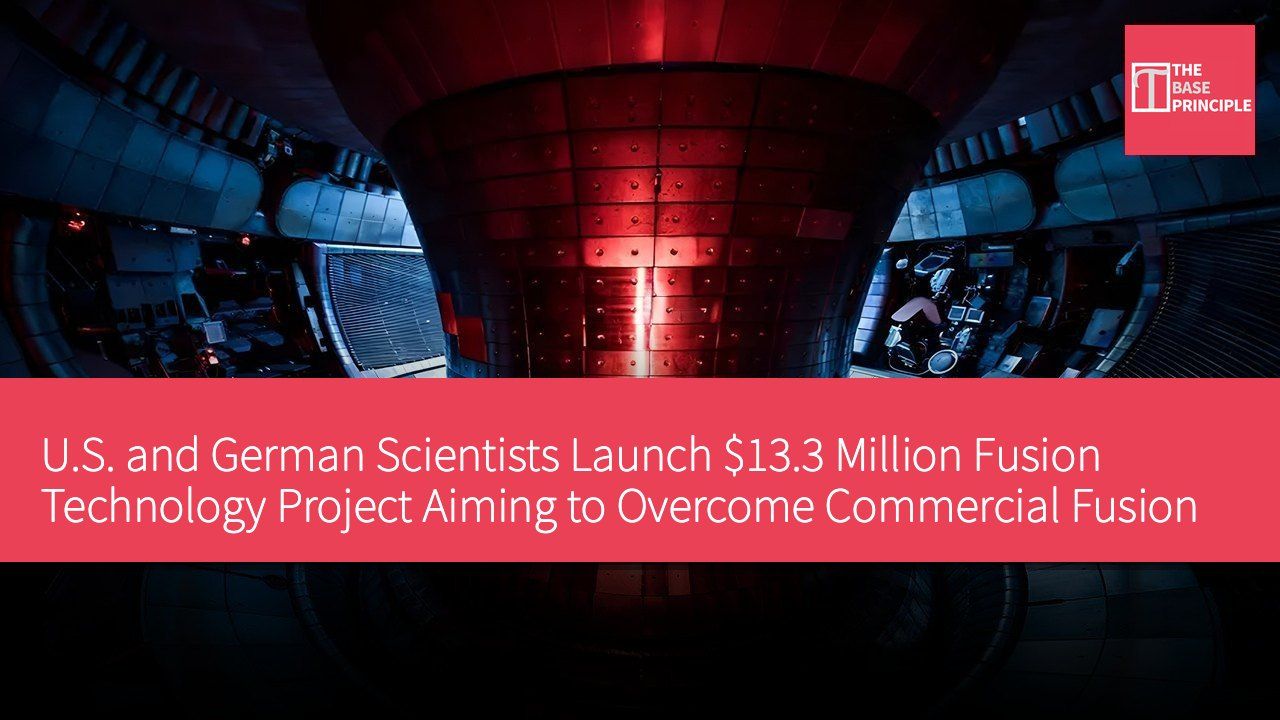
- U.S. and German scientists launch a $13.3 million fusion technology project.
- The research will combine the advantages of tokamak and stellarator designs to enhance plasma stability.
- The center will involve researchers from the private sector to promote collaboration.
- Early career researchers can spend a year at institutions in Germany or New York.
Researchers from the United States and Germany are launching a $13.3 million project aimed at improving fusion technology and paving the way for future fusion power plants. This collaboration brings together scientists from Columbia University and the Max Planck Institute for Plasma Physics (IPP) in Germany to explore the advantages of tokamak and stellarator designs while addressing challenges that hinder commercial fusion energy. The virtual research center, named "Max Planck Columbia Center: Optimizing Symmetry in Fusion Plasmas," is one of seven Max Planck centers established this year.
The center is scheduled to begin operations in 2027 and will run for an initial five years.
Combining the Advantages of Two Designs
The research will focus on combining the two different types of machines, tokamaks and stellarators, with the aim of harnessing fusion for clean energy. Both designs utilize strong magnetic fields to confine plasma at extremely high temperatures, creating the conditions necessary for hydrogen isotope fusion. However, they employ different methods for plasma confinement. Tokamaks rely partially on the current flowing through the plasma to help maintain its confinement, while stellarators use complex arrangements of external magnetic coils to create a three-dimensional magnetic field. This makes stellarators more complex in design and construction, but potentially better suited for continuous operation.
Researchers hope to combine the advantages of both designs to improve plasma stability and develop more practical fusion reactors.
The Max Planck Columbia Center will integrate two leading institutions in plasma physics and fusion research. IPP Director Thomas Klinger stated, "Our goal is to combine the strengths of tokamaks and stellarators to address significant scientific and technical issues on the path to fusion power plants. For me, it is particularly important to provide early career researchers with international experience at a world-class university and to establish lasting scientific networks early in their careers." This collaboration will allow researchers at Columbia University access to two major German fusion facilities: the Wendelstein 7-X stellarator in Greifswald and the ASDEX Upgrade tokamak in Garching.
Scientists will be able to participate directly in experiments at both facilities, enabling them to test ideas and compare results from the two reactor designs.
Private Sector Involvement
The research will also address challenges such as managing extreme heat, preventing sudden plasma disruptions, and improving superconducting magnets for fusion devices. The center will involve researchers from the private sector and invite scientists from Commonwealth Fusion Systems, Proxima Fusion, Thea Energy, and Type One Energy to participate in working groups.
Early career researchers, including doctoral students and postdoctoral scientists, will have the opportunity to spend a year at collaborating institutions in Germany or New York. This five-year project will secure $7.5 million in funding from U.S. sources, along with €5 million from the Max Planck Institute for Plasma Physics. The funding will cover expenses for researchers, project coordination, workshops, and international exchanges.
The center will be jointly led by Thomas Klinger from the Max Planck Institute for Plasma Physics and Carlos Paz-Soldan from Columbia's School of Engineering. Paz-Soldan stated, "Through collaboration, we will be able to provide unique opportunities to develop fusion talent and advance key scientific issues on the path to fusion energy."
The Importance of International Collaboration in Fusion Research
This U.S.-German collaborative project represents a trend toward internationalization in the field of fusion research, allowing researchers to more effectively tackle the challenges of commercial fusion by combining the technological strengths of both countries. The center not only promotes academic exchange but also attracts private sector involvement, which is crucial for advancing fusion technology development. The international experience of early career researchers will also help cultivate future fusion experts, further driving progress in this field.