
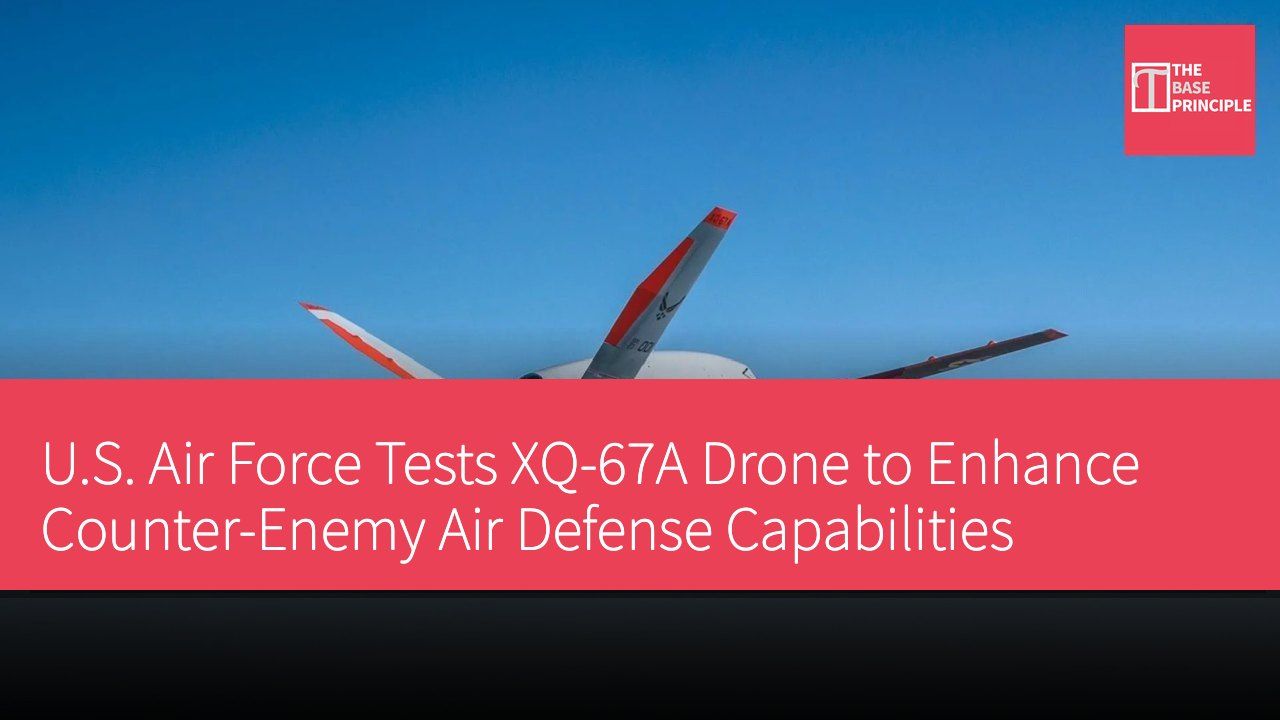
- The U.S. Air Force tests the XQ-67A drone to enhance reconnaissance capabilities.
- The drone is capable of maintaining connectivity in expansive airspace, improving operational efficiency.
- Autonomous drones can detect threats, reducing the risk to pilots from enemy defenses.
- The success of the program relies on reliable communications and the ability to operate in disrupted environments.
The U.S. Air Force conducted an experiment at the Nevada Test and Training Range to evaluate its XQ-67A drone, exploring whether the drone can conduct reconnaissance ahead of manned fighter jets while maintaining connectivity across vast airspace. This flight is part of the "Demon APE" program, officially known as the "ACP Performance and Effectiveness Demonstration," led by the Air Force Research Laboratory (AFRL). In a statement on October 27, AFRL noted that the tests were conducted by the experimental operations unit of the Air Combat Command, aiming to shorten the transition from laboratory experiments to practical application.
The tests also assessed multiple systems, including onboard mission equipment, beyond-line-of-sight communications, and software enabling the drone to operate autonomously. The goal of the program is to provide aircrews and command centers with a more comprehensive tactical picture, allowing for quicker decision-making when aircraft are dispersed over large areas. The data transmission range of beyond-line-of-sight links is greater than direct radio communication, enabling the drone to connect to a common command and control network across different areas as long as relay infrastructure is available. AFRL has not disclosed the communication range, frequencies, or the system's performance under electronic interference.
Drone Design and Functionality
The drone being tested is manufactured by General Atomics Aeronautical Systems. The XQ-67A is a jet-powered drone derived from the Off-Board Sensing Station program. It features fixed wings, a tail, and a single jet engine, and it first took flight from General Atomics' Gray Butte facility on February 28, 2024.
It is based on a common airframe that can be adjusted for different mission configurations, a method developed under the low-cost expendable aircraft platform sharing program. AFRL will focus on separating the sensor version from the weaponized version, allowing for the reuse of structures and subsystems to reduce development and production costs.
This new flight builds on tests conducted on July 16, 2025, when the XQ-67A integrated government-developed autonomous architecture with active tactical data links and received real-time mission updates. This time, the Air Force incorporated real-time, virtual, and constructive simulations to assess the platform's coordination capabilities in more complex environments. The XQ-67A represents a significant milestone in the Air Force's collaborative combat aircraft program. General Atomics leveraged its experience to develop the YFQ-42A, a combat-oriented drone. The XQ-67A remains in the experimental phase, focusing on sensing and system integration, while the YFQ-42A is specifically built for air combat.
Strategic Significance of the Program
For the Air Force, the primary benefit of this program lies in placing sensors ahead of manned formations. Autonomous drones can detect threats, relay information about the surrounding airspace, and extend surveillance coverage without frequently exposing pilots to enemy defenses. More aircraft in a given area can also make it more difficult for adversaries to detect and track forces. The success of this concept will depend on reliable communications and the ability of autonomous systems to operate continuously in disrupted electromagnetic environments. According to an analysis by Army Recognition, this is related to China's detection systems and integrated air defenses in the Indo-Pacific region, which pose challenges to U.S. operations, while in Europe, Russia's electronic warfare remains a primary concern for NATO.
The Role of Drones in Modern Warfare
The testing of the XQ-67A drone highlights the importance of drones in modern warfare, particularly in the face of enemy air defenses. By placing sensors ahead of manned formations, autonomous drones can effectively detect threats and provide real-time intelligence, which is crucial for enhancing overall operational efficiency. Furthermore, the development of this technology reflects the current demand for reducing personnel risks and improving intelligence-gathering capabilities in the evolving security landscape. As global security dynamics change, the application of drones may become a key factor in future military operations.