
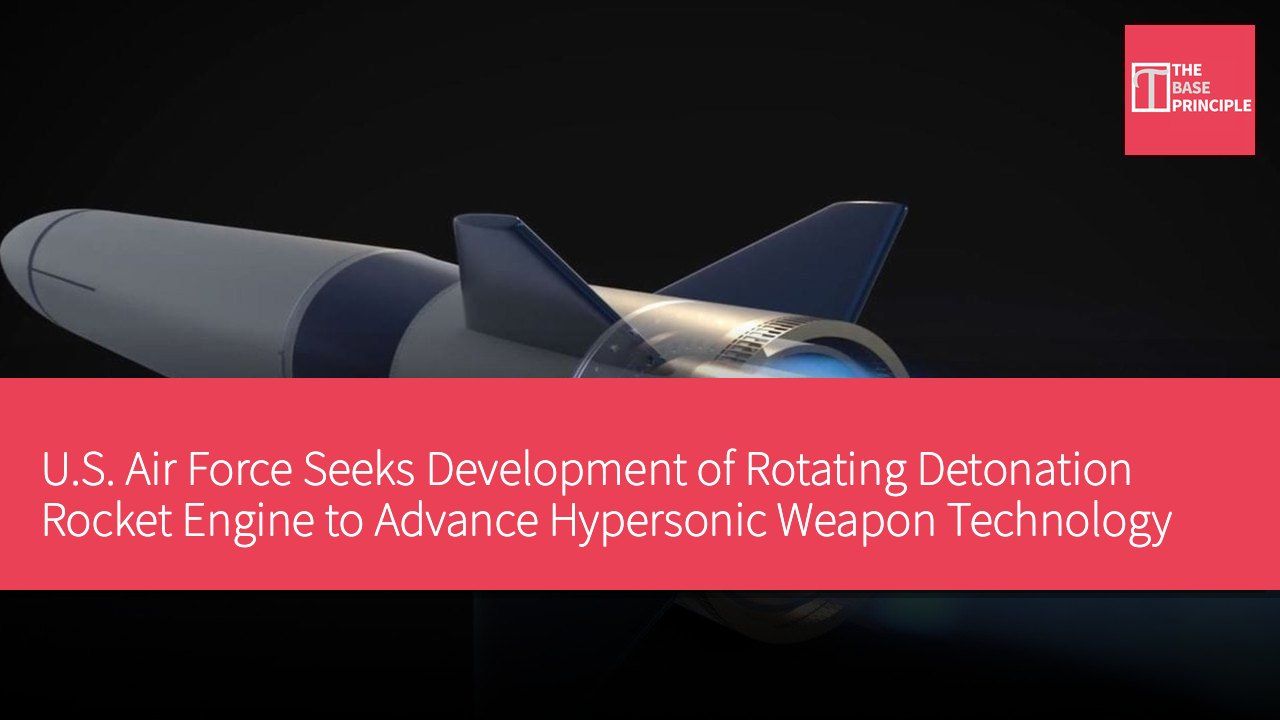
- The U.S. Air Force seeks to develop a rotating detonation rocket engine to support hypersonic weapon technology.
- The engine utilizes continuous detonation waves to enhance propulsion efficiency and reduce size.
- The initiative will progress from concept validation to prototype demonstration, expected to take 36 to 48 months.
- AFRL will conduct ground evaluations and flight tests to validate engine performance.
The U.S. Air Force is seeking proposals to develop and flight test a combined cycle rotating detonation rocket engine aimed at future hypersonic weapons. The initiative aims to advance the technology from early concept validation to a prototype demonstrated in relevant environments, expected to take 36 to 48 months. The engine utilizes a rotating detonation process for propulsion, where the combustion occurs through a series of continuous shockwave-driven detonations. This initiative supports the development of High Efficiency Affordable Mass Munition (HAMM), with a preliminary proposal deadline of November 16, 2026.
The U.S. Air Force Research Laboratory (AFRL) is seeking industry proposals to develop and flight test a combined cycle rotating detonation rocket engine specifically designed for future hypersonic weapons. This technology utilizes continuously propagating detonation waves to combust fuel, potentially serving as an alternative to traditional rocket propulsion. The initiative aims to advance the engine from laboratory concept validation to a prototype demonstrated in relevant environments, expected to take 36 to 48 months. The initiative is managed by the AFRL Rocket Propulsion Division located at Edwards Air Force Base in California and is conducted under the HERMES Broad Agency Announcement.
The deadline for preliminary white papers is November 16, 2026, with the goal of conducting flight demonstrations to support the development of HAMM.
How Rotating Detonation Engines Work
Traditional rocket engines typically burn fuel continuously in a combustion chamber to generate hot gases and produce thrust. In contrast, rotating detonation engines (RDE) use a different combustion process that creates a detonation wave traveling at supersonic speeds around a circular chamber. As the wave moves through the chamber, it ignites a mixture of incoming fuel and oxidizer, continuously producing a series of repeated detonations. This process harnesses the pressure generated by detonation rather than relying solely on traditional deflagration combustion. Researchers are investigating this technology as it may improve propulsion efficiency while reducing engine size and complexity.
The rotating detonation process may also reduce the need for certain traditional engine components, potentially allowing for more compact propulsion systems. However, the actual benefits depend on the engine design and its operating conditions.
Advantages of Combined Cycle Engines
The AFRL initiative focuses on a combined cycle configuration known as the Rotating Detonation Rocket Engine - Combined Cycle (RDRE-CC). This design integrates rocket propulsion with air-breathing operation, allowing the engine to utilize atmospheric oxygen during parts of the flight without carrying all the required oxidizer. This approach helps address the demands of hypersonic flight, as the propulsion system must operate under varying conditions. Combined cycle engines must integrate two operational modes while maintaining stable combustion and delivering the required performance throughout the flight profile. The planned development work encompasses engine design, testing, and integration with vehicles.
Ground evaluations will include direct connect tests that examine the engine's operation under connected test setups, as well as free jet tests that expose the propulsion system to simulated high-speed airflow. These tests aim to assess engine performance under conditions relevant to its intended flight environment before the launch of demonstration vehicles. The initiative is expected to conclude with a flight test in which a ground-launched sounding rocket elevates the engine-driven vehicle to the required conditions to demonstrate its operation. AFRL plans to advance the technology from Technology Readiness Level 3 to Level 6, where prototypes are demonstrated in relevant environments.
The solicitation requires participating companies to submit proposals for design, testing methods, timelines, and preliminary cost estimates. Selected applicants may be invited to provide complete technical and cost proposals, depending on the availability of funding.
This initiative builds on the U.S. military's ongoing research into detonation-based propulsion technologies. RTX's Pratt & Whitney conducted tests of a rotating detonation engine in 2025 under DARPA's Gambit program, which seeks air-breathing propulsion for future long-range weapons. AFRL researchers have also conducted ground-based tests of rotating detonation rocket engines at Edwards.
Potential Impact of Rotating Detonation Technology
The development of rotating detonation rocket engine technology could disrupt traditional rocket propulsion design concepts, particularly in the application of hypersonic weapons. The efficient propulsion method of such engines not only reduces engine size and complexity but also enhances propulsion efficiency, which is critical for military applications. As the U.S. military places increasing emphasis on new propulsion technologies, the success of this initiative could lead to significant transformations in future weapon systems, especially in enhancing long-range strike capabilities and responsiveness.