
- The Tsinghua University team has developed new technology to recycle retired wind turbine blades.
- Flash Joule heating technology can transform blades into silicon carbide and graphene.
- The new materials can enhance resin performance, enabling a closed-loop system.
- This method has the potential to change the recycling economic model and achieve profitability.
The research team at Tsinghua University has developed an "upcycling" method that utilizes flash Joule heating technology to convert retired wind turbine blades into silicon carbide and graphene. Both materials hold high value in manufacturing. The design of large wind turbine blades is intended to withstand extreme environments, capable of slicing through icy winds, enduring prolonged ultraviolet radiation, and resisting lightning strikes, with a lifespan exceeding twenty years. However, when these blades reach the end of their service life, their extreme durability becomes an environmental issue. Most retired blades ultimately end up buried in landfills.
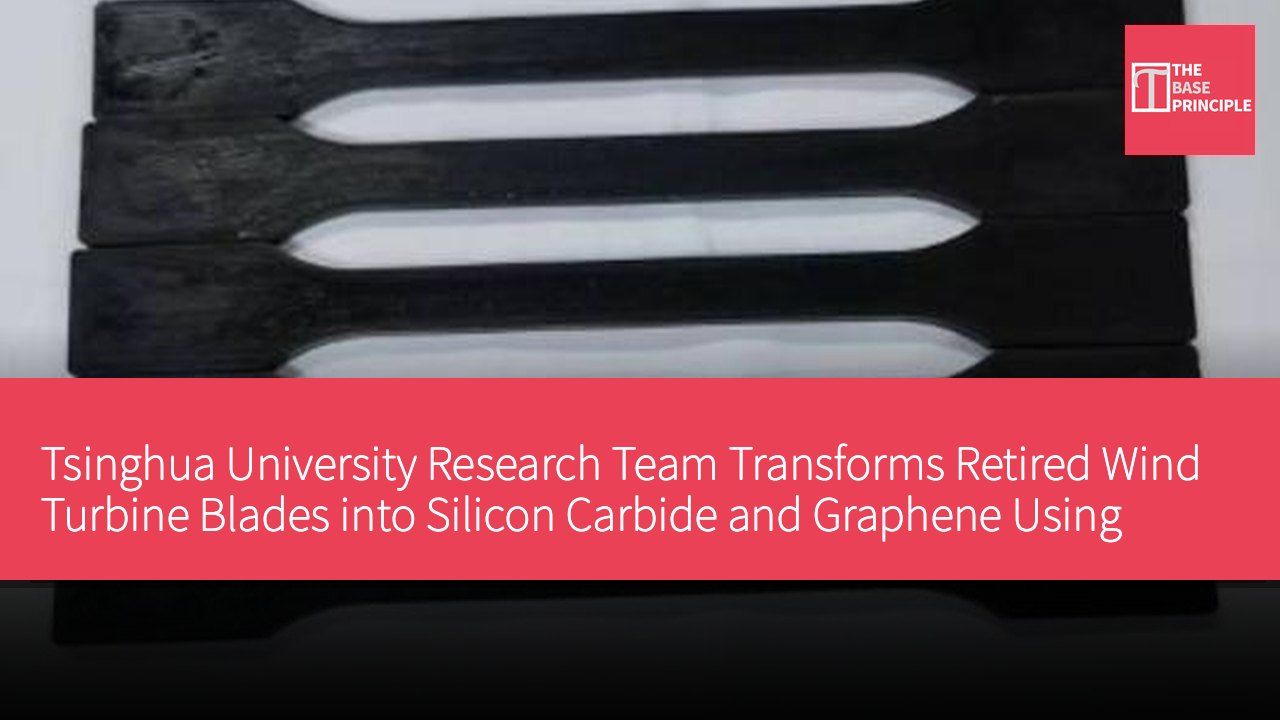
This team based in China is now addressing this long-standing challenge. These chemical and environmental engineers have found a way to transform robust composite material waste into high-value manufacturing materials using brief bursts of extreme heat. The researchers prepared samples of silicon carbide and graphene-enhanced resin recovered from discarded wind turbine blades and conducted tensile performance tests.
A Thermal Miracle in Seconds
Disposal Crisis and Environmental Challenges
The wind energy boom of the early 2000s has now led to an urgent disposal crisis, as the first generation of wind turbine blades, used for 20 years, has reached retirement age. The annual waste from retired blades in China, Europe, and the United States has reached thousands of tons. Comprehensive landfill bans on composite material waste in countries like Germany and Austria have made finding scalable alternative disposal methods a pressing priority for the renewable energy sector. Senior author and chemical and environmental engineer Deng Bing from Tsinghua University stated, "As aging wind turbines are decommissioned, especially in rapidly expanding wind energy markets like China, much of the waste ends up in landfills, which is a waste of resources."
The key lies in the raw materials already present within each blade. Wind turbine blades are made of glass fiber rich in silica and resin primarily composed of carbon. In this new study, researchers utilized flash Joule heating technology to instantaneously heat the damaged blade material to about 2000°C (3632°F). This intense heat triggers a rapid reaction, causing carbon to combine with silica to form silicon carbide, a super-hard, heat-resistant compound. Simultaneously, the remaining carbon atoms reorganize into graphene, one of the strongest and most conductive nanomaterials known to science.
Integrating a small amount of the recycled silicon carbide and graphene mixture directly into new resin can significantly enhance performance. Adding 0.3% by weight of the enhancer can increase resin strength by 27% and flexural strength by 9%. Moreover, adding just 0.1% concentration can improve the thermal diffusivity by 41%, allowing heat to dissipate more efficiently. This upgraded material can be used to construct the next generation of wind turbine blades, creating a closed-loop system where old blades help build stronger new ones.
Economic Benefits and Technological Scaling
Profitable Upcycling
Existing recycling methods, such as pyrolysis and solvent dissolution, are costly and have a large carbon footprint. Flash Joule heating technology may also change the economic model. Environmental engineer and lead author Pei Hao from Tsinghua University stated, "With traditional recycling methods, you have to pay to dispose of the waste. However, our method can actually yield about US$80 (approximately HK$624) per ton, because the recovered silicon carbide and graphene are highly valuable." He added, "In contrast, the cost of pyrolysis is about US$460 (approximately HK$3,588) per ton, while chemical dissolution costs about US$1,800 (approximately HK$14,040) per ton." The team is currently scaling up the process for industrial applications.
Expanding this technology could also assist in upcycling composite materials from the aerospace, automotive, and electronics industries.
As the issue of retired wind turbine blades becomes increasingly severe, the research from Tsinghua University offers an innovative solution. Utilizing flash Joule heating technology not only effectively transforms waste into high-value materials but also significantly enhances the performance of new materials, forming a closed-loop recycling system. This not only helps reduce environmental pollution but also lowers recycling costs and achieves profitability, demonstrating the potential application of this technology in the renewable energy sector. However, scaling the implementation of this technology for industrial applications remains a significant challenge.
Item Specification Technology Flash Joule Heating Heating Temperature About 2000°C (3632°F) Silicon Carbide Enhanced Resin Strength Improvement 27% Silicon Carbide Enhanced Resin Flexural Strength Improvement 9% Thermal Diffusivity Improvement 41% Projected Profit About US$80 (approximately HK$624) per ton Pyrolysis Cost About US$460 (approximately HK$3,588) per ton Chemical Dissolution Cost About US$1,800 (approximately HK$14,040) per ton Potential Impact and Challenges of Recycling Technology