
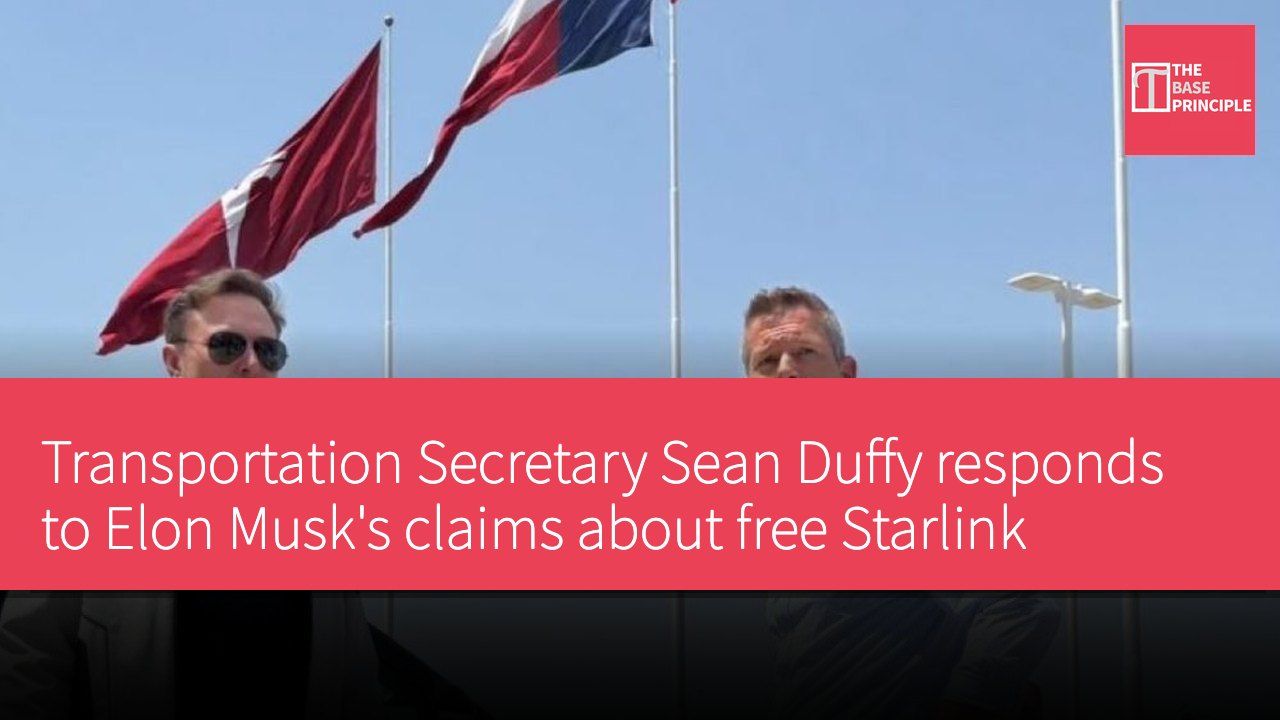
- Duffy responded to Musk's Starlink proposal, indicating that a ground network was a better choice.
- Musk accused the FAA on social media of not accepting the free Starlink proposal.
- The FAA remains cautious about Starlink as the sole communication technology for air traffic services.
- Duffy expressed a desire to move away from L3Harris's network, requesting funding for modernizing air traffic control.
U.S. Transportation Secretary Sean Duffy addressed Elon Musk's claim that the FAA rejected a proposal for free Starlink terminals prior to last week's nationwide grounding, stating that the department opted for a ground-based network after encountering issues with early versions of the satellite service. Duffy said at a press conference that Starlink did indeed play a role in certain system components. "My collaboration with Elon has been very smooth; Starlink is an excellent solution for some of our assets in Alaska, but we sent the early version of Starlink to our tech lab and encountered some issues that needed to be resolved. We believe a ground-based network is the best approach."
According to transcripts released by ZeroHedge, Duffy also mentioned, "I think his work on Starlink and speed is extraordinary, but our airspace is very large, and assets are spread out. Therefore, we are using him again to handle different parts of the airspace." Duffy did not deny the existence of the proposal nor did he disclose what issues the FAA found during testing.
Musk accuses FAA of rejecting proposal
The exchange began on Monday when Elon Musk wrote on X, "The proposal for free Starlink offered to the FAA was presented to Secretary Duffy, but he said it was not needed. It turns out they do need it." This post came three days after the FAA's nationwide grounding on November 13, when its outdated equipment became unstable due to data influx into its telecommunications network, resulting in 1,000 connection attempts every four to five seconds. The FAA traced this influx to radar stations in Amarillo, Texas, and radio stations in El Dorado, Arkansas, where L3Harris had installed a new router.
On that day, approximately 12,462 flights were canceled.
Duffy's dissatisfaction with L3Harris
Duffy also expressed dissatisfaction with L3Harris, the company operating the FAA's existing network. "I want to move away from L3Harris to a new system, but they own this network," he stated. "I cannot cancel the network they own." He has requested $50 billion from Congress for modernizing air traffic control, opposing "patchwork repairs to a system that is critical to every household." The FAA's stance on satellite connectivity was established earlier this week. In a letter sent to lawmakers in July 2025, FAA Administrator Brian Bedford stated that the agency "will not consider Starlink (or any satellite service) as the sole communication technology for safety-critical air traffic services."
Reuters reported at the time that the FAA had not considered replacing its contracts with L3Harris and Verizon with Starlink. Verizon's FAA enterprise network services contract was awarded in 2023, valued at up to $2.4 billion and lasting 15 years.
Elon Musk first raised the issue in February 2025 while leading the Office of Efficiency, stating that "the Verizon system is poorly functioning and poses serious risks to air travelers," but later corrected himself to blame L3Harris. At that time, SpaceX stated it was offering Starlink kits to the FAA for free and had no intention of taking over any existing contracts.
FAA's attitude towards Starlink and future challenges
In facing challenges in air traffic control, the FAA maintains a cautious stance towards new technologies like Starlink, reflecting a reliance on existing systems and a focus on safety. Duffy's dissatisfaction with L3Harris highlights the need for modernization of the current network, as he seeks more effective solutions. As technology advances, balancing innovation with safety will become a critical issue in future air traffic management.