
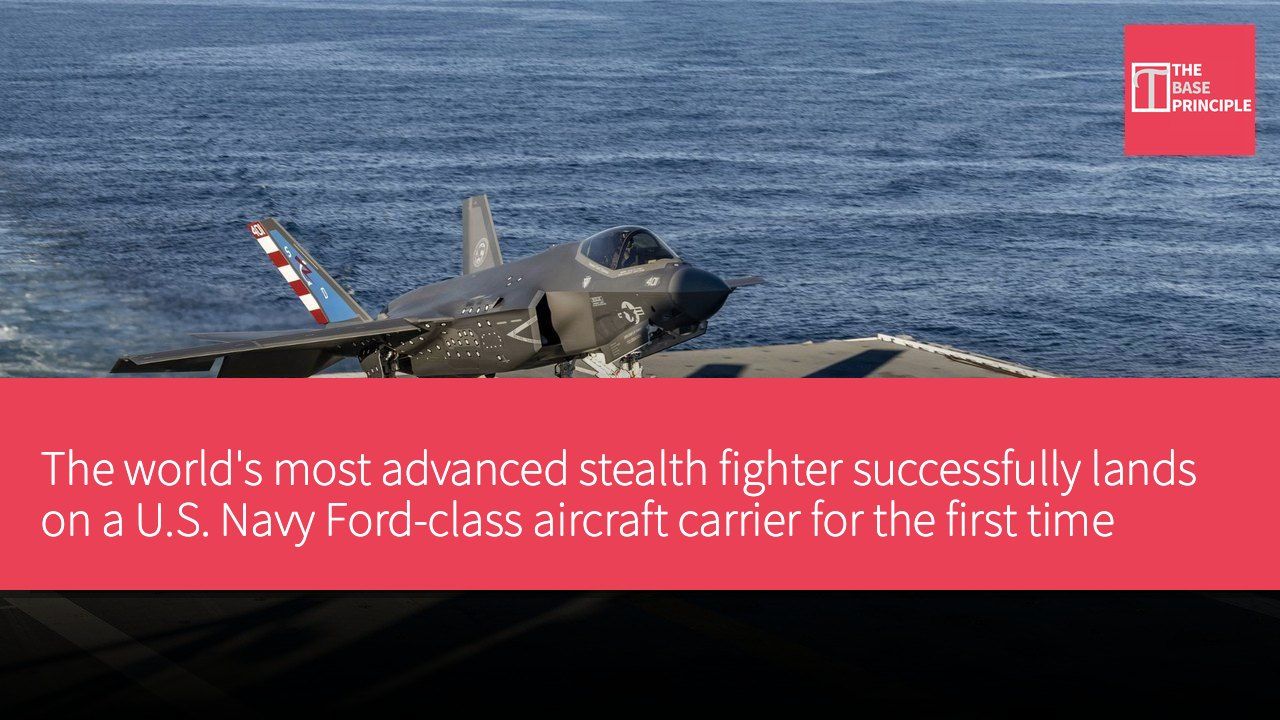
- The F-35C Lightning II fighter jet successfully landed on a Ford-class aircraft carrier for the first time.
- This landing demonstrates progress in the integration of advanced aircraft and electromagnetic launch technology.
- The F-35C is the most advanced fighter jet on U.S. Navy aircraft carriers.
- The F-35C features stealth technology and advanced sensors, enhancing its combat capabilities.
The world's most advanced stealth fighter recently achieved its first landing on a Ford-class aircraft carrier. The U.S. Navy's F-35C Lightning II fighter jet completed its landing on October 13 aboard the future USS John F. Kennedy (CVN 79). According to a message shared by the U.S. Navy on X, "The future USS John F. Kennedy (CVN 79) celebrated Navy Day in grand style, marking the F-35C's first landing on a Ford-class aircraft carrier."
An F-35C Lightning II from the Air Test and Evaluation Squadron (VX-23) made this historic landing.
Progress in Advanced Aircraft Integration Technology
This landing demonstrates progress in the complex integration program involving advanced aircraft, electromagnetic launch technology, and modern recovery systems. The test involved the F-35C aircraft and pilots from Air Test and Evaluation Squadron 23 (VX-23), in collaboration with the Navy's Aircraft Operations Center's F-35 integration test team. This team is conducting aircraft compatibility tests to assess how the carrier's aviation systems interact with Navy aircraft.
Lockheed Martin stated that the F-35 serves as a powerful force multiplier with its advanced nodes in the 21st-century network-centric security architecture, equipped with advanced sensors and communication systems. Its fifth-generation capabilities make the F-35 the most survivable and connected fighter jet globally, providing pilots with an edge against any adversary and enabling them to execute missions and return safely.
Combat Advantages of the F-35C
As threats evolve and older aircraft are phased out, the F-35 becomes crucial in maintaining current and future air superiority. The F-35C, operated by the U.S. Navy, brings radar stealth capabilities to the flight decks of Navy aircraft carriers for the first time. According to Lockheed Martin, the F-35C, with its stealth technology, advanced sensors, supersonic speed, weapon payload, and superior range, is the most advanced fighter jet ever to operate from an aircraft carrier deck.
The F-35C fighter jet is a carrier-specific variant of the F-35 Lightning II series, developed for operations on U.S. Navy aircraft carriers. Unlike the F-35A operated by the U.S. Air Force, this fighter jet features larger wings, reinforced landing gear, and a strengthened tailhook to handle the demanding conditions of carrier takeoffs and landings. The aircraft integrates low-observable stealth characteristics, advanced sensors, electronic warfare capabilities, and networked information-sharing functions.
These features are designed to help pilots identify threats, establish situational awareness, and coordinate operations in a competitive environment. When deployed from an aircraft carrier, the aircraft can extend the operational range of Navy aviation without relying entirely on land-based airfields. Its ability to operate in concert with other carrier-based aircraft makes it a vital component of the Navy's future carrier air wings. Carrier-based stealth aircraft can assist naval forces in surveillance, intelligence gathering, target identification, and countering threats in environments where adversary air defenses complicate conventional operations.
Impact of the F-35C on Naval Aviation
The successful landing of the F-35C fighter jet marks a significant advancement for the U.S. Navy in modernizing its aviation combat capabilities. As the warfighting environment evolves, the F-35C's stealth technology and advanced sensors play a critical role in achieving air superiority. This fighter jet not only enhances the Navy's operational range but also demonstrates its importance in executing missions without relying on land-based airfields, highlighting its significance in future naval aviation formations.