
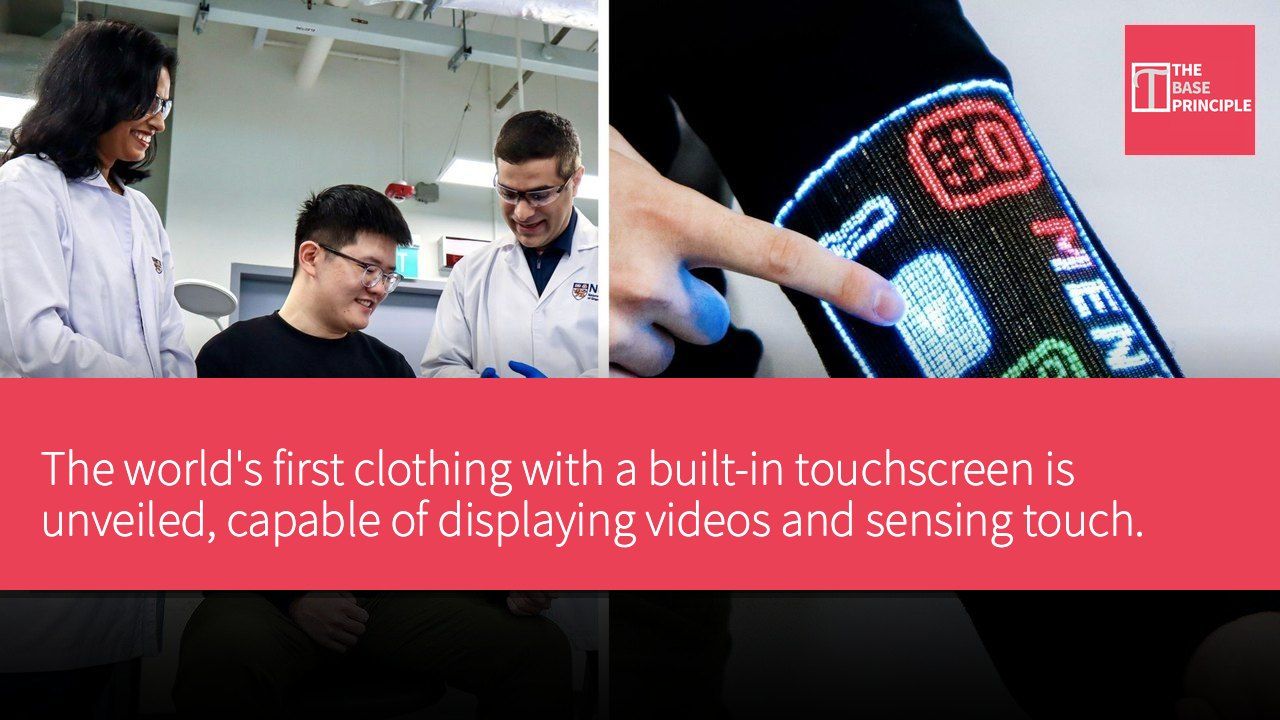
- The research team has demonstrated the world's first clothing with a built-in touchscreen.
- This clothing can display videos and sense touch without the need for a rigid screen.
- The team developed a programmable method to achieve over 20,000 electrical connections.
- The prototype integrates a microphone, speakers, and various sensors.
The research team from the National University of Singapore's School of Design and Engineering has unveiled the world's first clothing with a built-in touchscreen. They developed a fiber that combines pixel functionality and touch sensitivity, integrating 54 such fibers into the sleeve to create this innovation. Assistant Professor Khudiyev stated, "The realization of this technology is due to our ability to construct a GUI system using electronic components in fiber form, similar to traditional fibers, but with advanced electronic functionalities integrated directly inside."
The team revealed that the sleeve can display images and videos, respond to finger touches, and wirelessly connect with other devices, all while remaining washable, breathable, and flexible, indistinguishable from ordinary clothing. This invention allows the garment to serve as a direct interface for the wearer's health data and digital devices without the need for a rigid screen.
Display and Interaction Features of the Garment
Researchers pointed out that familiar screens, such as those on smartphones and laptops, typically display graphical user interfaces (GUIs) on flat, rigid panels and allow for interaction. Traditional textiles woven from one-dimensional fibers have never achieved this capability. Until now, a full-color touchscreen that can be woven like fiber has remained elusive. To construct a fiber-enabled garment display, the NUS team developed a programmable method to create connection points on tiny insulated cables, precisely where each microchip is needed. Lasers expose these locations, while controlled surface wetting encourages the molten solder to connect only at the programmed points, enabling the team to integrate over 5,000 chips through more than 20,000 electrical connections.
This interconnected digital LED strip was subsequently integrated into a multilayer fiber using a thermal stretching method, allowing for the precise formation of touch and pixel layers within a line that is only one millimeter thick and ten meters long. The layers beneath the LEDs can sense touch, completing circuits when the fiber is pressed, and signals can accurately indicate the location of finger contact, lighting up the nearest pixels. Assistant Professor Khudiyev added, "The fibers have a one-dimensional axially symmetric geometric shape, which makes it challenging to construct complex circuits using methods developed for traditional two-dimensional electronic devices."
We overcame this limitation through a new interconnection architecture, allowing thousands of microelectronic devices to be integrated and interconnected along the fiber."
Prototype Design and Technical Details
The researchers also revealed that in their prototype, 54 pixel fibers, each carrying 96 LEDs, were threaded into the forearm of the sleeve, forming a display of 96 x 54 pixels, measuring 168 mm x 105 mm, operating at a refresh rate of 30 frames per second and an 8-bit color depth. Each fiber has its own control channel, so a failure in one line does not affect the normal operation of adjacent fibers, and the system can register multiple touches simultaneously. Additionally, the team integrated peripheral fibers made in the same way, carrying microphones, speakers, and sensors for tracking motion, locating magnetic north, measuring temperature, and assessing ambient light.
Item Specification Display Size 168 mm x 105 mm Refresh Rate 30 frames per second
Potential Impact of Built-in Touch Technology
This technological breakthrough not only changes the functionality of clothing but may also lead the future development of wearable devices. By combining electronic components with fibers, clothing can become a multifunctional digital interface, enhancing user interaction experiences. As the demand for health monitoring and data collection increases, the practicality of such clothing will become increasingly evident, potentially facilitating the integration of health technology into daily life.