
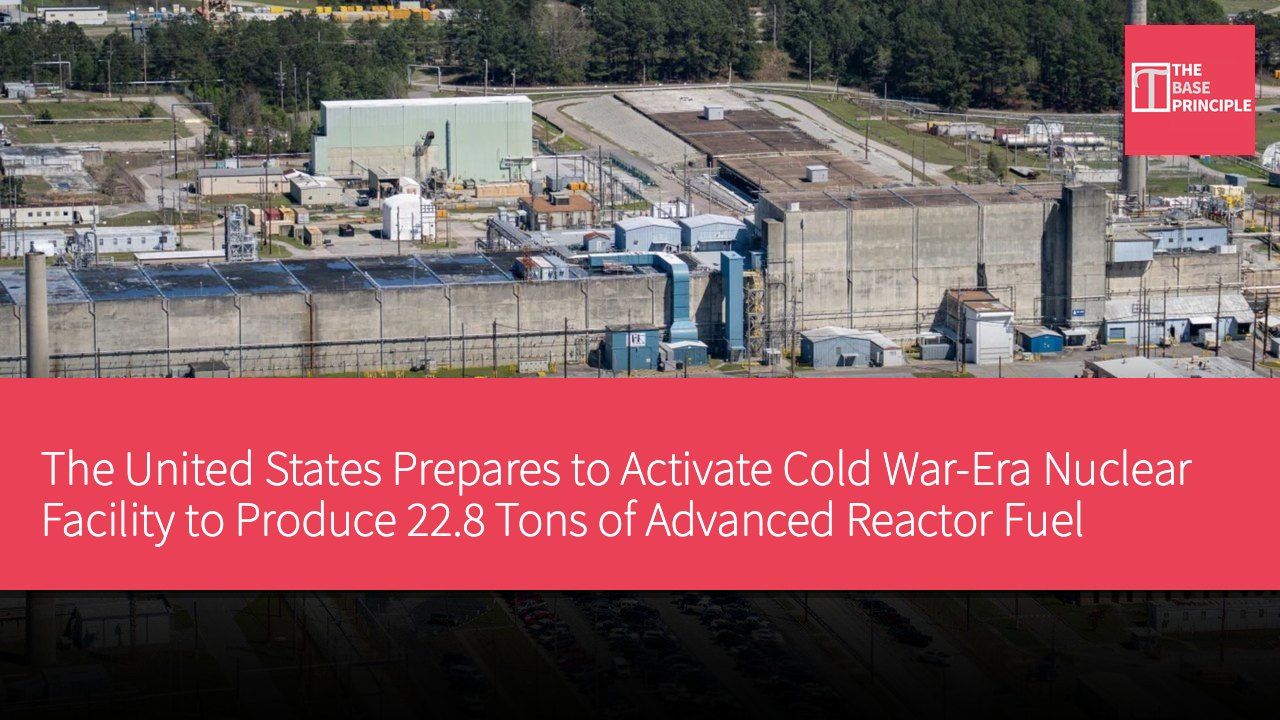
- The Savannah River Site is preparing to produce HALEU fuel to support advanced nuclear reactors.
- HALEU is enriched between 5% and 20%, suitable for next-generation reactor designs.
- Producing HALEU will help strengthen national energy independence and meet the demands of high-energy technologies.
- This mission will also reduce radioactive waste and lower long-term storage risks.
The Savannah River Site (SRS) of the U.S. Department of Energy is ready to begin chemical and mechanical preparations for producing fuel specifically for advanced nuclear reactors. Located in South Carolina, technicians at this facility have completed extensive planning, testing, and maintenance work for the initial "front-end" phase, which is located in H Canyon. The team is currently preparing to initiate the first cycle of operations. This phase requires the restart of hundreds of operational and maintenance procedures and the completion of complex design upgrades. This preparation milestone was achieved after the Department of Energy's Office of Environmental Management decided in February to restart uranium recovery operations at H Canyon.
Through the Fuel Utilization, Extraction, Leverage (FUEL) mission, the site aims to produce up to 22.8 tons of high-purity low-enriched uranium (HALEU).
Purpose of HALEU Production
The uranium enrichment level for standard commercial nuclear power plants can reach a maximum of 5%, primarily consisting of uranium-235, which is the main fissile isotope that sustains nuclear chain reactions. In contrast, HALEU is enriched between 5% and 20%. Most next-generation reactor designs, including small modular reactors and microreactors, require this higher concentration. This allows developers to build smaller reactors that generate more energy per unit volume while extending the operational cycle between refueling. Expanding the domestic supply of HALEU supports national energy independence and helps strengthen the grid to meet the growing electricity demands of data centers and high-energy technologies.
Since the early 1950s, H Canyon has been the only operating production-scale radiochemical separation plant in the United States. It is currently the only domestic facility capable of producing HALEU at this scale. The recovery process begins with used nuclear fuel from the L Basin, which serves as a disassembly and storage facility where the fuel is stored underwater. In the front-end phase, workers receive, dissolve, and process this fuel within heavy shielding equipment. Subsequent chemical addition and clarification steps prepare the liquid solution for further refinement. "The front-end process at H Canyon is the gateway to the HALEU mission," said Kevin Moeller, manager of the H Canyon and HB Line facilities.
"This is the first system in years of effort to produce HALEU." Once clarified, the uranium-containing material will undergo first and second separation cycles to isolate the substance. Technicians will then blend the recovered uranium with natural uranium to create HALEU suitable for transfer to industry partners.
Environmental Impact and Cleanup Goals
In addition to providing fuel for the commercial reactor sector, the FUEL mission directly advances the environmental cleanup goals of the Savannah River Site. By extracting usable uranium from used nuclear fuel, less radioactive waste will remain. This limits the number of high-level waste canisters required for final disposal, reducing long-term storage risks and cleanup costs. "We are not just safely managing legacy nuclear materials," said Edwin Deshong, manager of the Savannah River site for the Department of Energy. "We are actively converting them into HALEU fuel needed to drive the U.S. advanced reactor industry and strengthen national energy security."
Janice Lawson, senior vice president of environmental management operations for Savannah River Nuclear Solutions, summarized that this mission demonstrates the facility's flexibility. She added that staff continue to adapt infrastructure from decades ago to meet modern energy priorities.
What is the Savannah River Site in the U.S.?
The Savannah River Site (SRS) is located in South Carolina and is a facility of the U.S. Department of Energy dedicated to producing fuel for nuclear reactors.
What is HALEU?
HALEU stands for high-purity low-enriched uranium, with an enrichment level between 5% and 20%, primarily used for next-generation nuclear reactor designs.
What is the role of H Canyon?
H Canyon is the only operating production-scale radiochemical separation plant in the United States, responsible for processing and producing HALEU fuel.
Why is the U.S. producing HALEU?
The production of HALEU aims to support national energy independence and strengthen the grid to meet the growing electricity demands of data centers and high-energy technologies.
What is the environmental impact of this mission?
This mission not only provides the fuel needed for commercial reactors but also helps reduce radioactive waste, lower long-term storage risks, and decrease cleanup costs.
Strategic Significance of HALEU Production
As global demand for clean energy increases, the development of nuclear energy in the United States has become particularly important. The production of HALEU not only supports the operation of next-generation nuclear reactors but also promotes national energy independence and reduces reliance on external energy sources. Additionally, the environmental benefits of this mission cannot be overlooked; by recovering uranium from used nuclear fuel, it effectively reduces the generation of radioactive waste, lowers cleanup costs, and mitigates long-term storage risks. These factors collectively drive advancements in U.S. nuclear technology and enhance its competitiveness in the global energy landscape.