
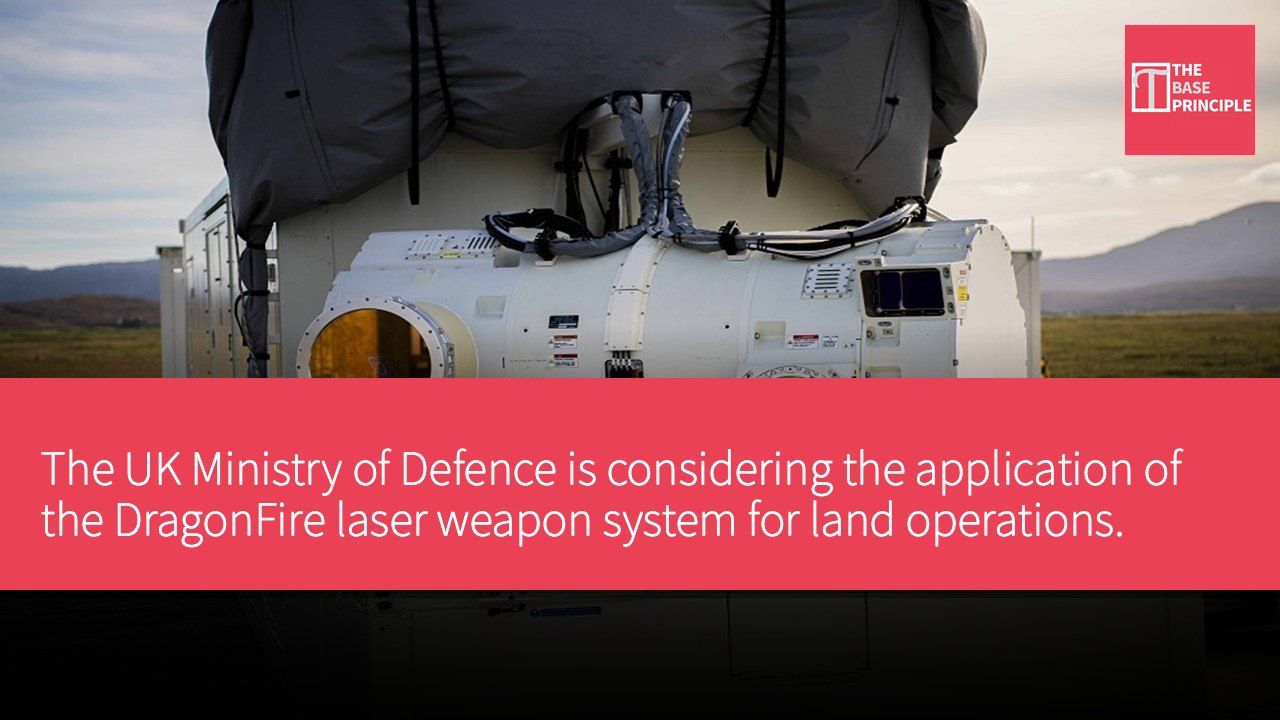
- The UK Ministry of Defence is researching the land application of the DragonFire laser weapon system.
- DragonFire is co-developed by several defense companies and uses powerful lasers to target objects.
- The system has successfully conducted high-power laser attacks on aerial targets, demonstrating its accuracy.
- The Royal Navy will be the primary procurer of DragonFire, with plans to install it on destroyers.
The UK is exploring whether DragonFire can be deployed on land; however, the Ministry of Defence's (MOD) investigation does not imply that the British Army has been authorized to procure the technology. In Parliament, Conservative MP Ben Obese-Jecty inquired whether DragonFire could be used by the Army. Defence Minister Luke Pollard responded that the project is still ongoing, and the MOD is examining various applications for DragonFire. Pollard noted, "The DragonFire project continues to make progress, based on successful tests, showcasing the UK's world-leading expertise in directed energy weapons."
As part of the transition to a hybrid navy and the broader modernization of our armed forces, the MOD is continuing to explore the potential future applications of DragonFire in multiple operational environments, including land environments. However, no specific information has been provided regarding the deployment of DragonFire on land vehicles or troops, nor is there a guarantee that land use options will be obtained.
Background on DragonFire Development
DragonFire is co-developed by the Defence Science and Technology Laboratory along with defense companies MBDA, Leonardo, and QinetiQ. DragonFire does not launch physical missiles but instead uses powerful lasers to target objects. While the effective range is classified, the system is designed for use within line-of-sight.
DragonFire conducted the UK's first high-power laser attack on aerial targets, which took place in January 2024 at the MOD's Hebrides Range. It is reported that DragonFire's accuracy is equivalent to hitting a £1 coin from approximately 0.62 miles (1 kilometer) away. In November 2025, the government stated that DragonFire successfully shot down a drone traveling at speeds of 404 miles (650 kilometers) per hour. Additionally, tests have demonstrated its capability to destroy drones from over three miles away.
The MOD claims this is the UK's first successful detection, acquisition, and attack of a rapidly moving drone beyond line-of-sight. Nevertheless, DragonFire still relies on line-of-sight for operation.
The reported cost per launch of DragonFire is approximately $13 (£10). However, as the government has not provided detailed information comparing the operational costs of DragonFire with other weapons, it should not be viewed as an indicator of overall costs.
Future Prospects for Land Deployment
Ongoing procurement is currently focused on the Royal Navy. MBDA has recently been contracted by the UK to develop two DragonFire systems at a total cost of $414 million (£316 million). One is scheduled to be installed on a Type 45 destroyer, which is five years ahead of the original plan. MBDA is collaborating again with QinetiQ and Leonardo. In the Defence Investment Plan, $641.7 million (£490 million) has been allocated for directed energy technologies, including DragonFire and radio frequency weapons, as mentioned in a parliamentary response on October 6, 2026.
However, the MOD has not disclosed how this funding will be distributed among the various projects. After installation on the Type 45 destroyer, the land deployment of DragonFire will be the next visible development stage. While investigations into land use are ongoing, the government has not specifically stated which land vehicles will be used, nor has it confirmed Army procurement or indicated when DragonFire will be deployed on land.
Has the DragonFire laser weapon system received procurement authorization from the British Army?
The UK Ministry of Defence is currently investigating whether DragonFire can be deployed on land, but it has not received procurement authorization from the Army.
What is the effective range of DragonFire?
The effective range of DragonFire is classified, and the system is designed for use within line-of-sight.
What is the cost of launching DragonFire?
The reported cost per launch of DragonFire is approximately $13 (£10).
When did DragonFire conduct its first high-power laser attack on aerial targets?
DragonFire conducted its first high-power laser attack on aerial targets in January 2024 at the MOD's Hebrides Range.
How will the Royal Navy use DragonFire?
The Royal Navy will be the primary procurer of DragonFire, with MBDA developing two DragonFire systems, one of which is scheduled to be installed on a Type 45 destroyer.
Strategic Significance of the DragonFire Laser Weapon System
The development of the DragonFire laser weapon system and its potential land applications demonstrate the UK's proactive exploration of modern military technology. With the increasing threat of drones, this high-precision weapon system can offer effective defensive options and may change future combat paradigms. Although procurement authorization from the Army has not yet been obtained, its application in the Navy will pave the way for future land deployment, highlighting the UK's commitment to and investment in directed energy weapons.