
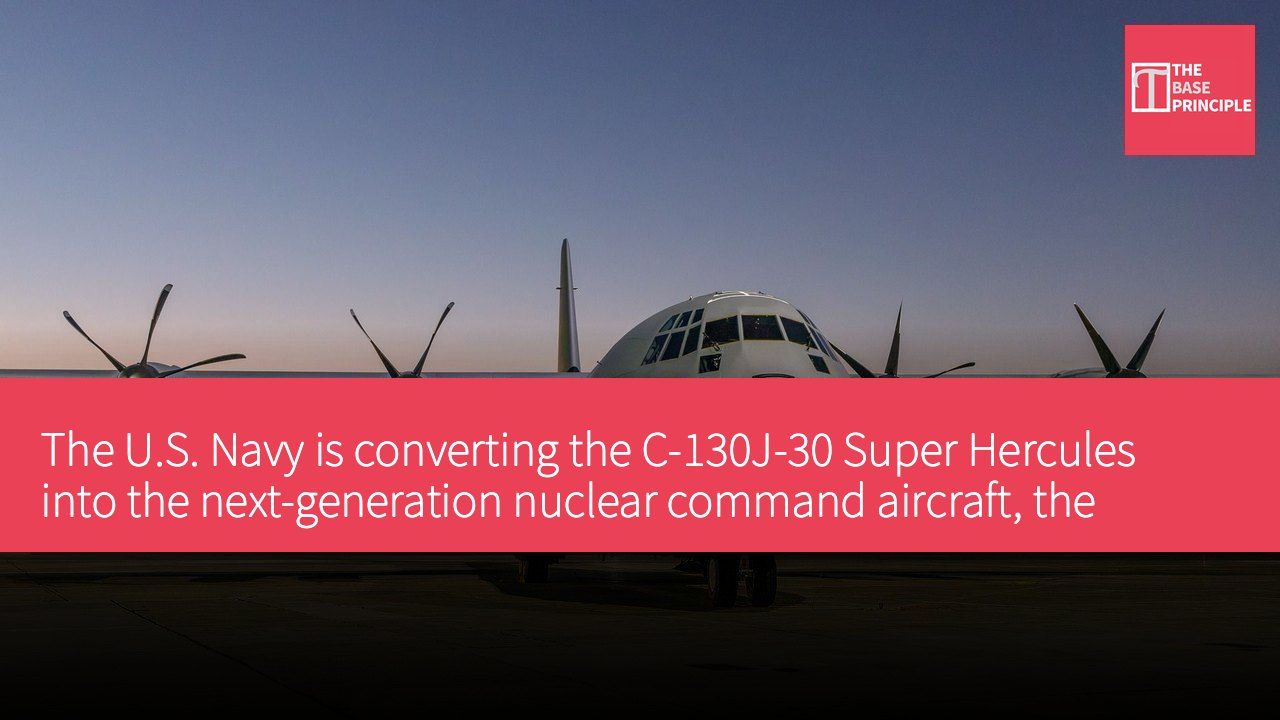
- The U.S. Navy's new nuclear communication aircraft, the E-130J Phoenix II, is undergoing modification.
- The C-130J-30 provides a robust airframe that requires significant engineering modifications to support its new mission.
- The aircraft will maintain the communication link between national leadership and nuclear forces.
- The Phoenix II program aims to restart the Navy's TACAMO mission, which requires completion of modifications and testing.
The U.S. Navy's new airborne nuclear communication aircraft has reached its first major milestone, but extensive engineering work remains before it can enter service. A C-130J-30 Super Hercules arrived at Lockheed Martin's facility in Marietta, Georgia, on October 15 for conversion into the E-130J Phoenix II. This aircraft will ultimately replace the Navy's E-6B Mercury fleet, responsible for transmitting strategic commands between national command authorities and U.S. nuclear forces. Its arrival marks the beginning of the process to transform a military transport aircraft into a specialized communication platform designed for one of the most critical defense missions in the U.S.
The C-130J-30 offers a powerful airframe that meets the Navy's requirements. Lockheed Martin lists its maximum takeoff weight at 164,000 pounds, with a standard maximum payload of 46,700 pounds and an operational empty weight of approximately 88,252 pounds. Its range varies with the aircraft's load, with a range of about 2,485 miles at a payload of 40,000 pounds, as listed by the manufacturer. Four turboprop engines provide the performance necessary for demanding military transport operations. However, the engineering challenges of carrying mission equipment differ significantly from transporting routine cargo.
Modification Requirements and Challenges
The Navy requires an aircraft capable of supporting specialized communication hardware during extended operations, and integrators must adapt the existing platform to meet these demands. The C-130J series provides a mature military airframe and modern avionics, with its existing capabilities serving as a starting point for the modifications. However, the transport configuration cannot perform the new mission without significant changes.
Northrop Grumman will integrate specialized equipment to transform the C-130J-30 into the E-130J Phoenix II. Planned work includes communication systems and enhancements designed to improve operational survivability. The aircraft's primary responsibility will involve the Navy's "Take Charge and Move Out" (TACAMO) mission. These aircraft maintain the communication link between national leadership and nuclear forces, including ballistic missile submarines. This role requires reliable equipment capable of transmitting strategic commands during severe national security crises. Engineers must integrate the necessary systems into the aircraft while ensuring they meet operational requirements for the mission.
Significant Milestones and Future Outlook
U.S. Navy Colonel Roger Davis, who oversees the Airborne Strategic Command and Communication program, described this delivery as an important milestone and emphasized the airframe's suitability for integrating the required systems for the mission. The delivery does not mean the aircraft can immediately begin operational service; integration and subsequent testing must ensure that the modified platform meets the Navy's requirements.
The Phoenix II program also reconnects the Navy's strategic communication mission with the Hercules family. According to Lockheed Martin, the service operated the EC-130Q for TACAMO missions from 1963 to 1993. The earlier aircraft established a historical precedent for using the Hercules platform in this specialized role. The E-130J reintroduces this concept with an updated airframe and upgraded mission equipment. The Navy must now complete the modifications to allow the aircraft to undertake its intended responsibilities. Progress will depend on the integration of communication hardware and demonstrating system performance through testing.
Replacing the E-6B Mercury fleet requires not only a new aircraft; the Phoenix II must provide reliable strategic communication capabilities, making the modification and validation phases central to the program's success.
Strategic Significance of the E-130J Phoenix II
The modification of the E-130J Phoenix II marks a significant advancement in the U.S. Navy's nuclear communication capabilities. As the global security environment evolves, reliable strategic communication is crucial for national security. The choice of the C-130J-30 is based not only on its robust transport capabilities but also on its flexibility in military missions. During the modification process, effectively integrating communication systems to meet the Navy's high standards will be a key challenge. As the program progresses, the Navy will be better equipped to address potential security threats and ensure the effectiveness of command and control.