
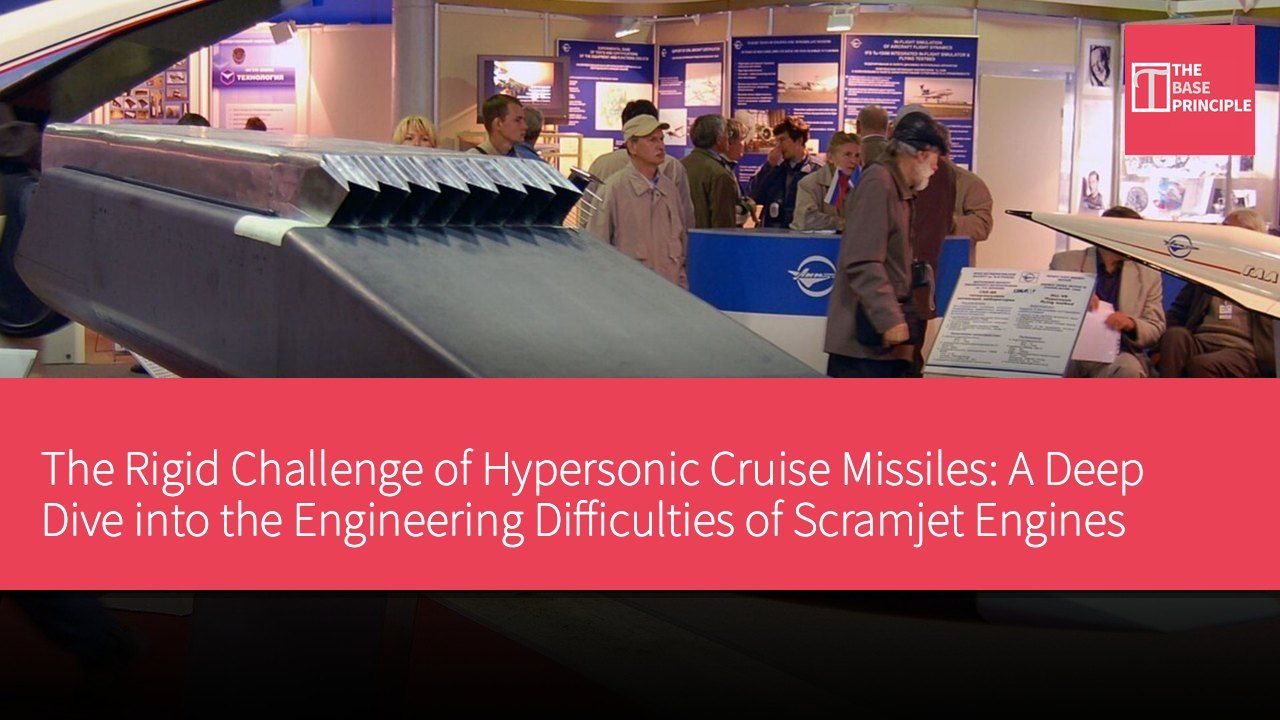
- Scramjet engines enable sustained atmospheric flight and operate at Mach 5.
- The engine uses the missile's speed to compress air, raising its pressure and temperature.
- The scramjet's design means it cannot generate thrust while stationary.
- Technical challenges include maintaining stable combustion and withstanding extreme temperatures.
Hypersonic cruise missiles must be able to do more than briefly reach extreme speeds; they require an engine capable of sustained atmospheric flight operating at least at Mach 5. That is the role of the scramjet. A scramjet, short for "supersonic combustion ramjet," is an air-breathing engine that uses the missile's forward motion to compress incoming air, then mixes it with fuel to produce thrust.
The concept sounds simple, but achieving it while traveling more than a mile per second is anything but easy.
How a Scramjet Works
How does a scramjet work? Unlike the turbofan engines used on commercial aircraft, a scramjet does not rely on rotating compressor blades. Instead, the shape of the intake and the missile's extreme velocity force incoming air into a narrow passage, raising its pressure and temperature. Fuel, typically a hydrocarbon or hydrogen, is then injected into this compressed flow. The mixture ignites inside the combustion chamber, releasing energy that expands through a rear nozzle to produce thrust. The crucial detail is that the air remains supersonic as it passes through the combustion chamber. Conventional ramjets slow the incoming flow to subsonic speeds before burning it, but at higher Mach numbers that approach becomes progressively less efficient.
Keeping the flow supersonic allows the scramjet to operate at speeds where ordinary jet engines cannot function.
Design Advantages and Challenges
That design, however, also means a scramjet cannot generate useful thrust while stationary or moving slowly. The missile must first be accelerated to the required speed by a rocket booster or another vehicle. Once the scramjet reaches operating conditions, it can be ignited and take over the propulsion role. Why are scramjets well suited to cruise missiles? Rockets must carry both fuel and oxidizer because they must operate without relying on the atmosphere. Scramjets draw oxygen directly from the surrounding air, eliminating the need to carry additional oxidizer during the cruise phase. This reduces weight and frees up internal volume for fuel, sensors, or a payload.
In addition, it enables sustained powered flight within the atmosphere rather than providing only a brief burst of acceleration. This distinguishes a scramjet-powered cruise missile from a hypersonic boost-glide weapon. A boost-glider is accelerated by a rocket and then coasts toward its target, while a hypersonic cruise missile continues to generate thrust with its air-breathing engine. Powered flight can give a cruise missile more flexibility during an engagement, allowing it to alter course or maneuver. Its speed, low-altitude atmospheric flight path, and potential maneuverability can also shorten reaction times and make detection and interception more difficult.
Scramjets, however, are not unlimited. Because they rely on atmospheric oxygen, their operation is bounded by altitude, air density, and speed. The engine must stay within a relatively narrow set of conditions to continue producing reliable thrust. Why is scramjet technology so difficult? Combustion inside a scramjet has been compared to lighting a match inside a hurricane. Air races through the engine in milliseconds, leaving the injected fuel almost no time to mix, ignite, and burn effectively. Engineers must prevent the flame from being blown out while also managing shock waves flowing through the intake and combustion chamber.
Disturbances in the airflow can trigger an event known as "unstart," which causes a sudden loss of thrust and can destabilize the vehicle. Heat poses another serious challenge. The friction and compression of the air expose the exterior of a hypersonic missile and its engine to extreme temperatures, demanding heat-resistant materials, protective coatings, and carefully designed cooling systems. Even small changes in altitude can alter the flow entering the engine, making the missile's airframe, intake, combustion chamber, and nozzle a tightly integrated propulsion system rather than separate components.
NASA demonstrated the technology's potential in 2004, when its unpiloted X-43A research vehicle reached approximately Mach 9.6 in a flight experiment. The test set a speed record for an air-breathing aircraft and showed that scramjet combustion is feasible at close to ten times the speed of sound. Since then, scramjets have become central to a number of military research programs. A gap still remains, however, between a successful test and a weapon that can reliably start, navigate, maneuver, and survive in demanding operational environments.
The technology's promise is clear: sustained hypersonic flight during the cruise phase without carrying an oxidizer. The challenge lies in achieving controllable combustion within some of the fastest and most hostile airflow conditions on Earth.
Technical Challenges and Potential of Scramjets
The development of scramjet engines represents a major breakthrough in military technology, enabling sustained hypersonic flight without carrying an oxidizer. This technology not only enhances missile maneuverability and reaction speed but also improves survivability in complex operational environments. Nevertheless, the challenges of achieving stable combustion and coping with extreme conditions persist, requiring engineers to make fine adjustments in design. As military research advances, scramjet engines have the potential to reshape the future of warfare.