
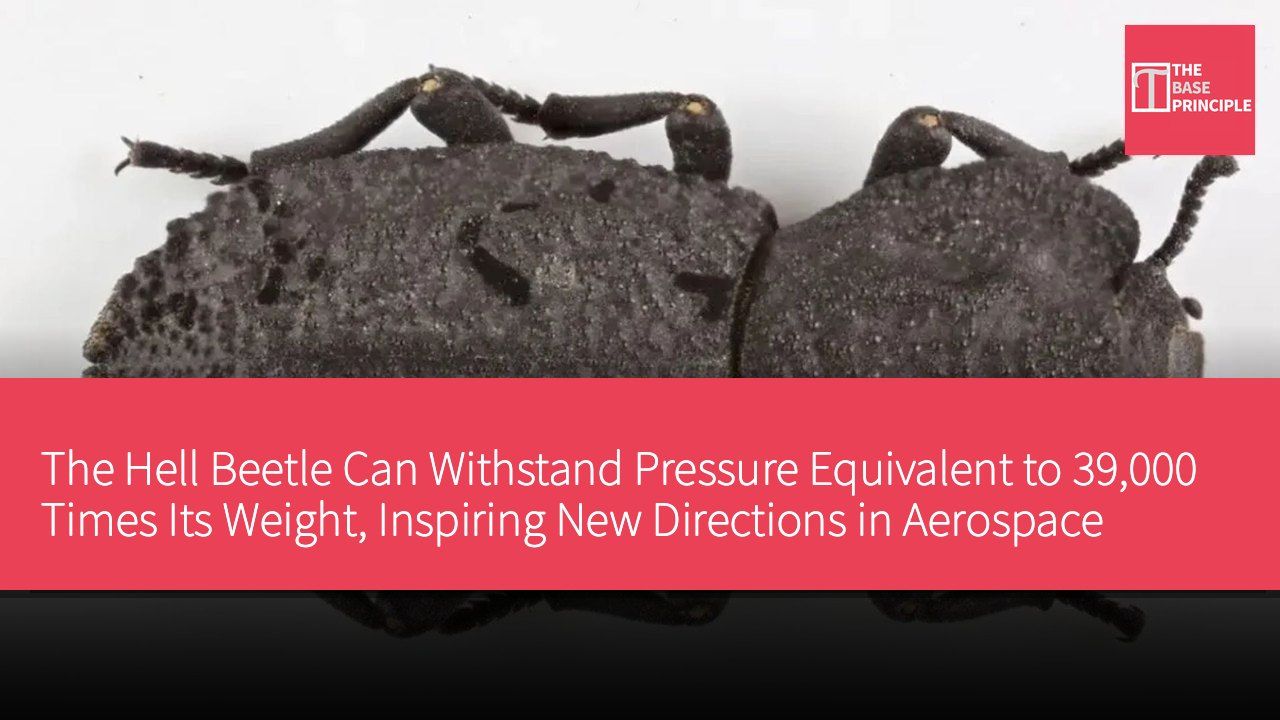
- The Hell Beetle can withstand forces 39,000 times its weight, demonstrating exceptional toughness.
- Its interlocking structure disperses pressure, preventing catastrophic failure.
- Researchers are developing carbon fiber fasteners inspired by the beetle to enhance aircraft strength.
- The new design highlights the potential of biomimicry in materials science, particularly in aerospace applications.
A species known as the "Hell Beetle," measuring about 2 centimeters in length and native to the western United States, can endure forces equivalent to approximately 39,000 times its body weight. Scientists have discovered that the remarkable toughness of this insect stems from its interlocking structure, which disperses pressure and allows for controlled damage rather than catastrophic failure. Inspired by this structure, engineers are developing stronger joints and repair interfaces for aircraft composite materials, ceramics, and other advanced materials to improve resistance to cracking and catastrophic failures.
The biological structure behind this insect's strength is particularly intriguing. The hardened forewings of the beetle, known as "elytra," have evolved into a shell after losing the ability to fly. These elytra meet at a seam called the "central suture," which contains an interlocking structure similar to puzzle pieces. Researchers from Purdue University and the University of California, Irvine, utilized microscopy, X-ray imaging, mechanical testing, computer simulations, and 3D-printed models to study this structure. Compression tests showed that the beetle's exoskeleton can withstand about 150 newtons of force before breaking, which is roughly equivalent to 39,000 times its body weight.
In comparison, other ground beetles can withstand only half of this force. Estimates suggest that the force exerted by a car tire crushing this insect on the ground is about 100 newtons.
The Toughness Mechanism of the Beetle
Researchers identified two mechanisms behind its toughness. First, the interlocking structure can disperse the applied forces, resisting being pulled apart. Second, under pressure, the internal layers gradually separate through a process known as "delamination." This controlled separation can absorb energy, preventing catastrophic structural failure and helping to protect vulnerable areas, such as the neck. This phenomenon clearly illustrates the distinction between strength and toughness: strength measures resistance to applied loads, while toughness describes how much energy a material can absorb before breaking. The exoskeleton also contains three types of connections: interlocking, locking, and flexible support structures, which provide higher rigidity near vital organs and greater flexibility at the rear.
The layered elytra are rich in proteins and contain no inorganic minerals.
David Kisailus, a materials scientist and engineer at the University of California, Irvine, stated, "We were surprised, especially considering that this beetle contains no mineral-based organic components." Pablo Zavattieri, a civil engineering professor at Purdue University, described the central suture as a puzzle-like connection that links different exoskeletal structures beneath the elytra. Beetle-inspired engineering techniques could enhance the strength of aircraft. Modern airplanes combine metals and composite materials, often using mechanical fasteners, which can increase weight and create stress concentrations where cracks and corrosion may occur.
Innovations in Materials Inspired by the Beetle
Researchers demonstrated an alternative by developing a carbon fiber fastener inspired by the beetle's armor. Mechanical testing showed that this fastener is comparable in strength to aerospace fasteners while providing significantly higher toughness. In a 2023 study, researchers combined the beetle's structure with that found in the skull of a white-tailed deer to develop stronger ceramic components. These designs absorbed up to 590% more energy in tensile tests, improved by 340% in bending tests, and increased by 700% in fracture tests. These designs also delayed failures by up to 50%.
In 2026, researchers developed an interlocking repair interface based on the beetle's elytra for damaged materials, including aircraft. Its puzzle-like geometry can disperse loads and make crack propagation more difficult.
Compared to circular step repairs, this design achieved a 30.47% higher peak force in tensile tests and an 8.65% improvement in bending tests. Although further testing is needed, these designs highlight the potential of biomimicry in creating materials that absorb energy, resist crack growth, and prevent catastrophic failures, particularly in the aviation sector. The research has been published in the journal Nature.
Prospects for Biomimicry in Aerospace Materials
The structural features of the Hell Beetle provide new insights for aerospace materials research. Its interlocking structure and controllable delamination characteristics illustrate the relationship between strength and toughness, which is crucial for enhancing the durability of aircraft materials. Modern airplanes require a balance between strength and weight, making beetle-inspired designs particularly attractive. The newly developed carbon fiber fasteners and interlocking repair interfaces not only improve the toughness of materials but also reduce crack propagation, showcasing the potential of biomimicry in aerospace engineering, which may lead to a new trend in material design.