
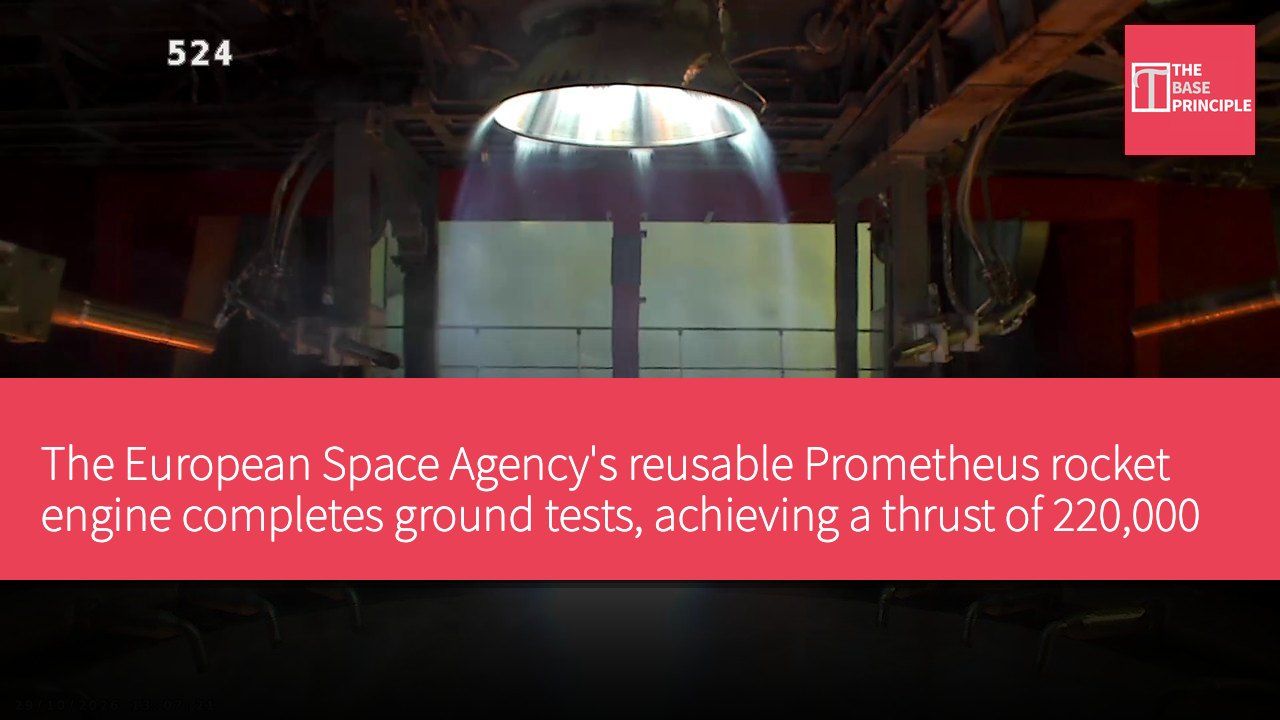
- The Prometheus rocket engine has completed ground tests, achieving a thrust of 220,000 pounds.
- The engine can be ignited without an independent ignition system, a first for Europe.
- The combustion chamber, manufactured using a new 3D printing process, participated in the tests, enhancing manufacturing efficiency.
- The adjustable thrust design is crucial for reusable rockets, allowing precise control during the return process.
The European Space Agency (ESA) reusable Prometheus rocket engine, capable of generating approximately 220,000 pounds of thrust (100 metric tons), has just completed a series of ground tests for future space missions. This methane-oxygen engine was built by the French aerospace company ArianeGroup, with tests conducted on October 29, 2026. The ground tests took place at the upgraded P5 test site of the German Aerospace Center (DLR). During this testing, Prometheus was ignited multiple times in a single day, achieving stable operating conditions after each ignition.
It also demonstrated the ability to ignite without an independent ignition system. According to ArianeGroup, this is a first for European gas generator cycle engines at its thrust level.
The Importance of Reusability
"Reusability is becoming increasingly important in space transportation," noted Philippe Clar, head of ArianeGroup's space transportation program. The tests also included the use of a combustion chamber manufactured with a new 3D printing process. According to DLR, the latest testing activities mark the first time at its P5 facility that repeated methane-oxygen engine ignitions have been achieved within a single test day. The upgraded test site can now handle up to five ignitions per day, as well as longer engine burns and different thrust levels.
Anja Frank, director of the DLR Institute of Space Propulsion, emphasized the significance of this achievement. "Igniting up to five times in a single test day places high demands on the coordination of the test stand systems," Frank said. "Our ability to conduct these procedures automatically, safely, and repeatedly is an important step for testing reusable propulsion systems."
Application of New Technologies
These capabilities are crucial for reusable rockets, as they may need to restart engines after launch to return to Earth and perform controlled landings. Meanwhile, the P5 facility has also been upgraded to accommodate liquid methane and liquid oxygen, the two propellants used by Prometheus. It can also measure thrust, fuel flow, pressure, and temperature, providing data to improve rocket engines. "With the modernized P5, we can reliably and comprehensively test high-thrust methane-fueled rocket engines," Frank added.
At the same time, the team conducted the first tests using combustion chambers manufactured with the cold gas spraying (CGS) process. This process involves spraying metal powder onto components at high speeds, where the particles bond to form a solid layer on the surface without melting. ArianeGroup is developing Prometheus on behalf of ESA, extensively using 3D printing to streamline manufacturing, shorten production times, and reduce costs. "The success of these new tests for the Prometheus reusable rocket engine is an important step forward for ArianeGroup and all of Europe," Clar stated in a press release.
This engine also features adjustable thrust, which is vital for reusable rockets. While high thrust is required during launch, the returning rocket stage needs precise control during descent and landing. It uses liquid methane instead of liquid hydrogen, as methane has a higher density and can be stored at higher temperatures. Clar emphasized the importance of collaboration in the design process for reusable rockets. "This new testing activity demonstrates our ability to develop solutions that meet market demands and open new frontiers, thanks to the collaboration between our teams in France and Germany, providing Europe with sovereign capabilities in reusable space technology."
Meanwhile, ArianeGroup has begun work on an upgraded engine, named Prometheus Mark 2. Reports indicate that its next testing activity will take place at the company's test center in Vernon, France.
The Impact of the Prometheus Engine on European Space Programs
The successful testing of the Prometheus rocket engine marks a significant advancement for Europe in reusable rocket technology. This not only enhances the reliability of propulsion systems but also showcases the potential applications of new manufacturing processes such as 3D printing and cold gas spraying. The integration of these technologies helps reduce costs and shorten production times, which is crucial for the sustainability of future space missions. Additionally, the adjustable thrust design of Prometheus allows it to respond more flexibly to different launch and landing requirements, further strengthening Europe's position in the global space competition.