
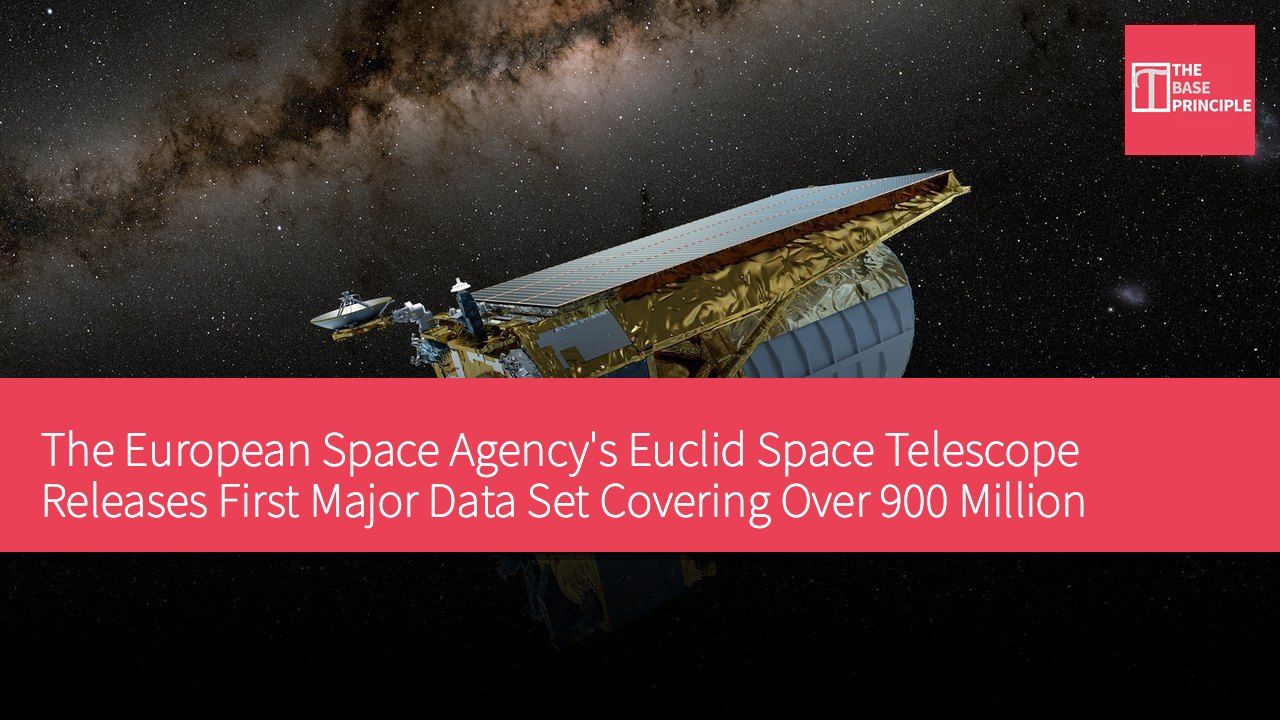
- Euclid Space Telescope releases first major data set covering over 900 million galaxies.
- This data set includes over 15,000 strong gravitational lens candidates and 60 million quasar candidates.
- Euclid is capable of deep sky observations, pushing the limits of detecting rare objects.
- Scientists believe this data set will reveal many previously undiscovered cosmic mysteries.
The European Space Agency's Euclid Space Telescope has released its first significant data batch, a catalog covering over one billion cosmic objects, with an observational area equivalent to the size of 9,500 full moons. This release, named DR1-Foundation, encompasses approximately 13 months of observational data. It is the first major data release since Euclid's launch in mid-2023, providing scientists with the necessary information to construct a detailed three-dimensional map of the universe, which is crucial for solving the mysteries of dark cosmos.
Scale and Scope of the Data Release
The data release includes over 900 million galaxies, approximately 15,000 strong gravitational lens candidates, over 60 million quasar candidates (the bright cores of distant galaxies), and spectral data from more than 160 million sources. Euclid's wide survey covers 1,900 square degrees of the sky and generates 1.7 million GB of data, including images and large sky mosaics. This represents a significant scale-up; project scientist Valeria Pettorino noted that previous data releases covered only a few days of observations, spanning about 60 square degrees, whereas this release includes over a year of data with a much broader coverage.
In comparison to the data release planned for March 2025, this report involves only about 500 strong gravitational lens candidates. Euclid is capable of deep and wide sky observations from above Earth's hazy, dim atmosphere, reaching areas that ground-based telescopes cannot, further advancing the limits of detecting rare, distant objects. This release contains the largest strong gravitational lens catalog ever, surpassing the total of all previous catalogs combined. These lenses form when the gravity of foreground galaxies significantly distorts the light from more distant galaxies, a phenomenon that is extremely rare.
Importance of Observing Strong Gravitational Lenses
Natalie Lines from the University of Southampton stated that strong gravitational lenses allow astronomers to "measure" individual galaxies, including their invisible dark matter, and study the expansion of the universe. Galaxy clusters are another focus. Barbara Sartoris from the JL Lagrange Laboratory in Nice, France, noted that Euclid is capable of observing a large number of ancient galaxy clusters over a vast range, which were previously inaccessible. Her team will study the growth of these massive galaxy clusters in the coming months.
Mapping relies on spectroscopy: breaking down the light from galaxies into a "rainbow" to reveal their distances. Once distances are established, scientists can place galaxies within the three-dimensional structure of the universe and connect them to the invisible grid of the cosmic web. For particularly bright galaxies, the rainbow also reveals their origins and composition. This data set covers only about 14% of the total sky that Euclid will investigate. A complete data release is expected in mid-2027, which will include weak lensing observations to complement strong lensing and calculate how galaxies and galaxy clusters fit into the cosmic web.
Carole Mundell, the European Space Agency's Director of Science, stated that this release is "far more than beautiful images," marking a scientific milestone and representing the largest space-based survey of its kind. Pettorino emphasized that the data set has sufficient statistics to reveal even rare objects and believes "many discoveries are still waiting for us."
Impact of the Euclid Data Set on Cosmic Research
The data release from the Euclid Space Telescope marks a significant milestone in cosmic observation, particularly in the study of strong gravitational lenses and galaxy clusters. These data not only cover a vast number of galaxies but also provide deep insights into dark matter and the expansion of the universe. With ongoing data releases in the future, scientists hope to uncover more cosmic mysteries and further advance our understanding of the structure of the universe. These studies will have a profound impact on the development of astronomy and may change our fundamental understanding of the cosmos.