
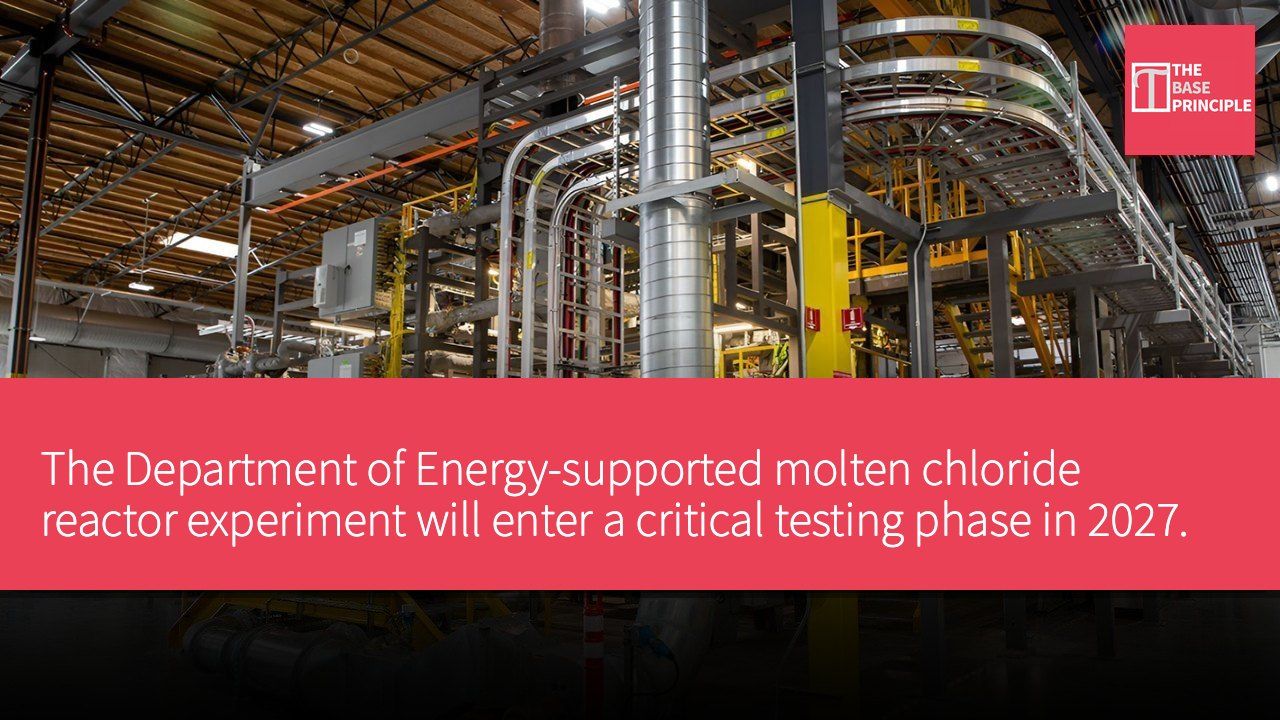
- The Molten Chloride Reactor Experiment is expected to provide important operational data in 2027.
- MCRE will investigate a chloride-based fast-spectrum molten salt system.
- Experimental data will help reduce predictive uncertainty in future reactor designs.
- Nuclear-powered commercial vessels could become an alternative to traditional marine fuels.
A nuclear experiment supported by the U.S. Department of Energy is expected to provide crucial operational data for next-generation reactors as early as 2027. The Molten Chloride Reactor Experiment (MCRE) aims to test a fast-spectrum molten chloride salt reactor operating under sustained fission conditions. The results could assist engineers in advancing this technology toward commercial application. The Department of Energy has approved additional co-funding to accelerate the final development phase of the experiment. Southern Company, Idaho National Laboratory, and CORE POWER are collaborating on this project through the department's Advanced Reactor Demonstration Program.
Design of the Molten Chloride Reactor
Unlike traditional reactors, molten salt reactor designs allow nuclear fuel to be dissolved in liquid salt. MCRE will study a chloride-based system that operates on a fast neutron spectrum. Fast neutrons retain more energy than thermal neutrons used in many traditional reactors, a difference that affects the behavior of nuclear fuel and the sustainability of fission in the reactor. Engineers need experimental data to understand these effects and improve designs. MCRE aims to be the world's first fast-spectrum molten chloride reactor experiment to achieve criticality. This milestone is reached when the reactor can sustain a controlled nuclear chain reaction.
Idaho National Laboratory will assist researchers in collecting direct measurement data on reactor behavior during operation.
Deputy Laboratory Director Jess Gehin stated that engineers currently rely on models to predict the performance of this reactor design. He noted, "Using real operational evidence to enhance these models will reduce predictive uncertainty for future reactor designers and regulators." These measurement data can help developers validate simulation tools and assess engineering decisions, and may provide information for future reactor licensing efforts, although regulators will still require safety evidence for specific projects.
Technical Challenges and Application Potential
Advanced reactor developers face significant technical challenges before deployment. Experimental results can help engineers identify uncertainties before committing to larger, more expensive demonstrations. MCRE may provide data on fuel behavior and reactor performance during sustained fission. These findings could assist developers in evaluating design choices and building a stronger technical case for future projects. Southern Company views this experiment as an example of how federal funding and private sector expertise can advance nuclear research.
Senior Vice President Mark S. Berry stated that collaboration can help reduce technical uncertainty, enabling developers to pursue reliable and economical energy. This research may also support applications beyond electricity generation. Fast-spectrum molten salt systems could ultimately meet industrial energy demands and produce medical isotopes. Developers are also exploring whether these reactors can extract additional value from used nuclear fuel.
CORE POWER sees potential applications in commercial shipping, where nuclear propulsion could provide long-duration, carbon-free power during operations. CEO Mikal Bøe stated that the company committed to establishing MCRE in 2020. The accelerated timeline now aims for criticality by 2027. Bøe noted that this experiment could help establish the engineering knowledge, licensing approaches, and supply chains necessary for commercial deployment. CORE POWER also hopes to integrate advancements in nuclear fuel technology with its maritime nuclear development efforts.
Nuclear-powered commercial vessels could ultimately become an alternative to traditional marine fuels. However, deployment will require significant work on reactor safety, vessel integration, regulations, and supporting infrastructure. The immediate goal of MCRE remains scientific rather than commercial. Its experimental results may help determine whether fast-spectrum molten chloride reactors can advance toward practical applications, including future maritime energy systems.
Future Potential of Molten Chloride Reactors
The success of the Molten Chloride Reactor Experiment could have profound implications for the development of nuclear energy technology. This technology not only has the potential to improve reactor operational efficiency but may also provide additional energy solutions for industrial and medical sectors. As demand for renewable energy increases, the potential of nuclear energy as a low-carbon source becomes increasingly important. The results of this experiment will pave the way for future commercial applications and could lead to advancements in nuclear propulsion technology, thereby transforming energy supply models in shipping and other industries.