
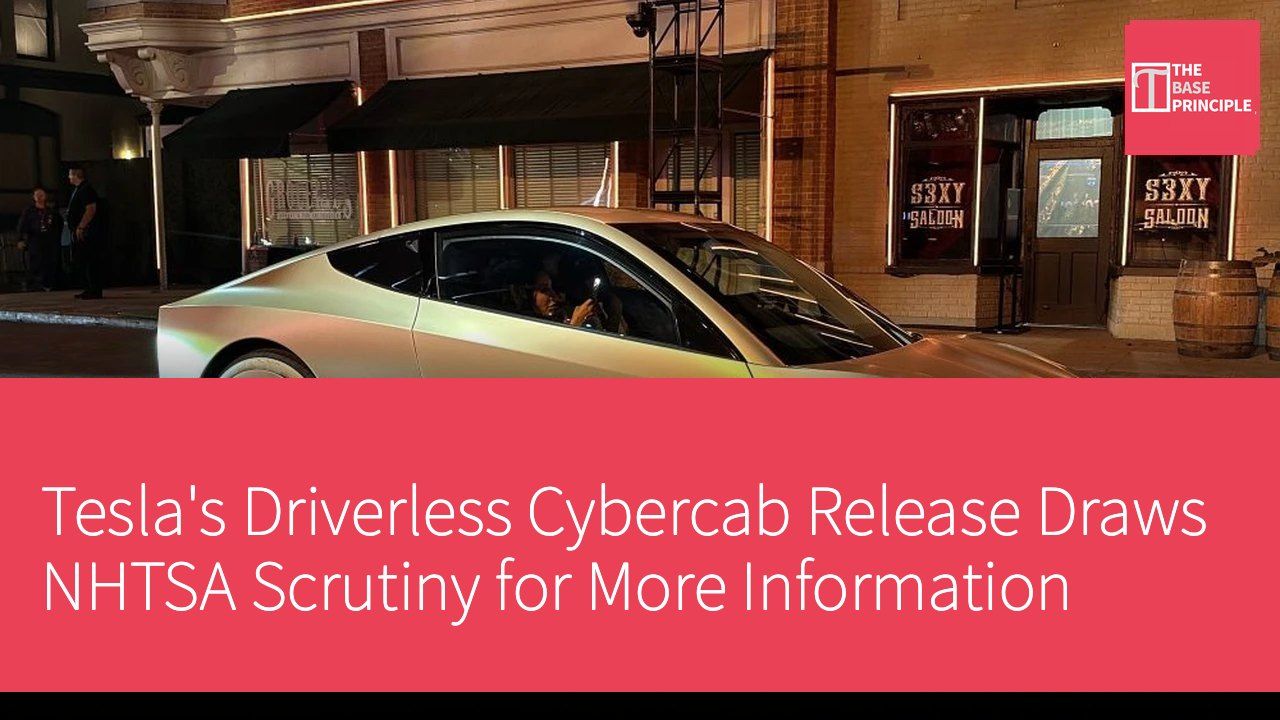
Tesla held a low-key, small event in downtown Austin, Texas, last night, unveiling the fully electric, steering wheel- and pedal-free Cybercab. The launch marks the beginning of unregulated ride-hailing services on the Tesla Robotaxi platform and has drawn the attention of the US National Highway Traffic Safety Administration (NHTSA), which has opened an Audit Query (AQ) into the vehicle's Federal Motor Vehicle Safety Standards (FMVSS) certification. Manufacturers typically self-certify vehicles to avoid excessive regulatory delays.
| Specification | Description |
|---|---|
| Steering wheel | None |
| Pedals | None |
| Traditional vehicle controls | Absent |
In a summary, the NHTSA stated: "On September 3, 2026, Tesla began the commercial deployment of a small number of Cybercab vehicles in Austin, Texas. Tesla has informed the agency that these Cybercab vehicles have been certified as compliant with all applicable Federal Motor Vehicle Safety Standards (FMVSS). Tesla has also informed the agency of its plans to gradually expand the commercial deployment of Cybercab, including increasing the number of vehicles and locations." The agency noted that the Cybercab's lack of traditional vehicle controls is a groundbreaking move.
This process is new to the NHTSA, giving the agency reason to scrutinize Tesla's release: "These vehicles lack permanently attached traditional manual controls, such as brake pedals, accelerator pedals, steering wheels, and rearview mirrors. The NHTSA is conducting this AQ to examine the processes and technical data Tesla relied upon in certifying the Cybercab, as well as related issues." The NHTSA will consider the extent to which Tesla's certification relies on certain FMVSS not being applicable to the Cybercab.
According to public filings submitted to Texas over the past week, Tesla has added 45 Cybercab units to its Robotaxi fleet in Austin. Achieving this level of autonomous driving is a goal Tesla has been working toward for years, and it seems reasonable for regulators to raise some questions now that it has been achieved. Many in the media may try to portray this as negative news, but in reality, it is an indication that an agency wants to learn more about the groundbreaking technology Tesla has been developing. To ensure the safety of passengers, pedestrians, and property, this initial, mid-term, and long-term driving data will likely be shared with the NHTSA to help shape broader deployment strategies in the future.
| Relevant Information | Content |
|---|---|
| Release Date | September 3, 2026 |
| Release Location | Austin, Texas |
| Number of Vehicles | 45 vehicles |
Meanwhile, Tesla's Asian division announced that the Cybercab will be on display in Hong Kong, Tokyo, Beijing, and Shanghai this month. Tesla's Asian official account posted on X, inviting Cybercab fans to "come to Hong Kong, Tokyo, Beijing, and Shanghai to experience the future of autonomous driving." Tesla's innovation lies not only in technological breakthroughs but also in its vision for the future of transportation. With the Cybercab on display in Asia, Tesla is once again demonstrating its leadership in the field of autonomous driving and its positive impact on the global market.
Tesla's efforts and achievements will undoubtedly bring profound changes to future modes of transportation.