
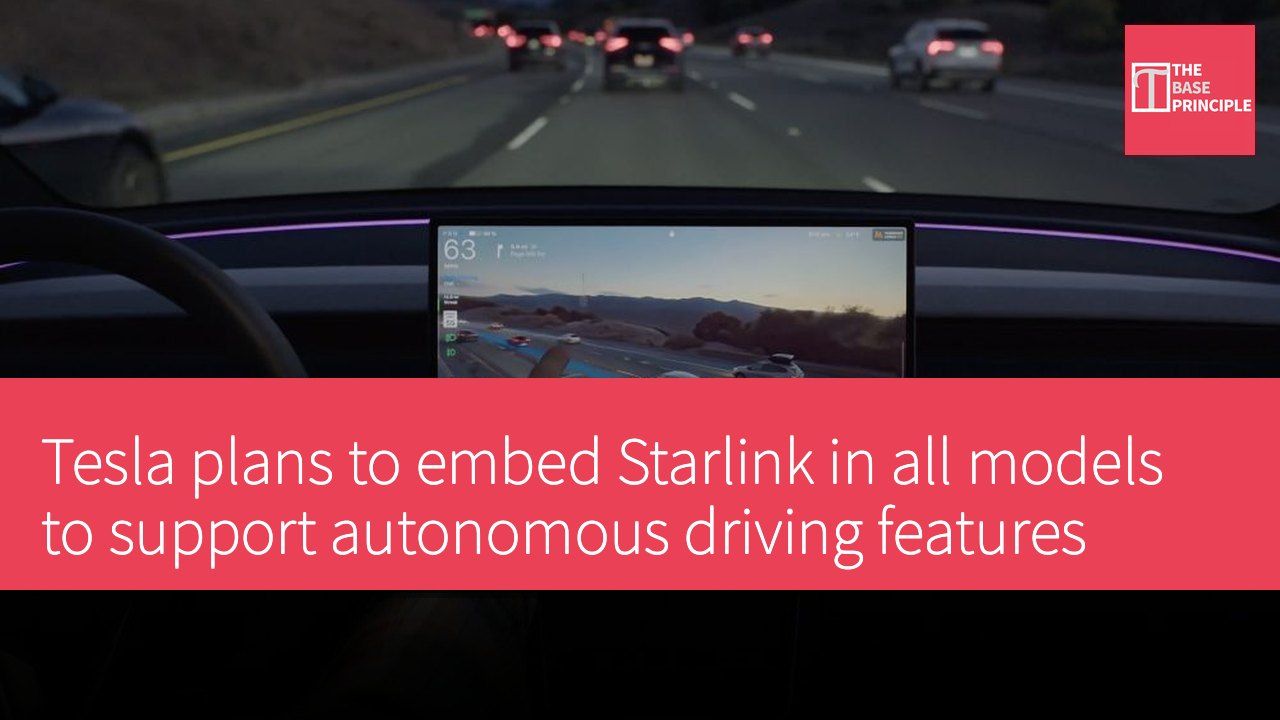
- Elon Musk stated that Starlink will be integrated into all Tesla models to support autonomous driving features.
- Currently, the Cybercab is the only Tesla model equipped with Starlink, and passengers have not yet been able to connect to the system.
- Musk mentioned that the memory for AI4.5 will be reduced from 32GB to 24GB to save costs.
- Starlink is illegal in China, so it will not be integrated there.
Elon Musk indicated that Starlink could be directly integrated into every Tesla model by the end of next year, a plan closely linked to the company's goal of advancing autonomous driving. In a response on the X platform to PayPal co-founder David Marcus on Sunday, who expressed anticipation for an embedded Starlink option beyond the Cybercab, Musk wrote: "Hope to have it available by the end of next year. This is crucial for Full Self-Driving, as passengers can work and entertain themselves with high-bandwidth internet everywhere."
He added an exception: "Except in China, where Starlink is illegal." Currently, the Cybercab is the only Tesla model equipped with Starlink. This two-seater vehicle features a flat-mounted Starlink V5 terminal in its trunk, with the latest unit beginning public ride service in Dallas this week. Passengers currently seem unable to connect to the system, and Tesla's Chief Technology Officer for AI, Ashok Elluswamy, has stated that the connection is primarily used for navigation, customer service, and fleet management, rather than safe driving.
The Relationship Between Starlink Integration and Autonomous Driving
Musk's comments suggest that passenger connectivity is part of the plan, and this feature will be realized once the hardware is expanded to other models. The timeline aligns with Tesla's goal of allowing owners to add their vehicles to its Robotaxi network. Musk stated last week that testing could begin as early as next month, and the company started rolling out FSD v15 to customers on Saturday. According to its release notes, Tesla claims this release has improved capabilities in handling safety-critical scenarios by 25 times compared to v14.
Musk also shared new details about Tesla's next-generation vehicle computer. In a response to Sawyer Merritt, he wrote: "AI4.5 is a relatively small performance increase, mainly due to the need to upgrade the RAM to LPDDR5X." In a subsequent post, he mentioned that Tesla is reducing memory to save costs: "RAM is very expensive, so we are reducing AI4.5's memory from 32GB to 24GB. That is sufficient. Given the memory bandwidth limitations, it's hard to utilize 32GB."
Reasons for the AI4.5 Memory Adjustment
This change contrasts with Musk's earlier statements during Tesla's first-quarter earnings call this year, where he mentioned that the RAM for each chip would increase from 16GB to 32GB. As AI data centers absorb supply, memory prices have surged, and Musk stated on Sunday: "Due to rising memory and storage prices, the cost of AI4 is now twice what it was before." He also confirmed that the next-generation chip will not be entering vehicles at this time. When asked when AI5 would appear in new cars, he responded: "It will be applied to Optimus."
Vehicles will remain on AI4. This is sufficient to meet the demands of superhuman driving." He noted that the computational power of AI5 is about 12 times that of AI4.
Musk also unusually revealed how the v15 driving software is constructed. He wrote: "Since last year, Tesla has had a near-pixel-perfect world model, which is crucial for synthetic data generation," and that "the (smaller) version in the car is a conditional mean flow model based on the recent Tesla universal visual encoder sequence." In practice, Tesla trains on a large model that can generate realistic driving scenarios, then runs a compact version to predict what will happen next based on recent camera inputs.
Tesla has not disclosed which vehicles will receive AI4.5 or when they will receive it, and Musk has not provided pricing for adding Starlink to vehicles beyond the Cybercab.
Elon Musk stated that Starlink could be directly integrated into every Tesla model by the end of next year.
Currently, the Cybercab is the only Tesla model equipped with Starlink.
Musk mentioned that Starlink is illegal in China, so it will not be integrated there.
Currently, passengers seem unable to connect to the system, which is primarily used for navigation, customer service, and fleet management.
Musk stated that the memory for AI4.5 will be reduced from 32GB to 24GB to save costs.
The Impact of Starlink Integration on Tesla
Tesla's plan to integrate Starlink into all models demonstrates its commitment to autonomous driving technology. High-bandwidth network connectivity will not only enhance the passenger experience for work and entertainment but also improve the navigation and management capabilities of autonomous driving. Although the Cybercab is currently the only model equipped with Starlink, this move could attract more consumers' attention to Tesla's autonomous driving technology. Additionally, Musk's memory adjustment reflects a balance between cost control and technological advancement, showcasing the company's agility in facing market challenges.