
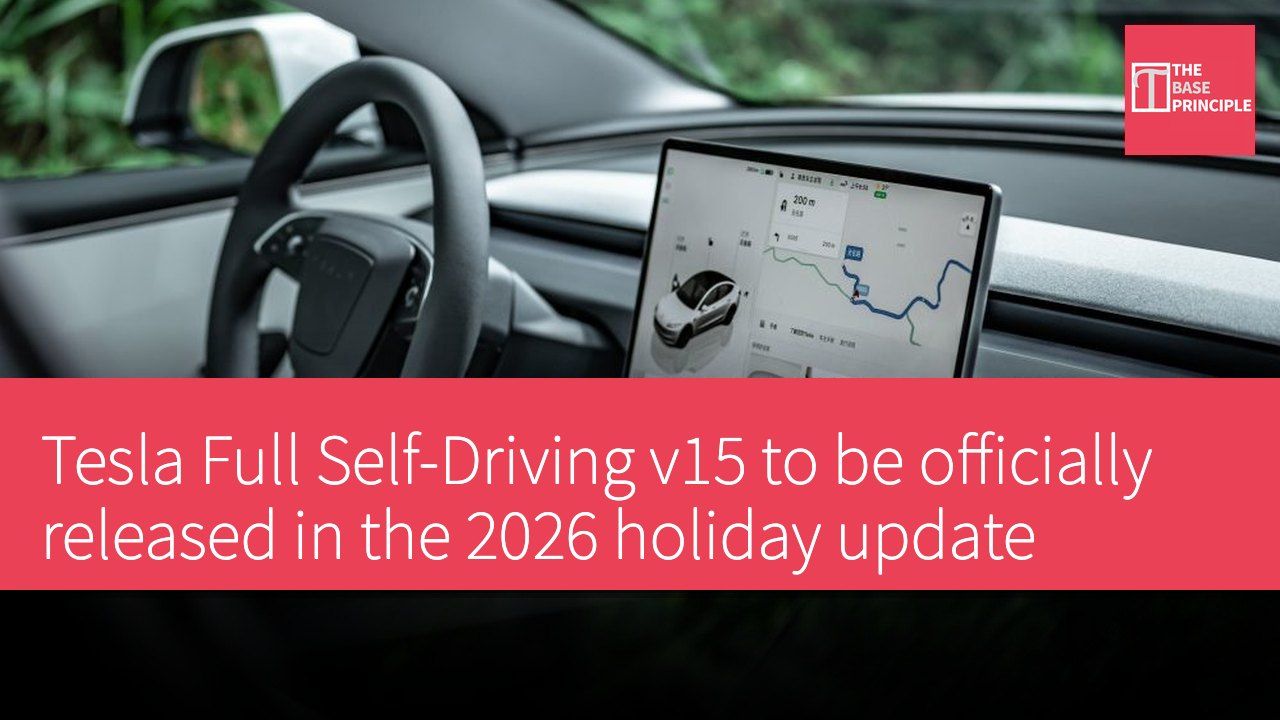
- Tesla FSD version 15 will be officially launched in the 2026 holiday update.
- Musk mentioned significant changes to the user interface.
- Version 15 will improve safety and collision avoidance systems.
- Parking functionality remains challenging, but version 15 may enhance capabilities.
Tesla's Full Self-Driving (FSD) version 15 has an official release date from CEO Elon Musk, who stated that this latest and most powerful version will be officially launched during the 2026 holiday update. This suggests that the initial versions of the system may be available sooner, as the Early Access Program will be the first to receive the new FSD version.
Musk's comments revealed some information but did not provide extensive specifics about its features. Musk mentioned supervised fine-tuning, describing it as "like cutting hair with a chainsaw," and noted that FSD version 15 will be officially launched for owners next month: SFT is more like cutting hair with a chainsaw, rather than "fine-tuning"! It should be built directly into the main training. Having a "system prompt" is quite ridiculous! The default behavior should be reasonable. The above situation already applies to Tesla AI (which does not yet deserve the title of "super").
It is the most efficient AI on Earth.
Advertisement - FSD version 15 will be officially launched next month. This will be a special update.
Significant Changes to the User Interface
The changes and fixes confirmed by Musk merely affirm that the new Full Self-Driving version will be released during the 2026 holiday update, and the two specific changes he confirmed are updates to the user interface (UI) and two minor adjustments. Musk's comments about the user interface confirm that there will be significant changes, stating: "Advertisement - @roger_kappler Yes. The new user interface will present reality in an incredible way. It's hard to describe, but it's fantastic."
These UI changes may upgrade Tesla vehicles equipped with AMD Ryzen, utilizing AI4 to visualize the vehicle using Unreal Engine, which was discovered in last year's coding: Tesla plans to use Unreal Engine for driver visualization, bringing amazing upgrades. Advertisement - Additionally, a user noted that their biggest complaint about the recent v14 version was the need to "stop refusing to use HOV lanes," with last-minute lane changes or turns happening too frequently.
Musk stated that these issues should be resolved in v15. @riley_stahura should fix this in V15.
Safety and Unsupervised Driving
In the past, we also received some details about version 15 from Tesla's AI director Ashok Elluswamy, who mentioned in September that version 15 would bring improved safety and collision avoidance systems. Tesla plans to introduce significant safety improvements for Full Self-Driving v15. Advertisement - A major prediction for v15 is whether it will enable some Tesla vehicles to achieve unsupervised driving. Although FSD has proven to be an excellent mode of transportation, there is still much room for improvement.
FSD still faces challenges with parking, often encountering errors after updates, failing to recognize potholes or large bumps on the road, and speed control remains a common complaint, while navigation has always been one of the biggest pain points. However, v15 may bring significant capability enhancements and provide users with more options, such as potential parking directions and more precise parking space selections. We can only wait to see what features Tesla will incorporate.
Potential Impact of FSD v15
Tesla's Full Self-Driving system continues to evolve, and the launch of FSD version 15 could significantly enhance the driving experience. Changes to the user interface and safety improvements demonstrate Tesla's attention to user feedback. While challenges remain with parking and navigation, the upgrades in v15 may offer users more choices and improve overall performance. This is crucial for advancing the adoption and acceptance of autonomous driving technology, especially regarding the possibility of unsupervised driving.