
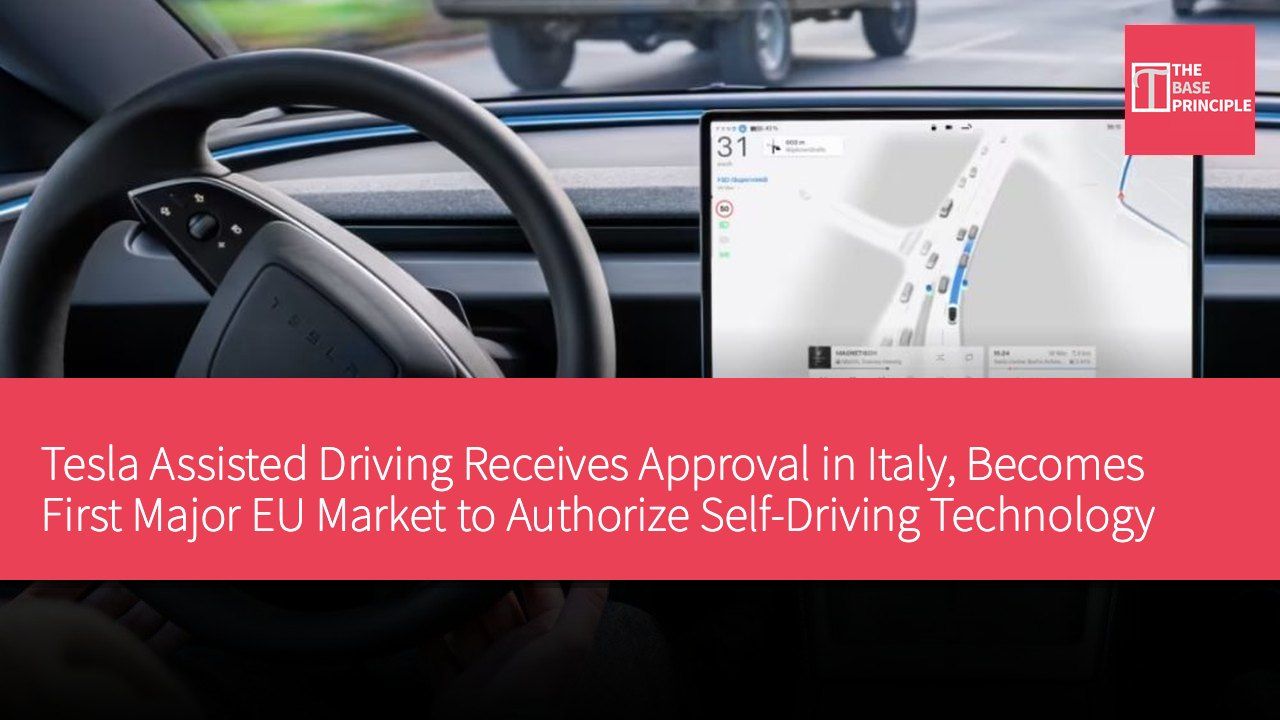
- Tesla's driving assistance system has been approved in Italy, making it the first major EU market to authorize self-driving technology.
- The approval in Italy is significant for Tesla's approval process in Europe, marking an important strategic foothold.
- The system will be launched in Italy via a subscription model at €99 per month, with updates delivered over the air.
- The approval in Italy adds important demographic and political momentum for future discussions at the automotive technology committee.
Tesla's driving assistance system (Tesla Assisted Driving, or TAD), the European counterpart to the full self-driving package in the United States, has officially received approval to operate in Italy, becoming the twelfth EU country to allow this package. The approval in Italy is significant for Tesla's approval process in Europe, as it is the first truly large European country to receive such authorization. On November 20, the Italian Ministry of Transport granted Tesla's driving assistance system (TAD) a temporary type approval.
Transport Minister Matteo Salvini announced the decision on social media platform X, stating that this is "another step towards innovation, technology, and future mobility, always prioritizing public safety."
Significance of the Approval in Italy
This approval was granted after a comprehensive technical feasibility assessment, making Italy the twelfth European country to authorize the technology and one of the largest markets within the EU. TAD, previously marketed as FSD (supervised), will be rapidly launched in Italy through over-the-air updates and will be offered via a subscription model at €99 per month (approximately HK$837). The green light from Italy carries significance far beyond previous approvals. The system first received temporary type approval from the Netherlands' RDW in April, with subsequent recognitions primarily coming from smaller countries such as Lithuania, Denmark, Belgium, Croatia, and Finland.
Challenges and Future Outlook
In contrast, Italy is the third most populous country in the EU and is one of the traditional "Big Four" countries, which also include Germany, France, and Spain. Its urban environment is particularly dense, presenting a more challenging real-world test for the system compared to many earlier markets. This approval also came after a meeting between Elon Musk and Salvini at the end of October, during which Salvini publicly supported rapid decision-making at the EU level. Authorization across the EU requires a qualified majority from at least 15 member states, representing 65% of the population. Italy's move adds significant demographic and political momentum for potential future discussions at the automotive technology committee.
Tesla took the opportunity to release a video showcasing a vehicle navigating near the Colosseum in downtown Rome, emphasizing the system's ability to handle unique urban traffic patterns. For Tesla, the authorization in Italy marks a strategic foothold in a major European automotive market, potentially accelerating customer adoption and fostering broader regulatory acceptance across the continent.
Strategic Implications of Italy's Approval for Tesla
As the third most populous country in the EU, Italy's approval holds significant strategic importance for Tesla. This not only marks further expansion for Tesla in the European market but also provides crucial political support for future technological discussions. With Italy's approval, Tesla can conduct testing in a large population market, which will aid in further optimizing and promoting the system. This approval may also encourage other EU countries to follow suit, further advancing the adoption and acceptance of self-driving technology.