
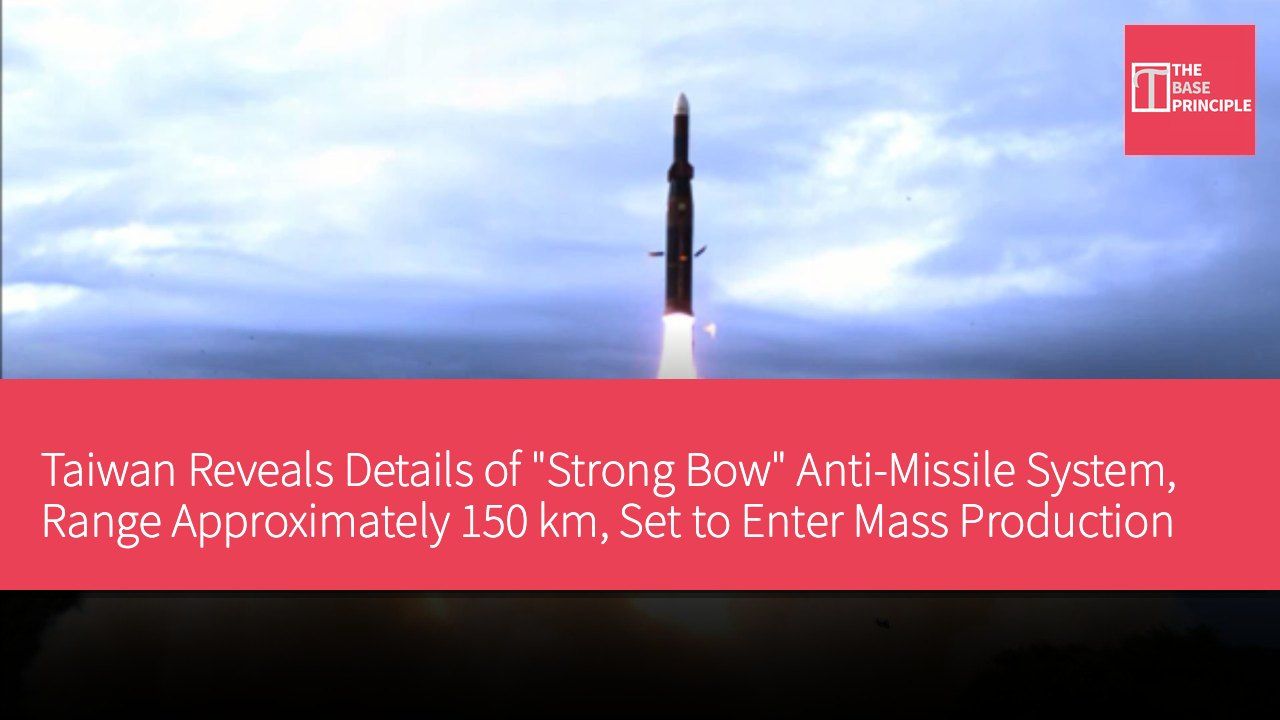
- Taiwan has revealed details of its domestically produced Strong Bow anti-ballistic missile system, seeking funding to move into mass production.
- The Strong Bow system is designed to intercept ballistic missiles at altitudes of at least 70 kilometers.
- The system will serve as the outermost layer of Taiwan's T-Dome multi-layered missile defense network.
- Experts say the Strong Bow will enhance Taiwan's missile defense capabilities and urge prompt funding for production.
Taiwan recently unveiled details of its domestically produced "Strong Bow" anti-ballistic missile system, seeking funding to advance the weapon into mass production. The National Chung-Shan Institute of Science and Technology (NCSIST) has released specifications covering propulsion, guidance, and radar systems. The government is seeking a budget of NT$36.1 billion (approximately US$1.13 billion) to produce two Strong Bow systems and 128 interceptor missiles.
Design and Functionality of the Strong Bow System
The Strong Bow system, also known as the "Sky Bow IV," is a high-altitude missile defense system designed to intercept tactical ballistic missiles at altitudes of at least 70 kilometers (approximately 43 miles). Its interception area is above that of existing Patriot and Sky Bow III systems. The interceptor uses a vertical launch system and is equipped with a two-stage solid-fuel rocket motor, enabling it to achieve hypersonic speeds. During flight, it relies on inertial guidance and updates target information via a radar uplink, with the terminal phase guided by an active seeker.
The interceptor is equipped with a thrust vector control system, allowing for agile maneuvering in the thin air of high altitudes, and features a high-explosive fragmentation warhead. The Strong Bow system utilizes mobile launch vehicles, each carrying four missile canisters; a tactical command vehicle supports launch operations, while an advanced radar system handles detection and tracking tasks. This radar can simultaneously identify multiple threats and continue operating in environments with electronic interference.
Taiwan's Ministry of National Defense stated that the radar on the Strong Bow system has a detection range and altitude that surpasses those of the radars used by the Patriot PAC-3 and Sky Bow III systems. Taiwan plans to deploy the Strong Bow as the outermost layer of its "T-Dome" multi-layered missile defense network. Lu Chien-sheng, deputy chief convener of the Sky Bow program at the Chung-Shan Institute of Science and Technology, said the system is specifically designed to counter tactical ballistic missiles and can operate in conjunction with other air defense units.
Budget and Production Challenges
The Strong Bow was initially included in a special defense budget of NT$1.25 trillion, with plans to begin production this year and complete the first indigenous regional air defense system by 2027. However, in May, the opposition-controlled legislature approved only about two-thirds of the budget, and the Strong Bow was not included in the final allocation. Attempts to move the program to the 2027 regular defense budget are facing pressure due to other weapons commitments and payments for U.S. military purchases. The government is now preparing a supplementary budget, and the Ministry of National Defense has confirmed it is considering providing additional funds for missile and drone programs that failed to secure approval.
Su Tzu-yun, a senior analyst at the Institute for National Defense and Security Research, described the Strong Bow as essentially a new missile, despite carrying the Sky Bow IV designation. He noted, "The tactical advantage lies in the higher the flight altitude, the larger the protection area," and estimated that each launch battery could cover 100 to 150 kilometers (approximately 62 to 93 miles). Su Tzu-yun referred to the Strong Bow as "Taiwan's version of THAAD" and estimated its radar detection range to be close to 1,000 kilometers (approximately 621 miles).
Chi Tung-yun, chairman of the Taiwan Security and Development Association, said that combining the Strong Bow with the Patriot PAC-3 missile's enhanced interception capability would provide defenders with more opportunities to intercept incoming ballistic missiles. He urged legislators to "approve funding for production as soon as possible," warning that delaying until 2028 would be "bad news for Taiwan's missile defense capabilities" as the People's Liberation Army of China continues to expand its ballistic missile forces.
Beijing claims Taiwan as part of China and has never ruled out the use of force. Washington opposes any coercive takeover and continues to supply weapons to Taiwan.
Item Specifications Intercept Altitude At least 70 kilometers (approximately 43 miles) Coverage Range 100 to 150 kilometers (approximately 62 to 93 miles) Radar Detection Range Close to 1,000 kilometers (approximately 621 miles) Propulsion System Two-stage solid-fuel rocket motor Guidance Method Inertial guidance, radar uplink, terminal active seeker Maneuver Control Thrust vector control system Warhead High-explosive fragmentation warhead Launch Platform Mobile launch vehicle, each carrying four missile canisters Planned Quantity Two systems and 128 interceptor missiles Budget Size NT$36.1 billion (approximately US$1.13 billion)
The Importance and Challenges of the Strong Bow System
The introduction of the Strong Bow anti-ballistic missile system demonstrates Taiwan's efforts to enhance its defense capabilities, particularly in the context of the military threat posed by China. The system's design aims to strengthen defenses against ballistic missiles and operate in conjunction with existing air defense systems. However, budget issues and delays in legislative approval could impact its production schedule, thereby affecting Taiwan's overall defense strategy. As geopolitical tensions escalate, the deployment of the Strong Bow system becomes increasingly critical.