
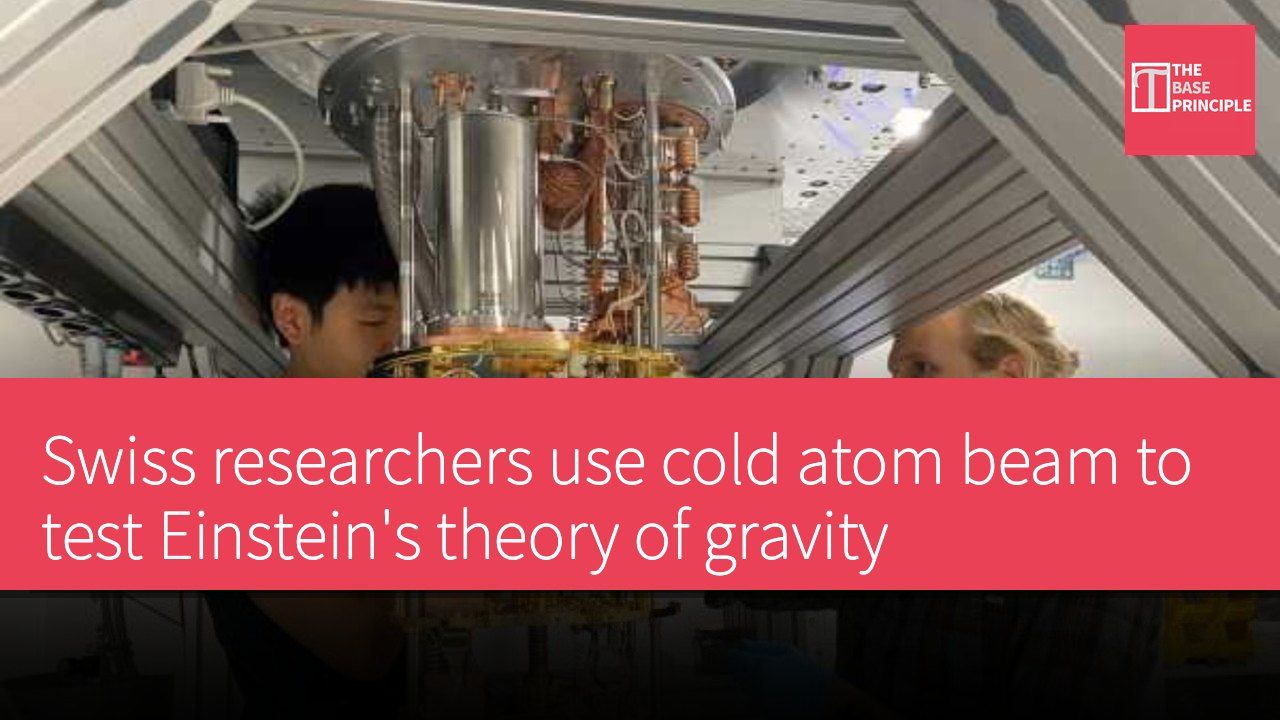
- Swiss researchers have successfully produced a cold atom beam, with plans to test Einstein's theory of gravity.
- Muonium is a second-generation particle, and researchers hope to measure how it falls under gravity.
- The challenge lies in muons' rapid decay, requiring the use of a quantum fluid to generate a stable stream of muonium atoms.
- Researchers plan to build an interferometer to detect gravity's effect on muons, which could point to a fifth force of nature.
Researchers at ETH Zurich and the Paul Scherrer Institute (PSI) in Villigen have successfully produced an intense beam of cold atoms, with plans to use it to test Einstein's theory of gravity. The cold atom beam is composed of muonium, an atom made of a second-generation antiparticle, and researchers hope to test its interaction with gravity to determine whether other as-yet-undiscovered forces of nature exist. The matter we see around us is made up of protons, neutrons and electrons, which scientists call first-generation particles.
Properties of muons and experimental challenges
The remaining two generations of particles are heavier but also unstable, rapidly decaying into first-generation particles. The muon is a heavier cousin of the electron among the second-generation particles. Researchers at PSI used a particle accelerator to successfully generate muons and their antiparticles; when an antimuon combines with an electron, it forms a neutral muonium atom. The researchers hope to measure how muonium atoms fall under gravity.
From Galileo to Newton and then Einstein, physicists have confirmed the universality of free fall. This equivalence principle holds that all objects in a gravitational field fall with the same acceleration regardless of their mass or internal structure. Einstein treated this principle as a foundational pillar of his famous theory of relativity, but it has so far only been tested with first-generation particles of matter and antimatter. Carrying out the measurement with muonium would be the first test on a second-generation particle. Muonium is well suited to the experiment because it is electrically neutral. By contrast, charged particles can be affected by stray magnetic fields, masking the subtle effects of gravity.
Future experimental plans
One major obstacle to conducting such an experiment is the rapid decay of muons. Because they decay within 2.2 microseconds, muons produced in earlier attempts also moved at different speeds, making the experiments difficult. Researchers at PSI used a quantum fluid to generate a stable stream of muonium atoms. PSI researcher Jessie Zhang explained in a press release: "We used superfluid helium at temperatures close to absolute zero (minus 273 degrees Celsius)." Superfluid helium is a quantum liquid in which individual helium atoms lose their identity and dislike impurities within the fluid. The antimuons generated in PSI's particle accelerator are fired into the quantum liquid, where they meet free electrons and form muonium atoms.
The positive chemical potential generated in this reaction pushes the muonium atoms toward the surface, and the chemical potential is converted into kinetic energy, causing them to shoot out of the liquid vertically.
The researchers now plan to build an interferometer that exploits the wave-like properties of muonium atoms to create an interference pattern for detecting gravity's effect on muons. The device may take two to three years to build, but once ready, it will answer a long-standing important question: does gravity act on exotic matter in a different way? If gravity does behave differently, it would point to the possibility of a fifth force of nature. For now, the team is focused on determining whether the equivalence principle applies to second-generation particles. The findings have been published in the journal Nature Physics.
Prospects and challenges of testing gravitational theory
Research on the cold atom beam is not only a challenge to Einstein's theory of gravity but also an important step toward exploring unsolved mysteries in physics. As second-generation particles, muons possess properties that make them ideal experimental subjects capable of providing new insights. The challenge researchers face lies in the rapid decay of muons, which requires innovative techniques to overcome. The future interferometer will help reveal how gravity affects different particles, and if the results show anomalies, they could change our understanding of the forces of nature and even introduce the concept of a fifth force of nature.