
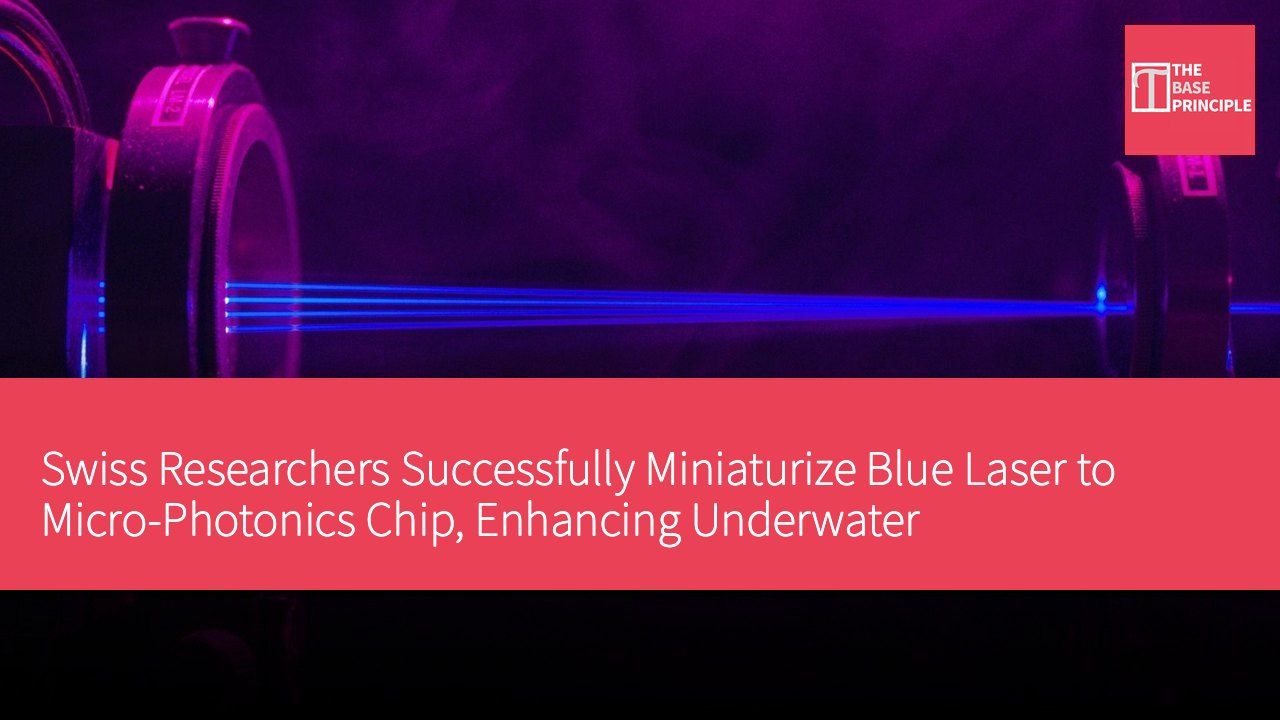
- Swiss researchers have successfully miniaturized a blue laser onto a micro-photonics chip.
- The blue device can maintain frequency variations below 30 kHz.
- Blue light propagates further in water, making it suitable for underwater communication systems.
- Research shows that blue lasers are highly sensitive to tiny air particles.
Researchers at the École Polytechnique Fédérale de Lausanne (EPFL) in Switzerland have successfully miniaturized a high-performance blue laser onto a micro-photonics chip without compromising its performance. The device can maintain an extremely stable light source, with frequency variations below 30 kHz, while rapid frequency changes can reach up to 900 MHz, allowing for adjustments of up to 1 million times per second. This breakthrough could facilitate the development of compact underwater communication systems, pollution sensors, and future quantum technologies. Blue light propagates further in water and is able to scatter more intensely from tiny air particles.
These characteristics offer multiple advantages over infrared systems currently used in modern optical communication systems. However, using blue light for these purposes requires precise control of the laser frequency. Researchers note that the laser must be stable enough to distinguish weak signals from background noise and capable of rapid changes to transmit data or perform sensitive measurements.
Advantages and Challenges of Blue Light
Existing systems that achieve this level of precision typically rely on bulky optical components, making them difficult to deploy outside laboratory environments. Constructing similar performance on a photonics chip, which guides light through micro-structures, is particularly challenging for blue wavelengths, as even minor manufacturing defects can scatter light and degrade performance. To address this issue, the EPFL team connected a traditional blue laser to a specially designed photonics chip containing a micro-ring resonator. This ring structure can filter light to precise frequencies and feedback some of the light to the laser, helping to produce a more stable beam, the researchers stated.
Additionally, during the experimental process, the thickness of the chip's light guiding structure was maintained at 25 nanometers to reduce optical losses. The team also incorporated aluminum nitride components, which slightly change shape when voltage is applied. These minor changes adjust the way light propagates within the ring, allowing the laser frequency to be electronically tuned at very high speeds. The resulting laser operates at a wavelength of approximately 461 nanometers. In one operational mode, it produces blue light with a linewidth below 30 kHz, demonstrating exceptional frequency stability. In another mode, researchers tuned the laser to over 900 MHz, repeating these adjustments up to one million times per second.
Experiments Demonstrate Blue Laser Performance
To showcase its powerful performance, the team tested the laser in two laboratory experiments. In the first experiment, they altered the laser frequency by encoding a digital image of the EPFL logo and transmitted the information through a 30-centimeter column of water. The receiving system successfully reconstructed the image, demonstrating the principles of underwater optical communication using this compact device. The team also conducted another experiment to detect candle smoke in the air. They found that the blue laser could clearly detect the smoke signal, while traditional infrared lasers failed to register measurable changes under similar conditions.
Researchers noted that although the test did not quantify particle levels, it demonstrated the higher sensitivity of blue light to tiny air particles. Based on these results, the researchers stated that this compact laser could ultimately support underwater communication systems, environmental monitoring instruments, and advanced technologies relying on highly stable blue light, such as atomic clocks and quantum computers. The related research findings have been published in the journal Nature Photonics.
Impact of Blue Laser Technology on Underwater Communication
Research from the École Polytechnique Fédérale de Lausanne indicates that blue lasers have significant advantages in underwater communication, as they can effectively propagate and maintain stability in water. This technological breakthrough not only enhances the potential of underwater communication systems but may also drive advancements in environmental monitoring and quantum technologies. The high sensitivity of blue light enables it to detect tiny signals in complex environments, which is of great significance for future technological applications.