
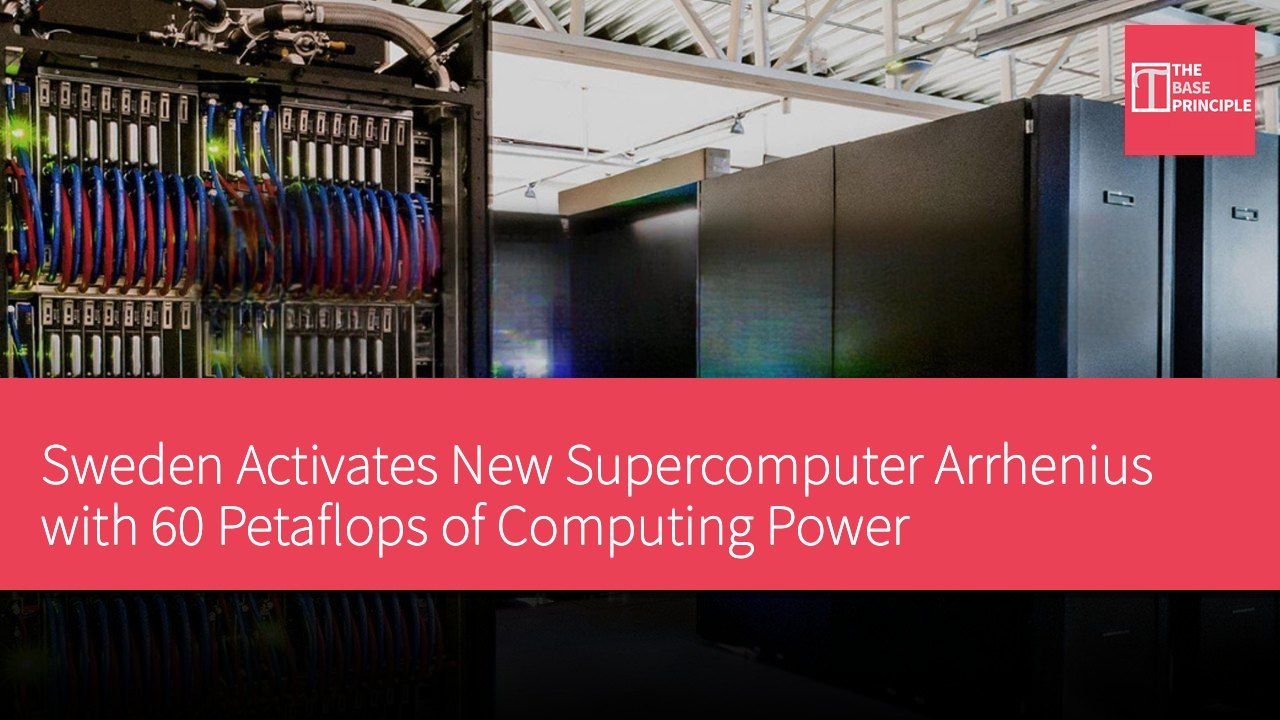
- Arrhenius supercomputer is located in Sweden and has a capacity of 60 petaflops.
- The system is classified as a mid-range supercomputer but boasts powerful performance.
- Arrhenius emphasizes security and data integrity, making it suitable for sensitive data research.
- The computer is a key component of Europe's push for computing sovereignty.
Europe has recently added a powerful new supercomputer named Arrhenius, located in Sweden, with a computing capacity of 60 petaflops—or over 60 billion billion operations per second. The supercomputer was officially inaugurated at Linköping University and will be available for use by researchers, businesses, and public sector organizations across Europe. It is designed to handle computationally intensive tasks across domains such as climate simulation, materials research, life sciences, engineering, and artificial intelligence.
Arrhenius Performance and Applications
Arrhenius is classified as a mid-range supercomputer, but its performance places it among the world's most powerful computers. In the TOP500 list released in June 2026, the system ranked 42nd. Its computing power is suited for workloads that are difficult or time-consuming to achieve on traditional computing systems. Researchers can use it to run complex simulations, analyze large datasets, and develop computationally intensive AI applications. Potential applications include climate modeling, materials science, drug discovery, life sciences, and engineering.
According to the EuroHPC Joint Undertaking, the system is designed with a focus on security and data integrity, enabling organizations to use it for proprietary product development and research involving sensitive personal data. Arrhenius is already being used by European researchers. Users gained early access through the EuroHPC AI for Science early access opportunity before the official inauguration, and now they can gain broader access through regular EuroHPC access applications as well as benchmarking and development modes.
The raw performance of modern supercomputers is just one metric of their capability. As computing systems grow in scale, the power consumption required to achieve that performance becomes increasingly important. According to EuroHPC data, Arrhenius delivers over 61 billion operations per watt, placing it 24th on the Green500 list, which ranks supercomputers by energy efficiency. The system was procured through a contract with HPE signed in July 2025, with an estimated total value of 68.5 million euros.
Approximately 35% of the cost was co-funded by the EuroHPC Joint Undertaking through the Digital Europe Programme, with additional contributions from the Swedish Research Council to the Swedish National Infrastructure for Computing (NAISS).
The Role in Promoting European Computing Sovereignty
The EuroHPC and NAISS jointly manage the system's usage rights. The system is not only an independent research computer for Sweden but also part of Europe's push for computing sovereignty. Arrhenius joins 12 other supercomputers procured by the EuroHPC Joint Undertaking, as Europe aims to establish a controllable and cross-border accessible computing infrastructure. Moreover, the program is also moving beyond traditional high-performance computing. EuroHPC is overseeing the implementation of 19 AI factories and 13 AI factory antennas across Europe and is developing a European quantum computing infrastructure to integrate quantum technology with traditional supercomputers.
The Swedish system is named after Swedish geologist and chemist Carl Axel Arrhenius, who discovered the mineral garnet in 1787. It was later found that garnet contains several unknown elements belonging to the rare earth element group. For European researchers and businesses, the urgent importance of this machine lies in its computing power. By providing tens of petaflops of processing power, Arrhenius offers scientists and industries another resource to tackle workloads that traditional computing cannot keep up with.
Item Specifications Computing Power 60 petaflops Energy Efficiency Over 61 billion operations per watt Procurement Contract 68.5 million euros
The Impact of Arrhenius on Research and Industry
The inauguration of the Arrhenius supercomputer marks a significant advancement for Sweden in the field of high-performance computing. Its powerful computing capabilities not only support complex scientific simulations but also meet the needs of businesses for data analysis and AI applications. As computing demands increase, the design of this computer also considers data security, providing assurance for research involving sensitive data. Furthermore, Arrhenius has become part of Europe's computing sovereignty plan, demonstrating Europe's ambition in the global technology competition.