
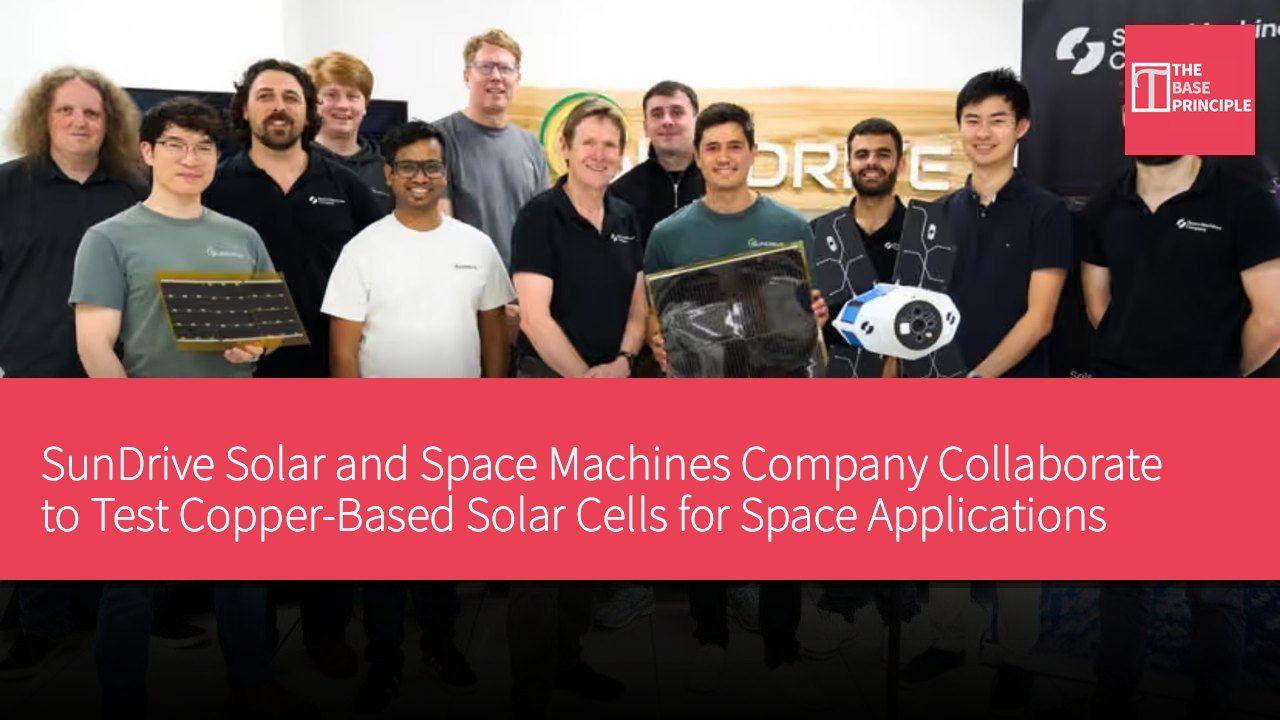
- SunDrive Solar collaborates with Space Machines Company to develop copper-based solar cells for space use.
- The solar panels must survive the harsh conditions of space while remaining lightweight.
- SunDrive's copper heterojunction cells offer advantages in efficiency and low cost.
- Both parties will jointly develop deployable solar cell arrays to serve future vehicle and satellite markets.
Australian solar technology company SunDrive Solar is testing and integrating its existing copper-based solar cell technology into space vehicles. To develop a product suitable for flight, the company has partnered with Space Machines Company (SMC), a space hardware and software manufacturer based in New South Wales. According to the collaboration agreement, both parties will focus on installing a series of solar panels on SMC's next-generation Optimus Viper spacecraft to meet its power needs.
The vehicle weighs approximately 440 pounds and is designed for autonomous operation in low Earth orbit.
Battery Challenges in Space Environment
Company officials noted that the solar panels must be able to survive the harsh conditions of space while remaining lightweight, which is a critical requirement for the equipment. Ian Partis, Vice President of Space Machines Company, stated, "A solar panel must withstand the vibrations of launch, vacuum, and extreme thermal cycling while remaining lightweight. This is precisely the challenge our structural, thermodynamics, and testing teams work on every day." To achieve this goal, SunDrive has chosen its copper heterojunction (HJT) cells, which are ultra-thin and lightweight, achieving an efficiency of 26.41% in previous Earth-based experiments.
Vince Allen, co-founder and Chief Technology Officer of SunDrive, stated that these characteristics are crucial in orbit, as every gram of solar panel weight affects the payload.
Cost-Effectiveness of Copper-Based Cells
The company's latest technology addresses the weight, cost, and efficiency issues of solar cells. Utilizing its proprietary direct copper plating technology, the Sydney-based company replaces silver used in traditional solar cells with widely available copper. Allen pointed out that copper costs about 100 times less per kilogram than silver, and its abundance is approximately 1,000 times that of silver. This enables the realization of high-efficiency, scalable solar cells while reducing reliance on critical materials.
The engineering teams from both parties began research and development work on the project last month. The first phase of the project is expected to be completed by April next year, which includes establishing prototypes of flight-ready solar panels. According to a press release, SunDrive will be responsible for the design of the solar cells and modules, while SMC will manage the structural design, testing, and integration with the Optimus Viper satellite model. Both parties will jointly develop a method to bond the solar modules to the solar panel substrate. In the future, they will focus on developing deployable solar cell arrays to serve SMC's future vehicles and the broader satellite market.
SpaceX has also acquired similar high-efficiency heterojunction (HJT) solar cell technology for its planned Starmind satellite network. The company signed a contract worth over $69 million with German equipment manufacturer SINGULUS TECHNOLOGIES on November 10 to establish production lines for these solar cells, with the first deliveries expected in the first half of 2027. The company stated that the production scale will support over 100 gigawatts (GW) of production capacity, but did not specify the capacity of the first production line.
Meanwhile, companies around the world are also exploring other lightweight and more efficient solar cell technologies to meet the demands of future space missions. In September of this year, American aerospace company Rocket Lab announced the production of its latest space-grade solar cells, which are completely free of germanium. This technology, named Inverted Metamorphic (IMM) Apex, claims to provide a starting conversion efficiency of 31.5% while reducing the mass of the cells by 40%.
Item Specification Solar Cell Technology Copper Heterojunction (HJT) Efficiency 26.41% Cell Weight Lightweight Design
Future Trends in Solar Cell Technology
As the demand for space missions increases, lightweight and high-efficiency solar cell technology becomes increasingly important. SunDrive Solar's copper-based cells not only address weight and cost issues but also operate in extreme environments, which is crucial for space missions. Additionally, other companies in the market are actively exploring new technologies, indicating that competition in solar cell technology is intensifying. This trend will drive innovation across the industry and could change the energy supply model for future space exploration.