
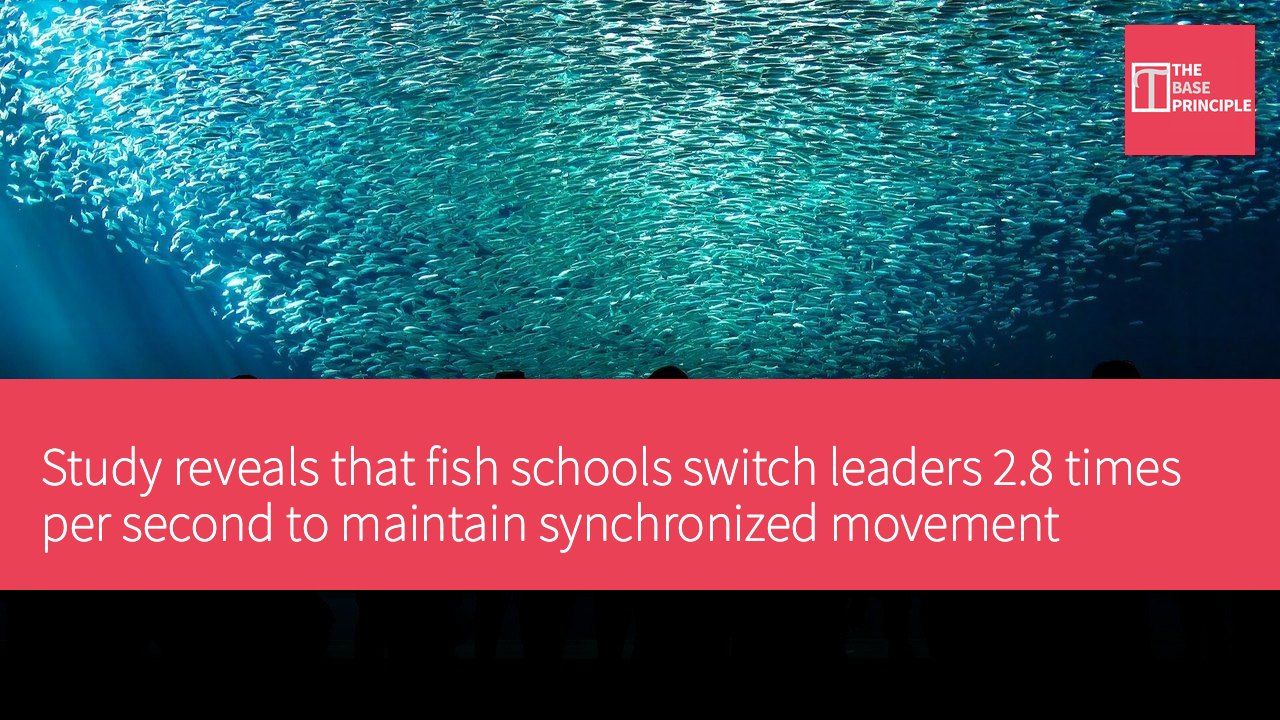
- The study found that fish schools switch leaders approximately 2.8 times per second to maintain synchronized movement.
- Coordinated movement in fish arises from local interactions rather than a fixed leader.
- The virtual fish setup made the behavior of real fish more cohesive.
- The research method has limitations, failing to simulate water flow and pressure disturbances.
In a virtual reality experiment, schooling fish switched the guidance of adjacent fish approximately 2.8 times per second, providing new insights into how fish maintain synchronization. To study coordinated movement in fish, researchers selected the well-known schooling species, the Rami nose tetra (Hemigrammus rhodostomus). The research team used a closed-loop virtual reality system that allowed real tetras to interact with digitally controlled fish. A projector displayed the images of the virtual fish on the walls of a 15-liter aquarium with a diameter of 52.2 centimeters.
A depth camera tracked the three-dimensional movement of the real fish. The researchers stated, "Collective movement in animal groups arises from local interactions, but how individuals choose and integrate social information remains poorly understood."
The research team programmed the virtual fish to respond to their one, two, or four most influential neighbors. They conducted eight one-hour experiments for each setup. The team compared swimming speed, distances between individuals, alignment, spatial organization, and turning behaviors. They found that coordination increased when virtual fish responded to more neighbors. The researchers noted, "The group became more cohesive, the trajectories of the fish became smoother, and the number of deviations from virtual subgroups decreased for the real fish." Although the virtual group became more cohesive when programmed fish responded to more neighbors, the analysis indicated that the behavior of real fish seemed to primarily track one most influential neighbor.
"Turning statistics provide a clear behavioral indicator that the dynamics of real fish are best explained when responding to a single most influential neighbor." This neighbor is not necessarily the closest fish.
How Fish Maintain Synchronization
As the fish move synchronously, the most influential neighbor continuously changes. The researchers recorded an average switching frequency of approximately 2.8 times per second. Between two consecutive spontaneous U-turns, about 40 changes occurred. The researchers pointed out, "The switching of influential neighbors reflects the ongoing spatial reorganization of the group, rather than a specific individual maintaining a continuous leadership period." Fish coordinate their movement by changing interactions rather than relying on a single leader. The researchers stated, "Social influences are continuously redistributed as individuals move relative to one another, creating a rapidly evolving network of interactions that still supports robust collective coordination."
Contrary to previous views, coordination does not necessarily require simultaneous integration of information from multiple neighbors.
Limitations of the Experimental Method
The researchers acknowledged limitations in their experimental method. While virtual fish visually responded to the movements of real fish, they did not produce water flow or pressure disturbances. The researchers explained that fish typically rely on multiple sensory pathways, such as visual cues, hydrodynamic signals, and pressure sensed through the lateral line system, when coordinating their schooling behavior. However, in the virtual reality setup, digital fish could only be perceived visually, as they did not generate water flow or pressure disturbances, which needs to be addressed in future experiments. The team hopes to conduct experiments with larger groups and incorporate the missing conditions into their models.
The research findings indicate that fish coordinate through continuously changing interactions rather than following a fixed leader. The results were published in PRX Life.
New Insights into Schooling Behavior
This study reveals behavioral patterns in fish during coordinated movement, challenging previous understandings of fixed leadership. The research shows that fish maintain group coordination through constantly changing social interactions, which has significant implications for understanding animal behavior and social structures. Additionally, the limitations of the experiment highlight the need to consider multisensory factors in future research, which will aid in a more comprehensive understanding of fish behavior and ecology.