
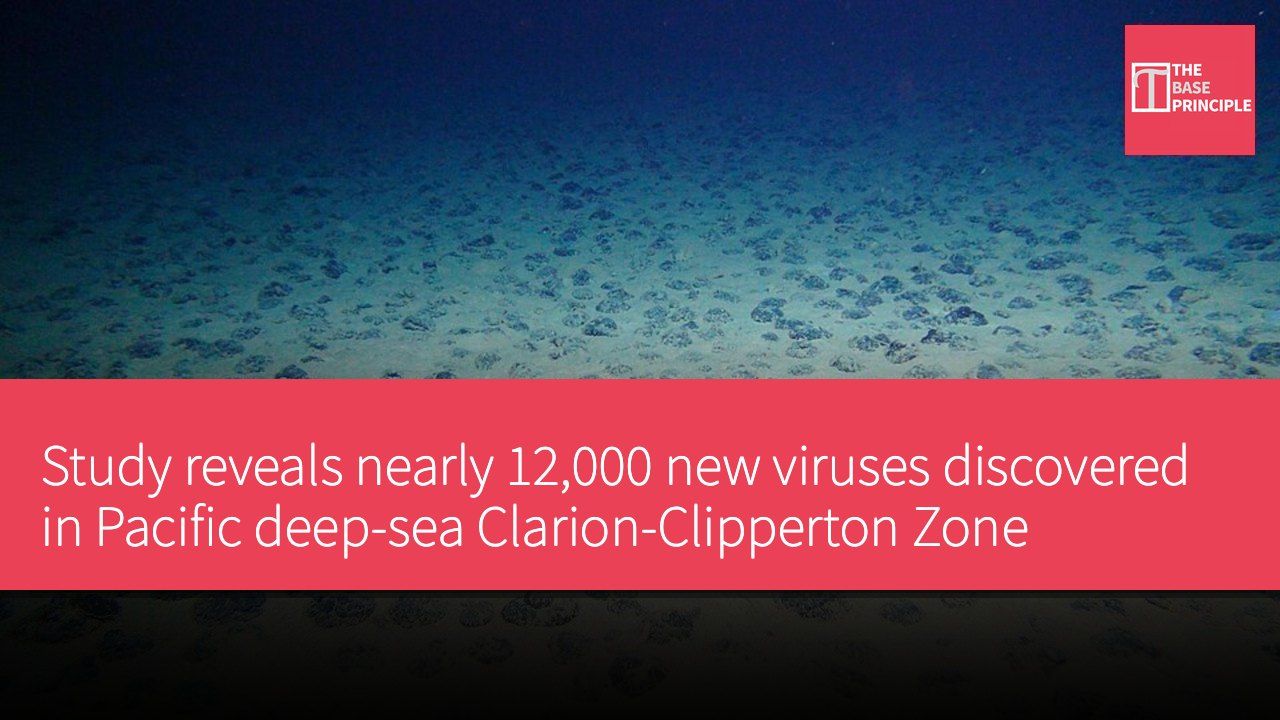
- Study reveals nearly 12,000 new viruses exist in the Clarion-Clipperton Zone.
- 99% of viruses were undiscovered in existing databases, showing extremely high viral diversity.
- Deep-sea viruses are crucial for ecosystem maintenance and microbial adaptation to metal toxicity.
- Mining activities may affect these viral communities and overall ecological balance.
A new study has revealed a vast and previously unknown viral diversity within the Clarion-Clipperton Zone (CCZ). The region lies in the deep Pacific, is rich in polymetallic nodules, and is the world's largest deep-sea mineral exploration area. In fact, 99% of the viruses discovered by researchers had never been seen before. Researchers from China analyzed seabed sediment samples, identifying 11,742 unique viruses, of which more than 99% (11,662) were entirely new to science and unique to this heavy-metal-rich, nutrient-scarce environment.
Environmental disturbance from potential commercial mining could affect these viral communities. The research team from Chongqing University stated in the paper: "Protein-sharing networks and phylogenetic analyses revealed extensive benthic viral diversity, with over 99% of viral populations unrepresented in existing reference databases."
Viral diversity and its significance
The Clarion-Clipperton Zone lies in the central Pacific, reaching depths of 6,000 meters (19,700 feet). The area is strewn with millions of potato-sized metal rocks. Deep-sea mining companies are targeting these metal-rich nodules to meet demand from the electric vehicle market. However, scientists are only just beginning to understand this ecosystem, which is also home to a variety of life. Several previous studies have pointed out that potential industrial operations could disrupt this complex and dark deep-sea ecosystem. This new study analyzed more than 60 sediment samples collected by the China Ocean Mineral Resources Research and Development Association.
Genetic comparisons showed that the region's deep-sea viral communities are almost entirely unique, with only 4% of protein clusters matching global databases. These viruses infect various deep-sea prokaryotes, driving critical cycles of carbon, nitrogen, phosphorus, sulfur, and metals.
Viruses influence host survival and regulate local metabolic processes through auxiliary metabolic genes and targeted infection. In addition, viral gene exchange helps microbes adapt to metal toxicity. All these benefits indicate that viruses play an important role in maintaining the nodule-field ecosystem. These deep-sea viruses pose almost no threat to human health. Most belong to the class Caudoviricetes, a group of tailed, syringe-like bacteriophages that specifically attack bacteria. These tiny deep-sea architects actively regulate microbial communities. Although the deep seabed is a nutrient-poor environment rich in toxic heavy metals, complex viral communities still actively sustain the ecosystem.
These viruses act as nutrient recyclers, releasing nitrogen and phosphorus by breaking down organic matter. They also serve as metabolic guides and stress managers. For example, some virus-encoded genes enhance bacterial survival and promote gene exchange, helping microbes adapt to extreme toxicity. If industrial mining machines disturb the seabed, these fragile biological networks could collapse. Massive sediment plumes could wipe out host bacteria, thereby halting the fundamental nutrient cycles that sustain the entire ocean. The International Seabed Authority has granted 17 exploration licenses in the Clarion-Clipperton Zone, five of which are held by China, whose researchers conducted this viral survey.
Pre-mining environmental impact assessment
As global demand for extracting lithium-battery metals such as cobalt, nickel, and manganese rises, the prospect of mining increases. Scientists insist that mapping these invisible viral networks remains crucial before any commercial dredging begins. These findings provide a pre-mining baseline for deep-sea microbial and viral ecosystems to guide future environmental impact assessments. The study was published in the journal Nature Communications.
Item Specification Depth 6,000 米
Fragility of the deep-sea viral ecosystem
The viral diversity of the Clarion-Clipperton Zone demonstrates the complexity and uniqueness of deep-sea ecosystems. These viruses not only play an important role in maintaining ecological balance but also help microbes adapt to extreme environments. As mining activities increase, these fragile biological networks may face threats, making it crucial to understand and protect these invisible viral networks before commercial mining proceeds. This study provides an important baseline for future environmental impact assessments, highlighting the necessity of scientific research for resource development.