
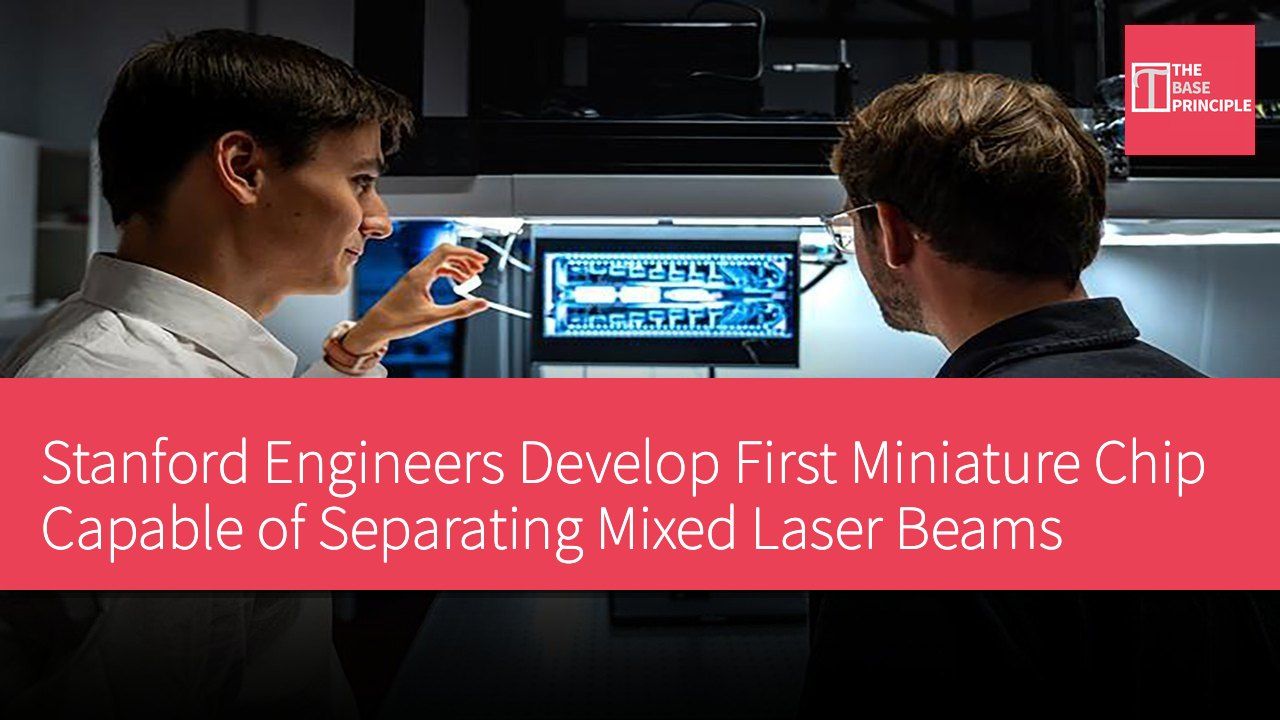
- Stanford University has developed a miniature chip that can separate mixed laser beams.
- The chip could facilitate the development of new communication, computing, and sensing technologies.
- The chip can learn the independent components of an unknown light field, referred to as coherent modes.
- It is currently collaborating with NASA to test whether the technology can detect light from distant galaxies.
Engineers at Stanford University and their colleagues have developed a chip the size of a fingernail that can separate mixed laser beams into distinct beams. The related research was published on October 30 in the journal Nature Photonics. Stanford University stated that this is the first time researchers have demonstrated that this device can handle partially coherent light, which is light waves that are only aligned for a brief period. Stanford electrical engineering PhD student Annie Kroo noted that laser beams are coherent, with their photons oscillating together, while light emitted from a bulb is incoherent, with photons out of sync.
Co-author Charles Roques-Carmes, an assistant professor at the Institute of Science and Technology Austria (ISTA), mentioned that the true nature of light is partially coherent. He stated that researchers hope to separate this mixed light into independent parts, which could promote the development of new communication, computing, and sensing technologies.
Basic Concept and Technology of the Chip
Kroo mentioned that this basic concept dates back to the 1980s but has never been tested experimentally. The team directed two beams of infrared laser light into a photonic chip, which can guide light for data processing, similar to how a laptop chip guides electrons. Stanford University pointed out that the combined beams are partially coherent, and the chip's algorithms separate them into independent outputs. The paper measures this process in terms of the visibility of disappearing fringes. In a test with a different circuit, adding a third laser beam was also successful. Co-author Paul-Alexis Mor, an academic visitor at ISTA, stated that the output results showed "no correlation at all."
Stanford professor Shanhui Fan noted that the chip can learn the independent components of an unknown light field, referred to as coherent modes, and send each mode to its respective output.
Potential Applications of the Chip
Stanford University stated that in recent years, photonic chips have become increasingly smaller and more powerful, but controlling the internal operations of light remains quite challenging. According to Stanford, cameras compress light into two-dimensional images, which often causes overlapping light sources to blur together. When observed under a microscope, two overlapping fluorescent particles may appear as one. Kroo pointed out that this chip could, in principle, distinguish them, as light itself carries signals from different sources. Notably, the tests mentioned in the release used infrared lasers rather than starlight or microscope samples, and imaging applications are considered a potential use.
According to the paper, the chip is adjusted by a feedback loop that runs external control electronics. The paper describes a nine-input chip capable of separating the two strongest light components from two laser beams. The authors reported that the cross-interference, or the degree of light leakage between outputs, was as low as -13 decibels. The paper notes that the chip can only recover the original lasers when the light beam patterns of the two lasers are orthogonal in space, meaning mathematically independent. Stanford's Kroo, David Miller, and Olav Solgaard are currently collaborating with NASA to test whether this technology can detect light from distant galaxies.
Stanford noted that light appearing as a single spot in a telescope may contain independent beams from stars and exoplanets.
Innovation and Future Prospects of Miniature Chip Technology
The development of this miniature chip marks a significant breakthrough in photonic technology, capable of effectively separating mixed laser beams, which has not been experimentally validated in the past. With the increasing demand for communication and computing, the potential applications of this technology are vast, particularly in enhancing the performance of optical imaging and sensing systems. Furthermore, the collaboration with NASA highlights the technology's potential applications in astronomy, possibly providing new methods for exploring independent light sources in the universe.