
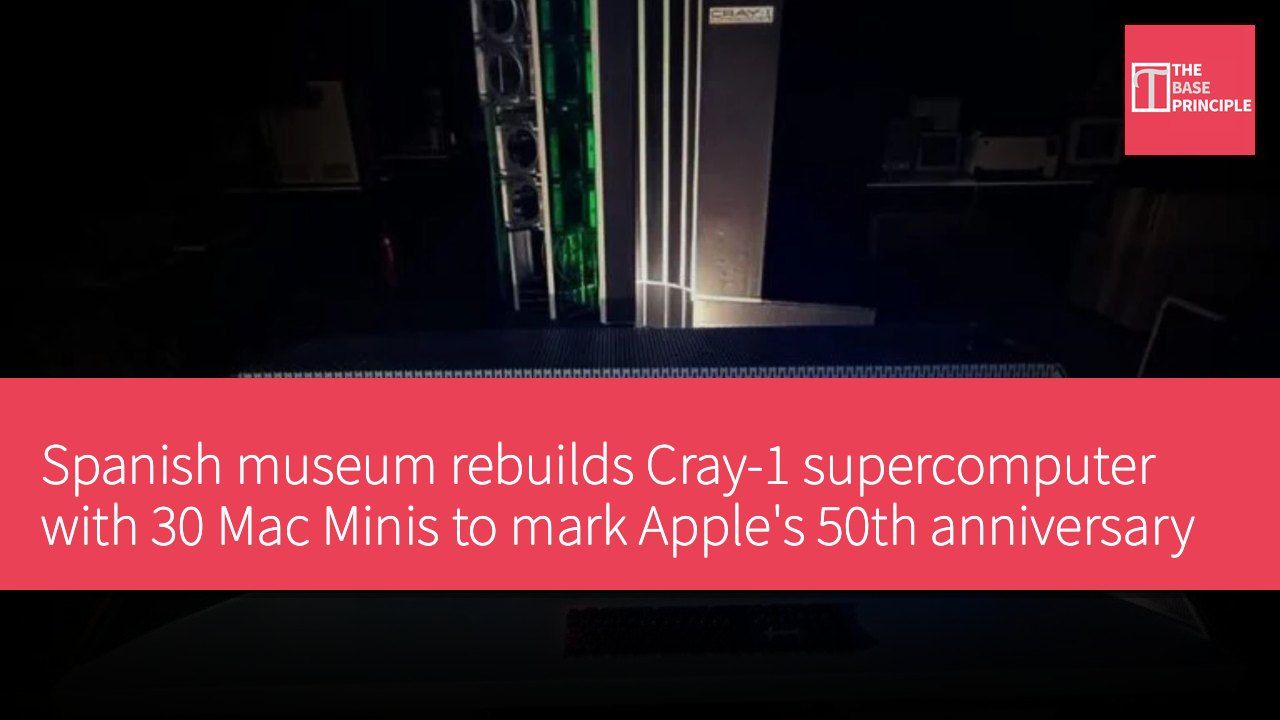
- Spanish museum rebuilds Cray-1 supercomputer with 30 Mac Minis to mark Apple's 50th anniversary.
- Modern chips far exceed the Cray-1 in computing power, but a single chip still falls short of its performance.
- The Cray-1 introduced vector processing technology, enabling efficient parallel data processing.
- The museum chose macOS as the system to demonstrate the Cray-1 replica's computing capabilities.
To mark Apple's 50th anniversary and the debut of the Cray-1 supercomputer, the Spanish Computer History Museum has unveiled a Cray-1 replica rebuilt from 30 Mac Minis. The project took 18 months and is now open to the public. At first glance, the idea of building a supercomputer from vintage chips might seem rather pointless. However, it is worth noting that the world's first commercially successful supercomputer, the Cray-1, was commissioned at Los Alamos in 1976.
Today's chips show a vast gap in computing power compared to those released a decade ago. Extending that gap across fifty years, per Moore's Law, makes the point even clearer. Even though a single modern chip still falls short of the Cray-1, the difference becomes apparent when the chips from 30 Mac Minis from 2012-14 are combined.
Comparison of modern chips with the Cray-1
The museum team procured 25 dual-core i5 units and 5 quad-core i7 units, giving the replica a total computing capacity of 1.5 TeraFLOPS. The original Cray-1 had a peak capacity of just 160 MegaFLOPS. That is still 9,375 times the original supercomputer's capability, illustrating how powerful chips have become over the years. Nevertheless, the Cray-1 remained a highly popular system in its day, with more than 80 units sold, favored by scientific and engineering institutions seeking to process massive datasets for accurate predictions in fields including weather forecasting, aerodynamics, and even nuclear physics.
The key to its efficient data processing lay not only in hardware but also in how it handled data. The Cray-1 introduced vector processing technology, enabling parallel data processing and saving precious time by avoiding the sequential processing of computers at the time.
Replica's cooling design
Looking back to 1976, the Cray-1 supercomputer used a large refrigeration pipe network connected to a 20-ton refrigeration compressor in another room for cooling. For this replica, however, the museum's designers adopted a passive cooling approach, using aluminum trays and a steel chassis to create a vertical convection tower for heat dissipation. This passive method eliminated the need for any mechanical fans, making the replica run extremely quietly. The only noise in the system comes from the Ethernet switch at the bottom, but the team plans to replace it with a silent model soon.
The team chose Apple's macOS Mojave (10.14) as the distributed system rather than relying on Linux, because macOS allows nodes in the cluster to pass tasks to one another. Museum visitors can also watch the Cray-1 replica run matrix algorithms and see demonstrations between single-core and full-suite modes to showcase its computing capabilities.
Custom terminal design
The design team also built a custom terminal that looks like a relic from the 1970s but embeds a Mac Mini to connect with other cluster nodes. The original plan included a CRT display, but it was ultimately replaced by a flat-panel display offering simpler connectivity. The museum may have cut corners in the process, but to ensure the Cray-1 replica makes the TOP500 supercomputer list, it will undoubtedly spare no effort. That would likely require adding another 70 to 80 Mac Minis, which should not be too difficult to obtain.
Item Specification Computing power 1.5 TeraFLOPS Original Cray-1 peak capacity 160 MegaFLOPS Processor configuration 25 dual-core i5 + 5 quad-core i7
Technical significance of rebuilding the Cray-1
The Spanish museum's Cray-1 replica is not only a tribute to Apple and supercomputer history, but also showcases the progress of modern technology. Although modern chip performance has improved dramatically, the passive cooling design and choice of macOS used in the rebuild demonstrate a deep understanding of computer architecture and operational efficiency. Moreover, the museum's efforts are not only educational for the public but may also inspire future technological innovation, prompting people to rethink the development history of computer technology.