
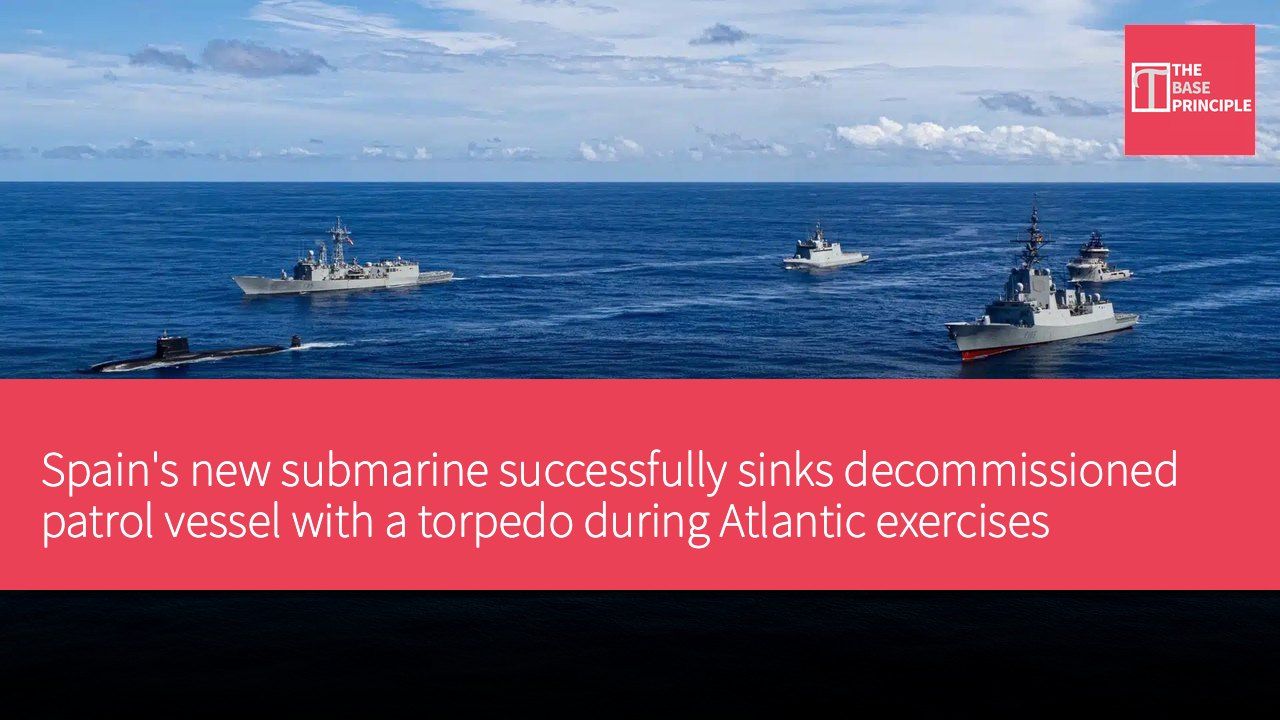
- Spain's submarine Isaac Peral successfully sank a decommissioned patrol vessel, showcasing its stealth strike capabilities.
- During the exercise, the submarine launched a torpedo against an unarmed vessel, demonstrating successful weapon deployment.
- The SINKEX-26 exercise evaluated naval coordination and weapon readiness, with diverse participating forces.
- Isaac Peral is the first operational submarine of Spain's S-80 program, holding significant importance.
Spain's latest submarine, Isaac Peral (S-81), successfully sank a decommissioned patrol vessel with a torpedo during live-fire exercises in the Atlantic, demonstrating its stealth strike capabilities. The exercise, conducted in November 2026, is significant for Spain's S-80 submarine program, proving that its first operational submarine can successfully attack surface targets in coordinated naval exercises. The Spanish Navy (Armada) stated on social media platform X, "Mastering the underwater environment and controlling the oceans are essential tools for enhancing deterrence and ensuring maritime security."
However, sinking an unarmed decommissioned vessel is fundamentally different from defeating a modern warship equipped with detection systems, defensive weapons, and countermeasures. This exercise showcased successful weapon deployment rather than combat effectiveness against an actively defending adversary.
Analysis of Combat Effectiveness in the Exercise
How did the submarine successfully sink its target? The engagement took place during the SINKEX-26 exercise, which aimed to assess weapon and crew readiness as well as coordination between naval and air forces. The target was Infanta Elena, a decommissioned offshore patrol vessel. Isaac Peral launched a torpedo, successfully sinking the vessel. The Spanish Navy announced the result on November 4, 2026, but did not disclose specific details regarding the engagement date, launch distance, launch depth, or torpedo type.
The participating forces in this exercise extended beyond the submarine itself, including the ships Cristóbal Colón and Navarra, the support vessel Carnota, the patrol vessel Relámpago, and a mine operations diving unit. Aerial participants included three AV-8B Harrier fighter jets, one naval helicopter, one ScanEagle drone, and one maritime patrol aircraft from the Spanish Air and Space Force.
Rafael Mira Calvo, commander of the 41st Escort Squadron, led the operation from the Navarra. This joint exercise allowed the navy to assess the cooperative operational capabilities of different military units.
However, it remains unclear whether other units provided target information to Isaac Peral or how the participating aircraft supported the torpedo attack. Environmental protection measures were also part of this operation. Prior to the exercise, Infanta Elena underwent decontamination to remove fuel, oils, and potential pollutants. Authorities also assessed and monitored the exercise area to protect marine mammals and civilian navigation.
SINKEX-26 is not the first instance of Isaac Peral launching a torpedo. The Spanish Navy recorded a torpedo launch during the SINKEX-25 exercise on June 15-16, 2025, which aimed at crew training and weapon assessment. Additionally, Spanish broadcaster Cadena SER reported on June 25, 2025, that the submarine had completed its first live torpedo launch. Other submarine torpedo launch demonstrations have also highlighted the evolving capabilities of underwater weapon platforms.
The Navy's weapon inventory for Isaac Peral includes the SeaHake Mod. 4 torpedo, designed to attack surface ships and submarines. However, it has not been confirmed whether this particular sinking utilized that model.
Isaac Peral is significant as it was built by Spanish shipbuilder Navantia and is the first of four conventional submarines under the S-80 program, which aims to develop a new generation of submarines for the Spanish Navy. The submarine was delivered to the Spanish Navy on November 30, 2023, measuring approximately 80.8 meters in length and displacing around 3,000 tons. It is equipped with six torpedo launchers and has a core crew of 32 personnel. Its sister submarine, Narciso Monturiol (S-82), has also entered the sea trial phase.
As operational experience grows, the submarine completed a month-long deployment in the Mediterranean in March 2026, participating in NATO's Noble Shield operation, with over 446 hours submerged and covering more than 2,043 nautical miles.
Future Capability Challenges for the Submarine
Currently, a crucial capability is still missing from its configuration: the BEST air-independent propulsion (AIP) system planned under the program. This system generates hydrogen from bioethanol and oxygen, using fuel cell technology to produce electricity underwater, reducing the need for the submarine to surface or use a periscope for recharging. Isaac Peral is expected to receive AIP during its first major maintenance. For Spain, SINKEX-26 adds a specific weapon achievement to the operational record of its latest submarine. However, the exercise leaves an important question unanswered: how would Isaac Peral perform against a modern warship actively seeking and defending itself?
Item Specifications Length 80.8 meters Displacement 3,000 tons Core Crew 32 personnel
Significance and Challenges of Submarine Exercises
The successful sinking exercise of Isaac Peral holds significant importance for the Spanish Navy, demonstrating the submarine's potential in stealth strikes. However, this exercise only targeted unarmed objectives, failing to adequately assess the submarine's performance against the defensive capabilities of modern warships. As the development of the next generation of submarines progresses, integrating advanced technologies such as air-independent propulsion systems will be key to enhancing submarine operational capabilities.