
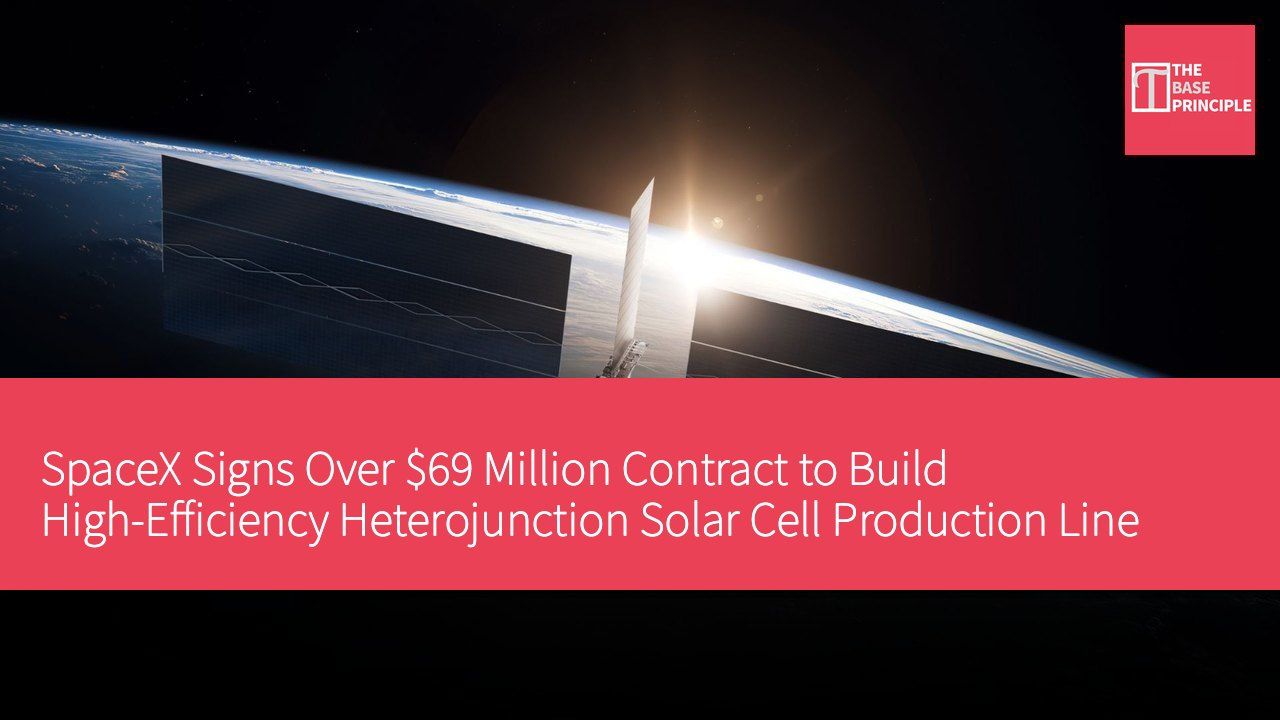
- SpaceX has signed a contract worth over $69 million with SINGULUS to build an HJT solar cell production line.
- The first production line is expected to be delivered in the first half of 2027, supporting the Starmind satellite network.
- Elon Musk stated that the order is for HJT solar manufacturing equipment with a capacity of 100 GW per year.
- This collaboration will leverage SINGULUS's manufacturing expertise to enhance SpaceX's battery production capabilities.
SpaceX has signed a supply agreement worth over $69 million with German equipment manufacturer SINGULUS TECHNOLOGIES to establish a production line for high-efficiency heterojunction (HJT) solar cells, providing a manufacturing pathway for its planned Starmind satellite network. The first turnkey production line is expected to be delivered in the first half of 2027. This agreement is part of a broader strategic partnership, under which SINGULUS will provide multiple additional production lines as SpaceX accelerates satellite manufacturing in Bastrop, Texas.
SINGULUS disclosed the contract on November 10, stating that the collaboration will involve the development of high-performance solar cells and the equipment needed for their production. The company noted that production will expand to support over 100 gigawatts (GW) of manufacturing capacity, although it did not specify the output capacity of the first production line.
Collaboration Details and Production Capacity
SpaceX CEO Elon Musk later clarified the scale of the order on the X platform, stating that the company has ordered HJT solar manufacturing equipment from SINGULUS in Germany with a capacity of 100 GW per year. He linked this order to Starmind, describing its ambition as creating a "sentient sun." Mike Nicolls, Senior Vice President of SpaceX Starlink, stated that this partnership provides a manufacturing pathway for solar cells for its Starmind satellites.
HJT technology combines crystalline silicon wafers with thin-film amorphous silicon in internal manufacturing, which helps reduce charge loss on the wafer surface and improves the ability of the cells to convert sunlight into electricity. Manufacturing these cells requires multiple processes, including wafer cleaning, thin-film deposition, and thermal treatment.
SINGULUS develops equipment for these stages, integrating wet chemical processing with vacuum coating technologies such as physical vapor deposition (PVD) and plasma-enhanced chemical vapor deposition (PECVD). SpaceX has ordered HJT solar manufacturing equipment from SINGULUS in Germany with a capacity of 100 GW per year to support Starmind's goal of creating a sentient sun. The company's production platform aims to achieve Qualcomm-level solar cell manufacturing. The company stated that its equipment supports HJT and other crystalline silicon cell technologies, including TOPCon and interdigitated back contact designs.
Technology and Manufacturing Expertise
This agreement grants SpaceX access to SINGULUS's manufacturing expertise while establishing a pathway for battery production at its Texas facility.
Currently, the two companies have not disclosed the planned efficiency of the batteries or the capacity of the first production line. SpaceX's Starmind initiative focuses on satellites equipped with computational loads that utilize solar energy generated in orbit. The specifications released for the AI1 satellite describe a deployment height of 30 meters, a wingspan of 75 meters, and a computational load that can peak at 250 kilowatts, averaging 175 kilowatts. According to SpaceX, these satellites are designed to operate in geostationary orbit and transmit data to the ground via laser links, connecting with the Starlink network.
The planned network is quite extensive. In its 2026 securities filing, SpaceX outlined its long-term ambition to deploy up to 100 GW of energy to orbit annually. The company stated that achieving this level would require thousands of launches each year while noting that it could establish a commercially viable business at a relatively lower deployment rate.
SINGULUS indicated that its strategic collaboration with SpaceX began in March 2026. During that month, SpaceX provided significant funding to the German company and again financed it in October through a subordinated guarantee loan. The first production line is expected to be delivered in the first half of 2027 as SpaceX prepares to expand satellite manufacturing in Texas.
Significance of the Strategic Collaboration Between SpaceX and SINGULUS
This collaboration not only strengthens SpaceX's capabilities in solar cell manufacturing but also provides critical support for its Starmind satellite initiative. The application of HJT technology can effectively enhance the conversion efficiency of the cells, which is crucial for satellites operating in orbit. As SpaceX deepens its reliance on solar energy, this partnership will foster innovation in solar technology and may change the way future satellites are powered.