
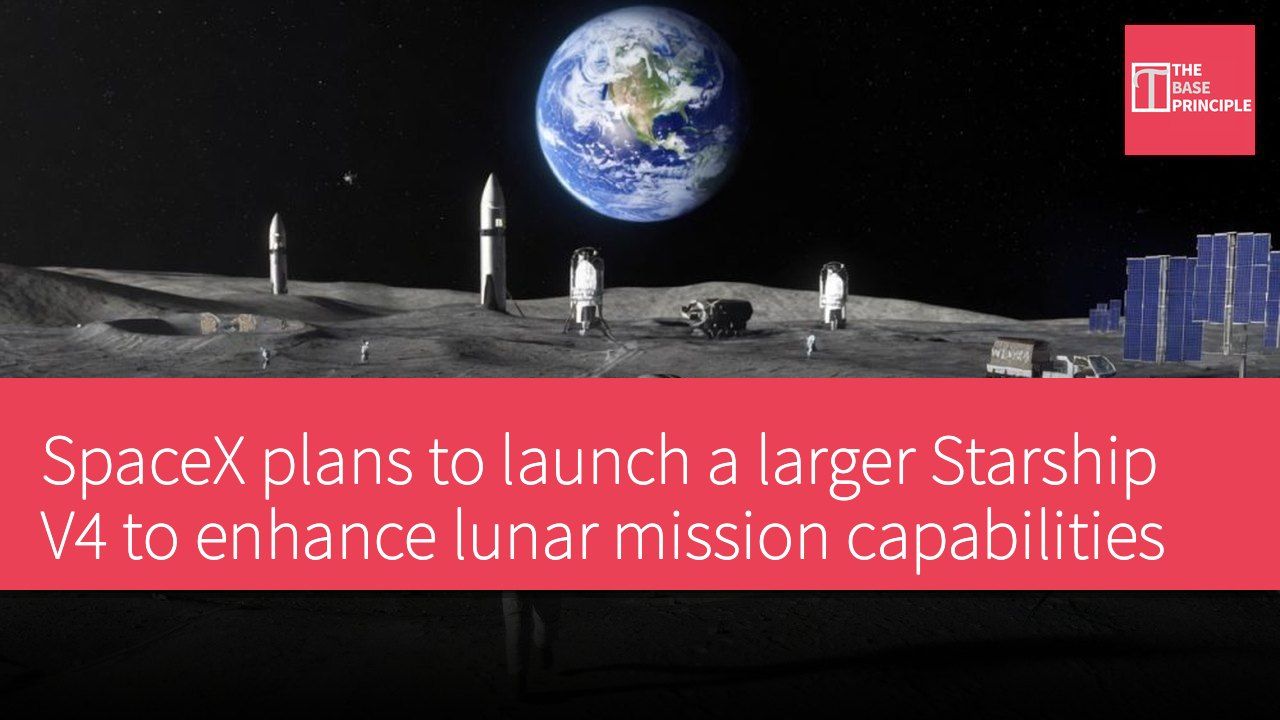
- The Starship V4 will be about 70 meters longer than the current model, an increase of approximately 40%.
- The V4 will increase to 9 engines, adding 3 new Raptor-Vacuum engines.
- Each V4 flight can carry over 200 tons of propellant, reducing the number of lunar resupply launches.
- SpaceX plans to begin cargo flights to the lunar surface in 2028.
Elon Musk of SpaceX recently revealed that the next-generation Starship V4 will be approximately 70 meters longer than the current model, representing about a 40% increase in length, and will be able to carry over 60% more propellant. He stated on social media platform X that the V4 will increase to 9 engines, adding 3 higher-thrust Raptor-Vacuum engines. The current V3 model stands at about 52 meters tall and is equipped with 6 Raptor engines, with 3 designed for sea level and the other 3 for vacuum conditions.
The V4 will be longer in design and will double the number of vacuum engines.
Design and Functionality of Starship V4
Musk first mentioned in August 2025 that the V4 would add 3 engines and would be a "significantly longer spacecraft," with flights expected to begin in 2027. This article provides the most detailed description of the spacecraft to date. Future payload capacity enhancements will become a focal point for the entire industry. SpaceX noted in its initial public offering prospectus that the V3 model is expected to deliver about 100 tons of payload to orbit, while future models are anticipated to reach 200 tons, with the V4 model potentially achieving this even sooner.
For comparison, the reusable Falcon 9 rocket has a payload capacity of about 17 tons to low Earth orbit. The implications for lunar missions could be even more profound. Each Starship lunar mission relies on a series of tanker flights in orbit to fill propellant storage before launching the lander. Last month, a NASA safety team member estimated this number to be about 22 flights, while Musk countered that it is actually more like "6 to 8," as reported by Teslarati.
This discrepancy largely depends on which spacecraft is conducting the delivery.
Impact on Lunar Missions
Musk stated that the V4 tanker can carry over 200 tons of propellant per flight, which could reduce lunar resupply missions to five or six launches. Fewer tanker flights needed for each landing means more landings can occur each year. SpaceX has announced that it will begin cargo flights to the lunar surface starting in 2028, with a price of $100 million per ton, while the Starship lander can deliver up to 100 tons of cargo to the lunar surface. In February of this year, Musk indicated that SpaceX has shifted its focus to "building a self-sustaining city on the Moon," which he believes can be achieved within 10 years, as reported by Teslarati.
The NASA Artemis IV landing plan aims for 2028, and the White House has called for the construction of a permanent lunar outpost to begin by 2030. Musk pointed out that all plans require reusable spacecraft, and Ship 42 will be critical. He spent part of Sunday inspecting the spacecraft that was captured on Saturday. He stated, "I just checked the entire thermal protection system of the Starship, and it looks really good overall. The engines are also in good shape. Ship 42 may only need a few weeks of repairs to be ready for flight."
He added, "A lot of minor repairs are needed to meet the immediately reusable standard (like an aircraft)."
SpaceX has never flown a spacecraft again after its initial flight. The re-flights of its two boosters were months apart, so a re-flight of Ship 42 within weeks would be a first for the program. Flight 15 has already demonstrated that the spacecraft can complete a full orbital mission and return to the launch pad, as reported by Teslarati on Saturday.
Item Specifications Length About 70 meters Number of Engines 9 Payload Capacity 200 tons (anticipated)
Impact of Starship V4 on Future Space Exploration
The launch of Starship V4 will significantly enhance SpaceX's capabilities in space transportation, particularly for lunar missions. With improved propellant transport efficiency, this will not only reduce the number of launches but also accelerate the construction of lunar bases. The self-sustaining city concept mentioned by Musk, if realized, will have profound implications for human space exploration and the future development of lunar ecosystems. Additionally, NASA's Artemis program will benefit from these technological advancements, further promoting human presence on the Moon.