
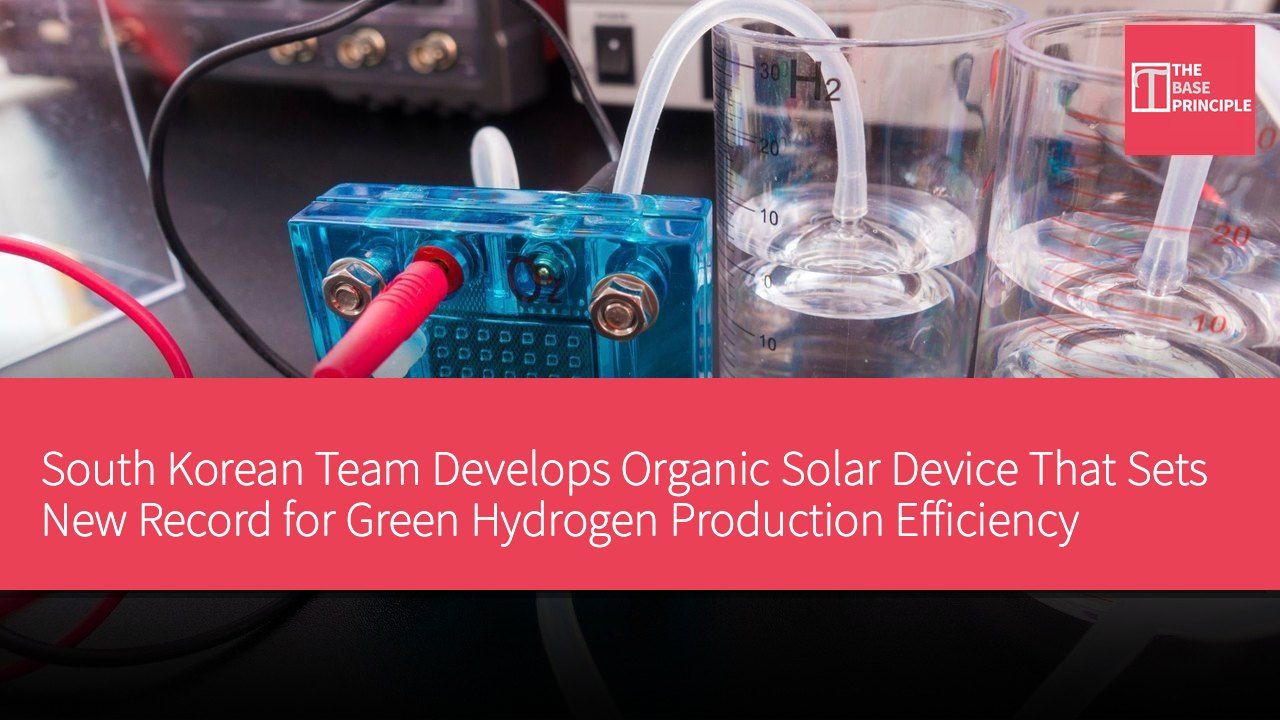
- The device developed by the South Korean team can autonomously split water molecules to produce green hydrogen.
- This device has set a new record for solar-to-hydrogen efficiency without requiring external power support.
- The new hybrid layer material improves the stability and performance of the device.
- This technology has the potential to lower hydrogen production costs and promote the development of renewable energy.
Scientists have discovered a method to produce clean green hydrogen using only sunlight and water. A team from South Korea has developed a solar-powered device capable of autonomously splitting water molecules. This technology has set a world record for the efficiency of organic water-splitting devices and requires no external power supply. Traditional hydrogen production relies on natural gas, a process that releases carbon dioxide. Therefore, the solar-powered device offers a truly zero-emission alternative. However, such devices face challenges in generating sufficient voltage autonomously and typically require external power support.
"Photoelectrochemical (PEC) water splitting provides a direct route to solar hydrogen, but organic semiconductor-based photoanodes are limited by insufficient photovoltage and interface instability," the researchers stated in their study.
Addressing the Bottleneck of Photoanodes
The research team at Ulsan National Institute of Science and Technology (UNIST) is currently attempting to address this bottleneck. The researchers designed a tandem device that stacks two layers of light-absorbing materials. In laboratory tests, the miniaturized battery achieved a solar-to-hydrogen efficiency of 7.9%, marking the highest recorded data for organic semiconductor photoanodes without applied voltage. The decomposition of water requires a minimum voltage threshold of 1.23 volts. Single-layer organic materials cannot stably reach this target. Previously, stacking two layers to enhance voltage led to rapid degradation.
Standard connector material PEDOT:PSS is highly acidic and susceptible to water, meaning it quickly damages adjacent components.
New Materials Enhance Device Performance
The UNIST team replaced this corrosive connector with an entirely new hybrid layer. They combined molybdenum oxide with an organic molecule called 2PACz. Molybdenum oxide is neither acidic nor prone to moisture absorption, while forming a protective barrier that prevents liquid solvent leakage during the coating process. At the same time, 2PACz molecules can smooth out microscopic defects, allowing charges to flow freely. "The final tandem photoanode achieved an initial potential of 1.67 V vs. RHE and a solar-to-hydrogen (STH) efficiency of 7.9% under two-electrode operation without applied external voltage, which, to our knowledge, is the highest reported data for organic semiconductor-based photoanodes without external bias," the study added.
Commercial Potential and Cost Reduction
After 10 hours of continuous operation, the device retained 86% of its initial photocurrent, while the performance of traditional designs dropped to 36%. This technology has already surpassed the laboratory phase. The researchers assembled an outdoor module with an area of 320 square centimeters, successfully producing hydrogen under natural sunlight. To reduce costs, engineers significantly minimized the use of precious metals. The platinum content on the hydrogen electrode was reduced to just 0.1%, while the counter electrode relied on an affordable nickel-iron-cobalt catalyst. Since both sides operate in the same chemical bath, this setup completely avoids the need for expensive ion exchange membranes.
Economic models indicate that if the device can achieve its theoretical efficiency limit of 16% at scale, the production cost of hydrogen could drop to US$4.26 per kilogram (approximately HK$33). Meanwhile, researchers at Nanyang Technological University in Singapore are pushing solar fuel production in an exciting new direction. Their blade-inspired device extracts hydrogen directly from seawater using sunlight while neutralizing a toxic industrial chemical: hydrazine. These two breakthroughs demonstrate that solar-driven chemical technologies are rapidly evolving from a fragile concept into practical industrial tools.
Breakthroughs in Organic Solar Devices and Future Prospects
The research achievements of the South Korean team indicate significant progress in hydrogen production using organic semiconductor solar devices. This not only addresses environmental issues in traditional hydrogen production processes but also showcases the potential of new materials to enhance device performance. As the technology matures, these innovations could lower hydrogen production costs and promote the widespread adoption of renewable energy, holding significant implications for the future transformation of energy structures.