
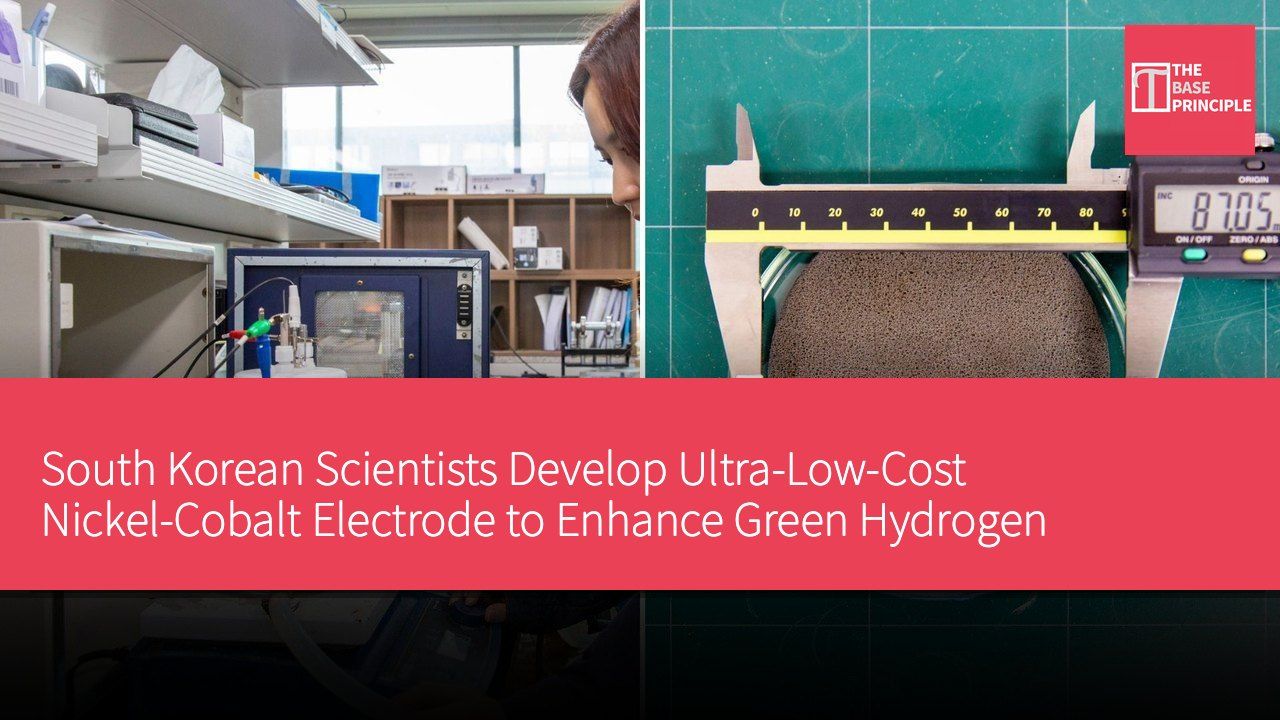
- South Korean scientists have developed a platinum-free nickel-cobalt electrode to enhance green hydrogen production efficiency.
- The new electrode demonstrates world-class performance and durability in alkaline water electrolysis.
- The technology achieves hydrogen production at overpotential, showcasing top-tier performance.
- The future electrode could operate alongside solar and wind power plants.
South Korean scientists have developed a new ultra-low-cost component for producing green hydrogen from water and electricity. The Korea Institute of Energy Research (KIER) has created a platinum-free nickel-cobalt electrode that effectively conducts alkaline water electrolysis. This non-precious metal Ni/Co heterostructure electrode enhances the performance of alkaline water electrolysis while reducing costs. This advancement has the potential to eliminate a major economic barrier to the global expansion of green energy. Dr. Kang Kyung-soo, the chief researcher at KIER, stated, "This research demonstrates that non-precious metal electrodes can achieve world-class performance and durability in alkaline water electrolysis."
The key to reducing hydrogen costs lies in the simplicity of water electrolysis. By applying an electric current to water, water molecules are split, capturing pure hydrogen with zero carbon emissions. However, in practice, especially in large-scale alkaline systems, the reaction rate is relatively slow. Under alkaline conditions, the time required to split water molecules exceeds that in acidic environments by over 100 times. To accelerate the reaction, industrial electrolyzers typically use precious metals. Platinum costs about US$58 per gram (approximately HK$452), while ruthenium is about US$54 per gram (approximately HK$421). Given the scale of factories, this makes large-scale production economically unfeasible. The KIER team ultimately decided to completely forgo platinum, opting instead for nickel and cobalt, priced at US$0.02 per gram (approximately HK$0) and US$0.05 per gram (approximately HK$0), respectively.
Technical Advantages of the New Electrode
How do inexpensive metals surpass platinum? This is due to their intelligent architecture. The team created a dual-component heterostructure that pairs nickel oxide and nickel-cobalt alloy on the same electrode surface. Each component handles different stages of the reaction. Nickel oxide acts as a chemical catalyst, rapidly splitting water molecules during the initial slow dissociation step, while the Ni-Co alloy is used to combine the released hydrogen ions into usable fuel gas.
Performance results demonstrate the potential of this technology. The electrode achieved equivalent hydrogen production at an overpotential of just 22.7 mV, which is about 40% of the 56.5 mV required by commercial platinum systems. Researchers noted, "The developed electrode provides equivalent hydrogen production at approximately 40% of the overpotential, showcasing top-tier performance among non-precious metal alkaline electrodes reported in the past three years." Many laboratory innovations fail in practical grid tests because fluctuating solar and wind energy subject equipment to harsh operating cycles. KIER specifically designed this new electrode to withstand these unpredictable conditions.
In an 8.7 cm unit test, the electrode reduced cell voltage by 11% compared to standard nickel batteries. Even after 600 consecutive start-stop stress cycles, there was no loss of performance.
Future Commercialization Potential
In the future, this electrode could operate alongside unstable solar and wind power plants. The team has moved beyond the laboratory stage. Co-lead Dr. Lee Hyun-jun revealed that the team has manufactured large electrodes with a diameter of 40 cm and is refining the manufacturing process for commercial production. The ultimate goal is to expand the electrode surface area to 5,000 square centimeters for direct integration into megawatt-scale industrial facilities. If successful, this could ultimately resolve the precious metal tax issue for hydrogen. The research findings have been published in the journal Advanced Science.
Impact of Platinum-Free Electrodes on Hydrogen Production
The development of this new platinum-free nickel-cobalt electrode marks a significant breakthrough in hydrogen production technology. Traditionally, hydrogen production has relied on expensive precious metal catalysts, limiting its economic viability. By using cheaper metals, this technology not only reduces production costs but also enhances hydrogen yield and efficiency. With the proliferation of renewable energy, the application potential of this new electrode is immense, promoting the widespread use of green hydrogen and further advancing the global energy transition.