
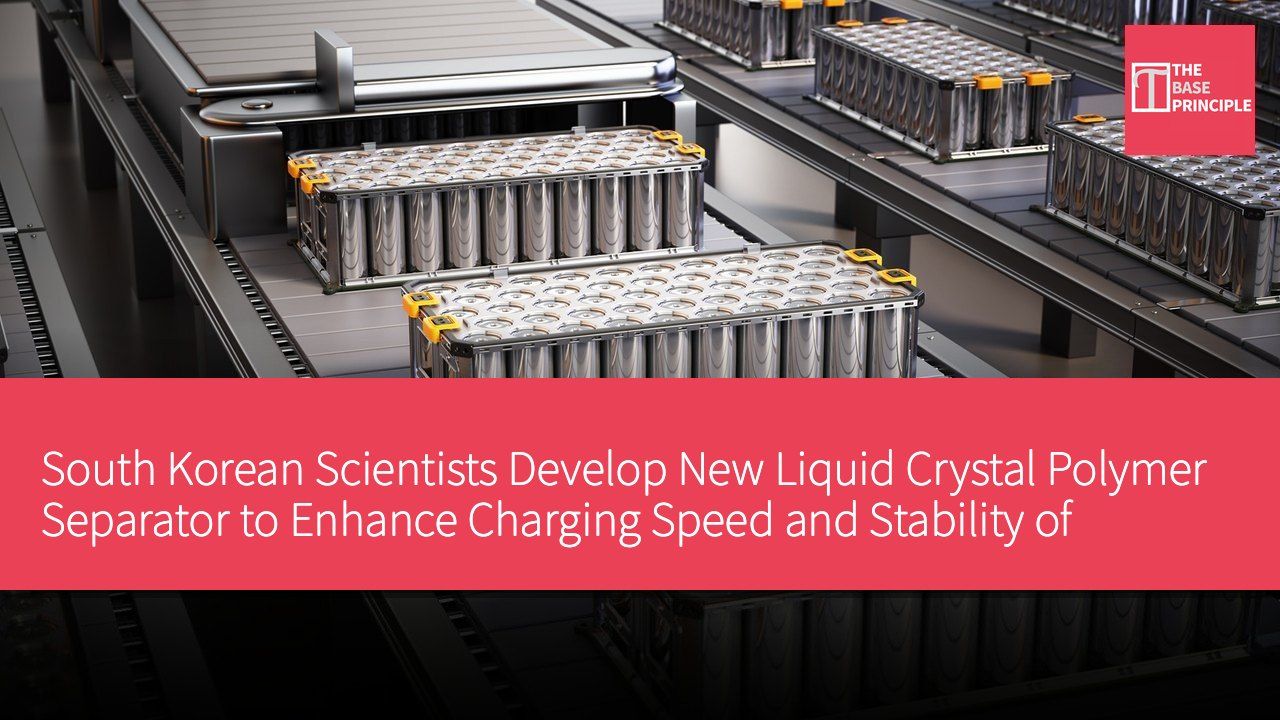
- The new liquid crystal polymer separator enhances the charging speed and stability of lithium metal batteries.
- The separator maintains 94% of its capacity after 100 charge-discharge cycles.
- The research team uses liquid crystal polymers to control lithium ion movement, addressing dendrite formation issues.
- Molecular arrangement is crucial for battery performance, expected to promote the development of high-energy density battery technology.
South Korean scientists have recently unveiled a new liquid crystal polymer separator that retains 94% of its capacity after 100 charge-discharge cycles during lithium metal battery testing, with a charging rate of 4C. This separator was developed by a research team from the Korea Advanced Institute of Science and Technology (KAIST). According to reports, this technology is expected to improve battery stability and charging speed, allowing drivers to charge electric vehicles in just 15 minutes. The research is led by Professors Dong Ki Yoon and Hye Ryung Byon from the Department of Chemistry at KAIST.
They stated, "Lithium metal batteries can store more energy than traditional batteries. However, during the charging process, lithium accumulates on the electrode surface, forming sharp branch structures known as 'dendrites.'
Innovation in Liquid Crystal Polymer Separator
In this separator, researchers use liquid crystal polymers to control the movement of lithium ions within lithium metal batteries. Professors Yoon and Byon believe their research findings can address the issues of slow ion transport and dendrite formation. The advantage of lithium metal batteries lies in their ability to store more energy than traditional batteries, but during the charging process, lithium accumulates on the electrode surface and forms dendrites, which are tiny needle-like metal crystals that can grow on the anode, potentially damaging the separator between electrodes and leading to short circuits and increased fire risks.
To tackle this issue, the research team created a porous separator made from liquid crystal polymers, which possess a solid-like ordered structure while retaining some liquid characteristics. In this project, the team integrated polyethylene glycol (PEG) chains into the material to facilitate lithium ion transport. The scientists then monitored the arrangement of liquid crystal molecules, aligning them vertically or horizontally to examine how their orientation affects ion movement. The vertically aligned separator provides a direct pathway for lithium ions, reducing the complexity of the ion transport path by approximately 2.5 times compared to the horizontally aligned separator, allowing for faster and more uniform movement of lithium ions.
Impact on Future Battery Technology
Moreover, this design also suppresses dendrite formation and improves battery stability. Ultimately, the researchers tested this separator in an operational lithium metal battery to evaluate its performance. To their surprise, the battery retained 94% of its initial capacity after 100 charge-discharge cycles. In simple terms, a charging rate of 4C means the battery can be fully charged in 15 minutes. According to the team, the way molecular arrangement is controlled has the potential to enable faster charging and longer lifespan without compromising safety. Professor Yoon emphasized the significance of this discovery for future battery development.
He stated that molecular arrangement plays a critical role in battery performance. "We expect this approach will contribute to the development of high-energy density next-generation battery technology, where long-range travel and fast charging are essential requirements," he added in a press release. The scientists believe this method will aid the development of high-energy density batteries for future electric vehicles, where fast charging and longer driving distances are crucial. However, further testing will reveal the effectiveness of this technology in larger batteries. The research has been published in the journal ACS Nano.
Item Specification Charging Rate 4C Cycle Count 100 times Capacity Retention Rate 94%
Potential of Liquid Crystal Polymer Separator Technology
This research demonstrates the application potential of liquid crystal polymer separators in lithium metal batteries, particularly their advantages in enhancing charging speed and stability. With the increasing demand for electric vehicles, fast charging and high energy density have become critical challenges. This new technology not only improves battery performance but also helps reduce fire risks, which is vital for the future development of electric vehicles. The findings of the research team may pave the way for next-generation battery technology, promoting the safer and more efficient adoption of electric vehicles.