
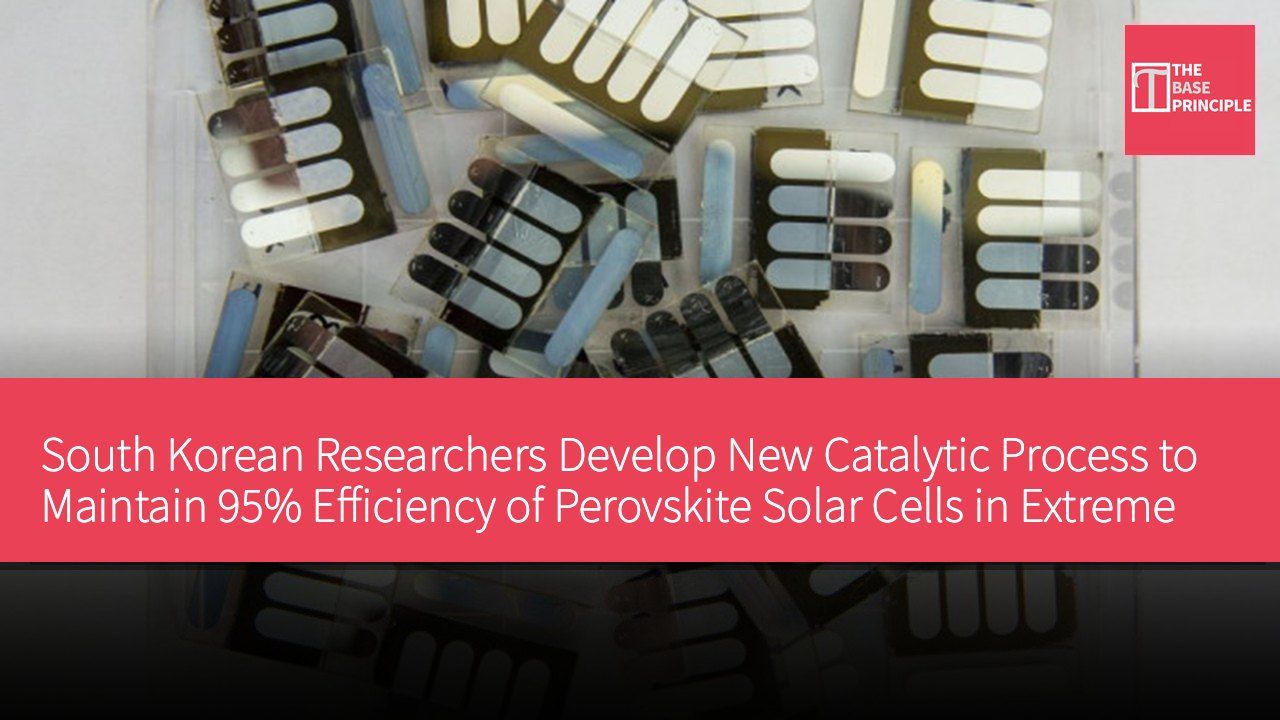
- The new catalytic process extends the lifespan of perovskite solar cells.
- The cells maintain 95% efficiency in high-temperature and high-humidity environments.
- The new process removes harmful lithium ions without the need for chemical additives.
- This technology may improve the performance of tandem solar cells.
Even after 1,000 hours of exposure to high temperatures and humidity, the cells maintained 95% of their initial power conversion efficiency. The team stated that this new process could help perovskite solar cells compete with traditional silicon panels. Dr. Ahn emphasized, "By addressing the longevity issue, this will be an important milestone for the commercialization of perovskite and tandem solar cells." Perovskite solar cells are a type of thin-film photovoltaic device that relies on perovskite materials to convert sunlight into electricity. They have garnered significant attention in recent years due to their high energy conversion efficiency and potential for low-cost production.
The cells are not only inexpensive, easy to produce, and lightweight, making them ideal for flexible solar panels. However, their lifespan is limited, typically ranging from 2 to 10 years, compared to 25 to 30 years for silicon panels. Additionally, perovskite solar cells are particularly sensitive to heat and moisture, which can accelerate their degradation. This reduces their long-term reliability, especially in hot and humid climates. The issue stems from lithium salts and additives in the hole transport layer. While these substances enhance the efficiency of the cells, they also accelerate degradation. In hot and humid environments, these additives may evaporate, leaving tiny voids that diminish performance.
Meanwhile, lithium ions can move freely within the cells, causing further damage and shortening their lifespan.
Technical Details of the New Catalytic Process
Until now, researchers have struggled to remove these substances without hindering the cells' ability to convert sunlight into electricity. To address this issue, the KIER team developed a new catalytic process called post-catalytic reaction filtration extraction. This method removes harmful lithium ions and eliminates the need for additives while maintaining high power conversion efficiency. The technology uses nickel oxide (NiOx) as a catalyst, which attracts and removes lithium ions from the solution used to create the hole transport layer. When nickel oxide powder is added to the solution, a reaction occurs that alters its surface properties, allowing it to attract lithium ions.This reaction separates lithium ions from the salts without using chemical additives. The released ions subsequently bond with the nickel oxide particles. The researchers then used a physical filtration process to remove the powder from the solution. Because the nickel oxide particles are relatively large, they become trapped in the filter, along with the attached lithium ions. To evaluate this technology, the team tested solar cells made using the new process and compared them to traditional cells. The results showed that this technology significantly maintained the performance of the cells. Additionally, the new cells achieved an efficiency of 25.24%, slightly higher than the 25.21% efficiency of traditional cells using additives.
Potential Impact of the Research Findings
According to the team, this discovery could improve the performance of tandem solar cells. Dr. Ahn summarized in a press release, "This work is significant because it breaks away from the traditional framework of perovskite manufacturing and proposes a new process that catalytically triggers the necessary reactions and then filters out the root cause substances." The research has been published in the journal Advanced Science.
Item Previous Generation/Comparison This Generation/Specification Efficiency 25.21% 25.24% Testing Conditions None 185°F (85°C), 85% Relative Humidity
How the New Technology Could Change the Future of Perovskite Cells
Perovskite solar cells have been recognized for their high efficiency and low cost, but their short lifespan and environmental sensitivity have remained major challenges. The newly developed catalytic process not only removes harmful substances but also enhances stability without hindering cell performance, which is crucial for advancing the commercialization of perovskite cells. As the technology matures, perovskite cells have the potential to compete in the market with traditional silicon panels, further promoting the adoption of renewable energy.