
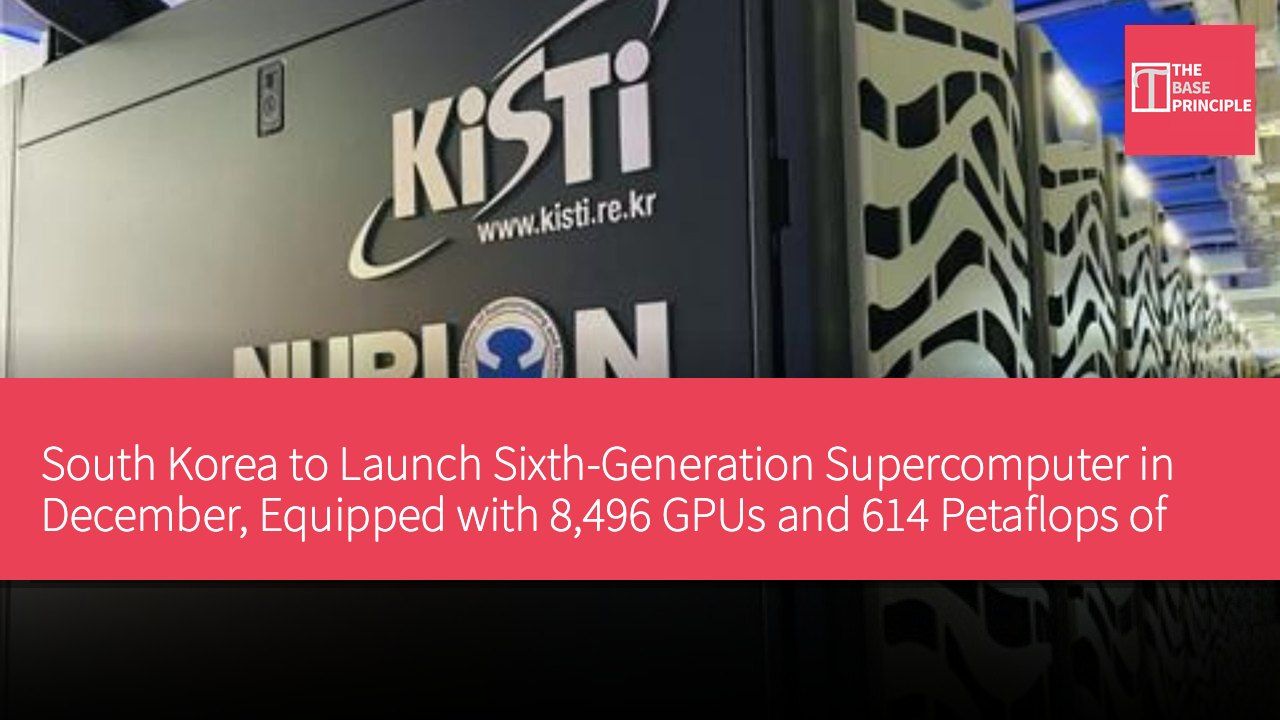
- South Korea will launch its sixth-generation supercomputer, named Supercomputer No.6, in December.
- The computer will be equipped with 8,496 GPUs and have a performance of 614 petaflops.
- Supercomputer No.6 aims to enter the global top ten and promote scientific research.
- The launch faces challenges due to soaring GPU prices, with the budget exceeding by 53%.
The Ministry of Science and ICT (MSIT) and the Korea Institute of Science and Technology Information (KISTI) have announced that the next-generation national supercomputer will be launched in December this year. The machine, known as "Supercomputer No.6," will be equipped with 8,496 Graphics Processing Units (GPUs) and have a performance of 614 petaflops, positioning it to enter the global top ten supercomputers. Supercomputers are ultra-high-speed, large-scale computers capable of performing extremely complex mathematical calculations, solving engineering and scientific problems that ordinary computers cannot handle.
From energy exploration to weather forecasting, from space research to drug discovery, the task of supercomputers is to perform simulations to help us better understand these fields and assist scientists in making discoveries. Countries typically build these large computers in their national research institutions to promote scientific breakthroughs and gain economic leadership, while also using them for national security measures.
Applications of Supercomputers
The world's top supercomputers are listed in the TOP500, with the latest version showing that China's LineShine has ended the US dominance of the list. South Korea has 15 supercomputers on the list, with KISTI's Supercomputer No. 5 ranking 109th. KISTI and MSIT aim to enter the top ten, with Supercomputer No. 6 set to be unveiled in December. Supercomputer No. 6 is powered by NVIDIA's GraceHopper 200 chip, integrating Central Processing Units (CPUs) and GPU units.
The unit will be equipped with 8,496 GPUs and 9,936 CPUs, have 205 petabytes (PB) of on-board storage, and a network speed exceeding 400 Gbps. Theoretically, Supercomputer No. 6's computing performance is 614 petaflops, a significant leap compared to its predecessor, Supercomputer No. 5 "Nurion," which was launched in 2017 with a computing performance of 25.7 petaflops.
In addition to a 24-fold increase in theoretical computing performance, the successor supercomputer will also increase storage by 10 times and network speed by 4 times.
Challenges in the Launch Process
MSIT and KISTI signed a system installation agreement with Hewlett Packard Enterprise last year. Installation checks began last month and are currently undergoing performance and stability testing, with South Korea expecting to commission the supercomputer in December. Once operational, the supercomputer will provide massive computing resources to researchers engaged in computational science, data simulation, and AI-based scientific research. Plans include redistributing resources to three projects: national strategy (30%), R&D innovation (55%), and industrial innovation (15%).
While the launch of the new supercomputer and its impending availability is good news for researchers, the acquisition process has not been without its challenges. After the launch of Supercomputer No. 5 in 2018, South Korean researchers began searching for its successor as early as 2021. However, with the rise of generative AI, particularly the maturation of ChatGPT and Claude, the demand for GPUs surged. As GPU prices soared, South Korea was unable to obtain these chips at the budgeted price and ultimately had to spend 448.3 billion Korean won (approximately US$334.90 million, or HK$2,612 million), a 53% increase over the original budget of 292.9 billion Korean won (approximately US$218.80 million, or HK$1,707 million).
Kim Sung-soo, Director-General of the R&D Policy Bureau at the Ministry of Science and ICT, said in a press release, "Supercomputer No. 6 is a core infrastructure for driving a significant leap in the productivity of science and technology research in the AI era. We expect it to produce tangible results, contributing to the safeguarding of national strategic technologies, including K-Moonshot and the Seven SEEDs, and to promoting research innovation in industry, academia, and research institutions."
Item Specifications Number of GPUs 8,496 Number of CPUs 9,936 Storage Space 205 petabytes Theoretical Computing Performance 614 petaflops Network Speed Over 400 Gbps
The Impact of Supercomputers on South Korean Technology
The launch of Supercomputer No.6 marks a significant advancement for South Korea in the global computing power competition, particularly in the fields of AI and scientific research. As computing demands increase, especially with the rise of generative AI, South Korea faces the challenge of rising GPU purchase costs, reflecting the dynamic changes in the global tech market. The performance boost of the supercomputer will provide researchers with powerful resources, promoting the development of national strategic technologies and thus maintaining competitiveness in both economic and technological spheres.