
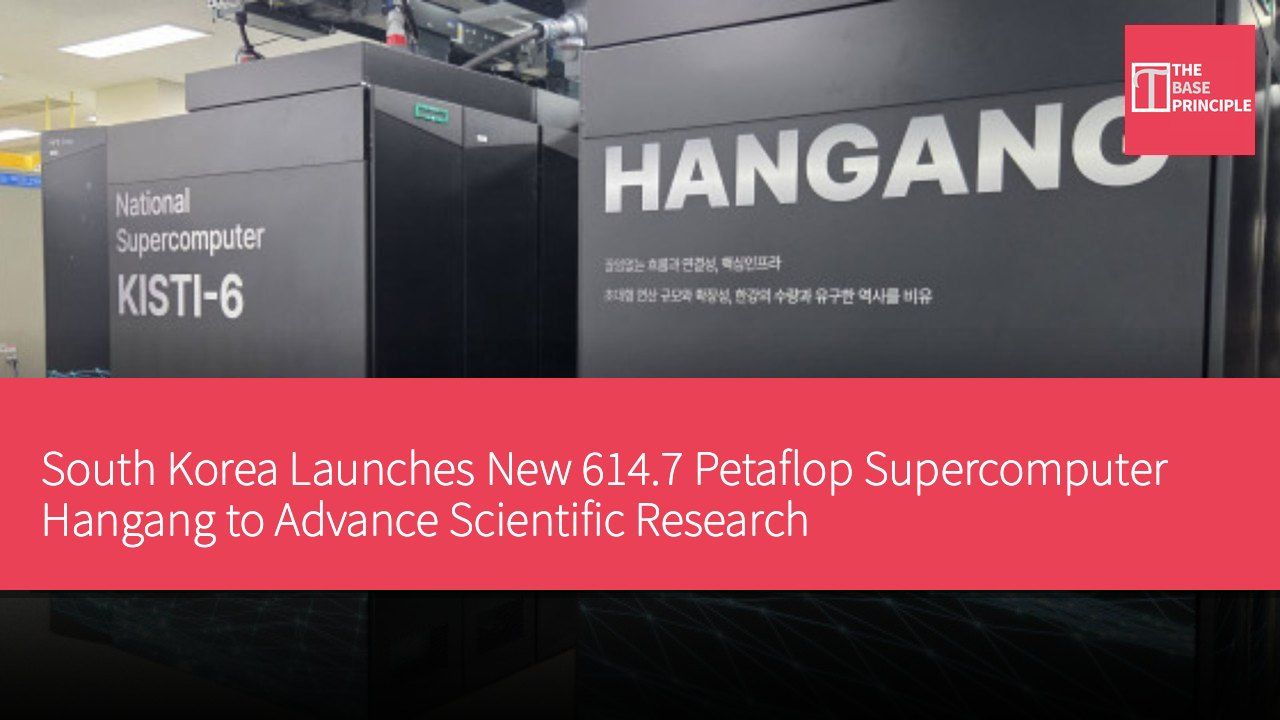
- The Hangang supercomputer launched in South Korea achieves a performance of 614.7 petaflops.
- Hangang will support new GPU-driven research and enhance the workload of Nurion.
- There are plans to connect Hangang with quantum computers by 2027 to advance hybrid research systems.
- South Korea needs to be more self-sufficient in its supercomputer ecosystem to reduce external dependencies.
The delay in the launch of Hangang was due to a recent surge in GPU prices caused by the AI boom. The project passed feasibility studies in 2022, but the bidding process was unsuccessful due to skyrocketing GPU demand. The team had to redraw plans to adapt to changing research needs and possibilities, and after four years, South Korea's sixth-generation supercomputer is set to serve users.
Hangang's Performance Leap Hangang is powered by 8,496 integrated GPUs and CPUs from NVIDIA's GH200 chip and features 9,936 CPUs. The supercomputer has a storage capacity of 205 petabytes (PB) and a transfer speed of 400 gigabits per second (Gbps). Overall, the supercomputer can perform 614.7 quadrillion calculations per second. Its test performance in June was 342.6 petaflops (PF), ranking 12th on the TOP500 list at that time.Performance of the Hangang Supercomputer
In September, KISTI began recruiting researchers for pilot services of Hangang, gradually increasing its utilization. When the system enters full service on the 16th of next month, its theoretical performance will reach 614.7 petaflops, which represents a 24-fold increase over Nurion. Hangang is expected to not only take on Nurion's workload but also support new GPU-driven research. KISTI previously announced that computational resources will be allocated to research and development (55%), national strategy (30%), and industrial innovation (15%), the latter of which will support small and medium-sized enterprises.
Future Quantum Computer Connection
Quantum Connection In early 2027, KISTI also plans to connect Hangang with a quantum computer it intends to introduce, bringing a hybrid research system to South Korea. This will create a win-win situation, combining the superior computational power of quantum computers with the large-scale and precise computational capabilities of supercomputers. One potential application area is drug discovery, where quantum computers can narrow down protein structures that can bind to enzymes, while supercomputers calculate their binding energies. Although KISTI is focused on innovative applications, the institution must also prepare to introduce a replacement for the current supercomputer, which is still in the pilot phase.This is not only to avoid repeating past mistakes but also to ensure South Korea's computational needs in a competitive market. In the future, South Korea will seek to be more self-sufficient in building such systems. However, in the short term, the country lacks an ecosystem for establishing its own supercomputers and must rely on GPUs sourced from abroad to reduce costs.
Item Specifications Processor NVIDIA GH200 Number of GPUs 8,496 Number of CPUs 9,936 Storage Capacity 205 PB Transfer Speed 400 Gbps Computational Performance 614.7 PF
Strategic Significance of the Hangang Supercomputer
The launch of the Hangang supercomputer not only enhances South Korea's competitiveness in the global supercomputer arena but also strengthens its capabilities in scientific research and industrial innovation. With its resource allocation strategy, Hangang will support research across multiple fields, particularly the development of small and medium-sized enterprises. The future connection with quantum computers will further expand its application potential, especially in cutting-edge technology areas like drug discovery. These initiatives demonstrate South Korea's commitment to technological innovation and self-sufficiency, particularly in the context of global market competition.