
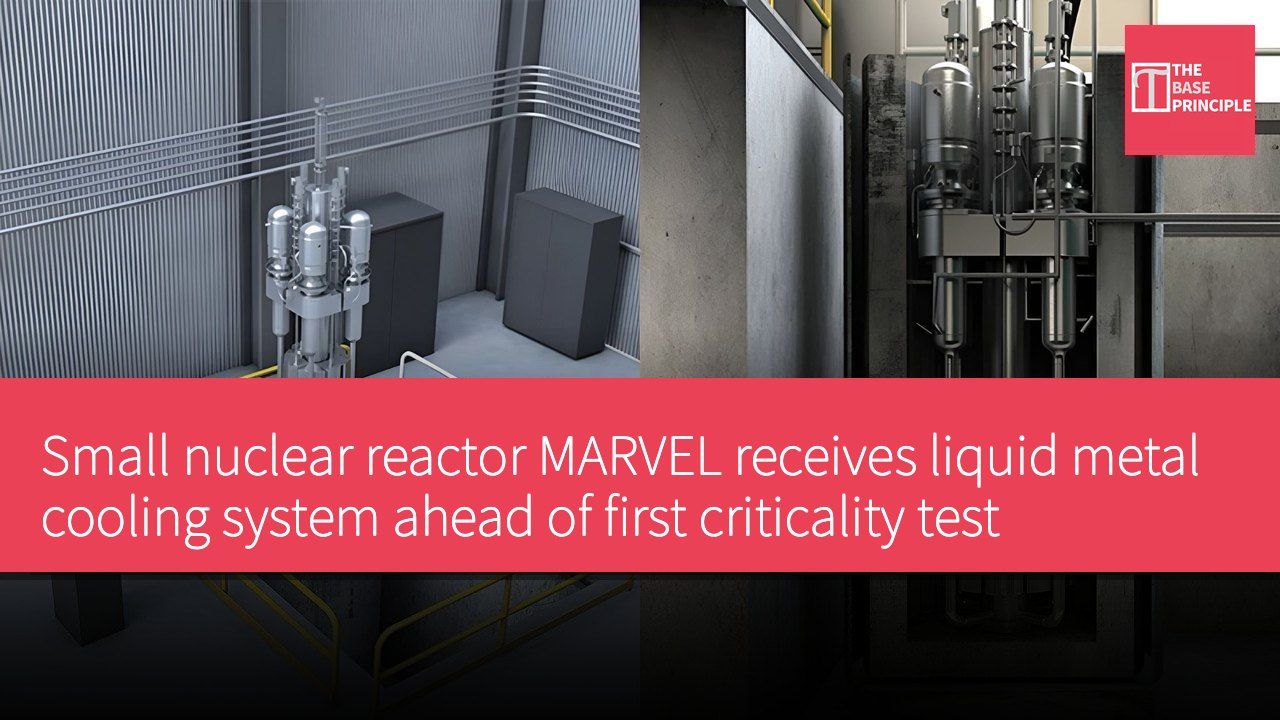
- MARVEL microreactor cooling system arrived at Idaho National Laboratory in September.
- First criticality will gather data on reactor physics and behavior.
- Dry criticality allows testing without generating power.
- MARVEL will provide critical evidence for future microreactor technology.
A small nuclear reactor at Idaho National Laboratory is poised for its first criticality test after engineers received a key component of its cooling system. The primary cooling system for the U.S. Department of Energy's MARVEL microreactor arrived at Idaho National Laboratory in mid-September. The delivery allows engineers to integrate another major component before the reactor enters preliminary testing, currently scheduled for December. MARVEL stands for Microreactor Applications Research Validation and Evaluation. Idaho National Laboratory leads the project, with researchers exploring the behavior of compact nuclear systems and how their operational data can support future reactor development.
The primary cooling system will ultimately carry heat away from the MARVEL reactor core. It uses a sodium-potassium alloy that remains liquid at room temperature and can transfer heat at high temperatures. Unlike water-based systems that operate under high pressure, this liquid metal coolant does not require pressurization to remain flowing. That behavior makes it particularly important for researchers studying compact reactor designs. The system has arrived at Idaho National Laboratory's Transient Reactor Test Facility, where engineers will integrate it with the rest of MARVEL, work that will put the reactor through a series of tests leading toward initial criticality.
Criticality marks the point at which a reactor sustains a nuclear chain reaction.
Significance of first criticality
MARVEL's first criticality will not mean full operation immediately. Instead, researchers will use the early phase to gather measurements on reactor physics and behavior. The project reached another key checkpoint before the cooling system arrived. The Energy Department's Idaho Operations Office approved MARVEL's final documented safety analysis, clearing the way for a dry criticality configuration.
Dry criticality allows engineers to achieve a controlled critical state with virtually no power generation. The configuration does not require coolant during testing. The distinction matters because MARVEL's initial physics work can proceed before the reactor enters full thermal operation. Researchers can focus on reactor behavior and collect data under tightly controlled conditions. MARVEL lead Abdalla Abou-Jaoude said the team can move toward initial criticality following the approval. The safety analysis may also hold value beyond MARVEL.
Abou-Jaoude said the Energy Department's guidance gave the team an opportunity to share the approved documentation with industry stakeholders.
Engineering challenges of small reactors
Idaho National Laboratory nuclear safety engineer Doug Gerstner said the analysis reflects years of engineering and safety work. He said the approval supports the risk-informed approach the project has established. Testing could influence design. MARVEL's significance extends beyond the reactor housed at the Idaho National Laboratory test facility. Its experiments could provide a benchmark for researchers to check the differences between reactor physics calculations and actual nuclear system measurements. That data could prove highly useful as developers pursue other advanced reactor concepts.
Small reactors face engineering challenges distinct from large commercial plants, particularly as designers try to shrink system size and complexity. MARVEL will provide a controlled environment to test those ideas without attempting to replicate a commercial nuclear plant. The aim is to generate evidence that researchers and engineers can use when evaluating future microreactor technologies. The next major test is on the calendar for December. If MARVEL reaches initial criticality as planned, researchers will have their first chance to examine the reactor's physics and begin building the dataset the project aims to produce.
MARVEL's impact on future nuclear technology
The development of the MARVEL microreactor marks an important advance in small nuclear reactor technology. With the cooling system in place, the first criticality test will provide researchers with critical data to understand the reactor's physical behavior. This data is not only crucial for MARVEL itself but could also have far-reaching implications for the design and development of other advanced reactors. The design challenges of small reactors differ from those of large commercial plants, and MARVEL's success will provide an important experimental benchmark for evaluating future microreactor technologies.