
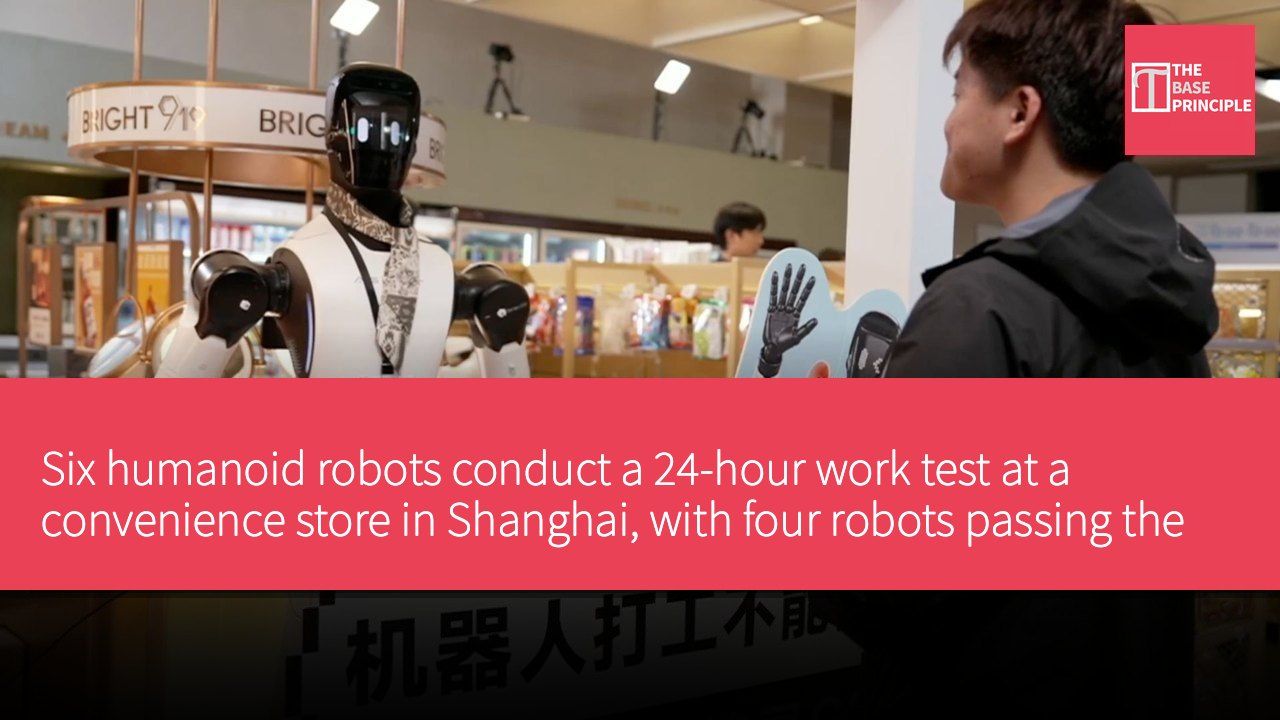
- Six humanoid robots conducted a 24-hour work test at a convenience store, with four passing the evaluation.
- The robots faced challenges in cleaning and restocking tasks, failing to meet performance standards.
- AGIBOT utilized the Genie Master framework to enhance the robots' autonomy and adaptability.
- The experiment revealed gaps in autonomy and adaptability in retail work.
Six humanoid robots worked for 24 hours at a convenience store in Shanghai, responsible for greeting customers, making coffee, providing food, and restocking. However, at the end of the shift, only four robots passed the performance evaluation, highlighting the challenges robots face in handling unpredictable daily tasks. This experiment, titled "Robots Never Clock Out," was organized by Chinese robotics company AGIBOT and took place from 10 AM on November 2 to 10 AM on November 3 at a convenience store in Shanghai's Xuhui District. The company deployed six G2 wheeled humanoid robots and conducted a live stream that attracted over two million online viewers.
According to AGIBOT, the six robots completed a total of 1,730 tasks during the trial. However, two robots responsible for cleaning and shelf inspection and restocking did not meet the company's performance standards.
The six robots were assigned different retail responsibilities, covering customer service, product handling, coffee making, hot food service, and cleaning. AGIBOT reported that these robots completed 683 customer service interactions, 369 product pickups and deliveries, 147 coffee orders, and 126 breakfast supplies. They also performed 277 shelf inspections and restocking tasks, as well as 128 table cleaning tasks. The experiment encompassed four operational periods: lunch peak, evening peak, overnight operations, and the subsequent morning breakfast peak, allowing the robots to face varying customer activity levels and changing in-store conditions, rather than being limited to brief controlled tasks.
Robot Performance Evaluation Results
AGIBOT evaluated the robots based on their working hours, task completion, customer feedback, response times, and their ability to handle unexpected situations. Four robots passed the final evaluation, while two were placed in an observation group for further improvements. The failures of the two robots were primarily attributed to the particularly challenging nature of cleaning and shelf management tasks. According to TechSpot, citing Chinese media ITHome, the cleaning robot was unable to proceed along its planned path when encountering a full trash bin. It failed to resolve this obstacle, deviating from its designated path and leaving the store without returning to its position.
The robot responsible for shelf inspection and restocking also struggled to keep up with the store's demands, reportedly lacking proactivity and failing to continuously identify and replenish products that were missing due to sales.
These issues highlight the challenges robots face in automation. Performing tasks under predictable conditions is not the same as reliably completing tasks in a changing environment. Robots can be programmed to follow cleaning paths, but overflowing trash bins introduce situations they may not be able to resolve. Similarly, restocking involves more than just identifying empty spaces; robots must recognize products, locate misplaced items, handle packaging, and determine when to pay attention to shelves. During the challenge, AGIBOT also deliberately set up some difficult tests, asking the robots to distinguish between regular and diet cola, rearranging gum to return it to its proper place, and blocking pathways with a person and a box to test obstacle detection and navigation capabilities.
AGIBOT's Technical Framework
This trial also showcased AGIBOT's Genie Master embodied artificial intelligence agent framework, which connects task planning, execution, and feedback. Utilizing its embodied execution protocol, the system coordinates assigned tasks and collects execution results for analysis. AGIBOT stated that it can retain experiences of success and failure, using these experiences to troubleshoot issues and convert effective adjustments into training data to improve future robot behavior. This approach is crucial as humanoid robots need to integrate perception, decision-making, and physical operation to function outside controlled environments.
Robots not only need to identify objects but also determine how to approach, grasp, and move them without damaging nearby items or posing a danger to people.
The convenience store experiment provides useful insights into addressing this challenge. Although the robots completed over 1,700 reported activities, the two robots that did not pass evaluation demonstrated that seemingly routine retail tasks can still expose gaps in autonomy and adaptability. For AGIBOT, the next step is to improve performance through operational feedback and test its robots in more realistic environments. The results indicate that humanoid robots are increasingly capable of handling specific retail responsibilities, but reliably managing an entire shift remains a more daunting task.
Challenges for Humanoid Robots in Retail Environments
The convenience store experiment revealed the challenges humanoid robots face in automated retail environments. While the robots were able to complete multiple tasks, they still showed shortcomings in responding to changing environments and unexpected situations. Particularly in tasks such as cleaning and restocking, the robots' autonomy and adaptability did not meet expected standards. Although AGIBOT's Genie Master framework provides a foundation for improvement, further optimization is needed to ensure the robots can operate effectively in the real world. These challenges underscore the complexity of robotic technology development and provide important references for future improvements.