
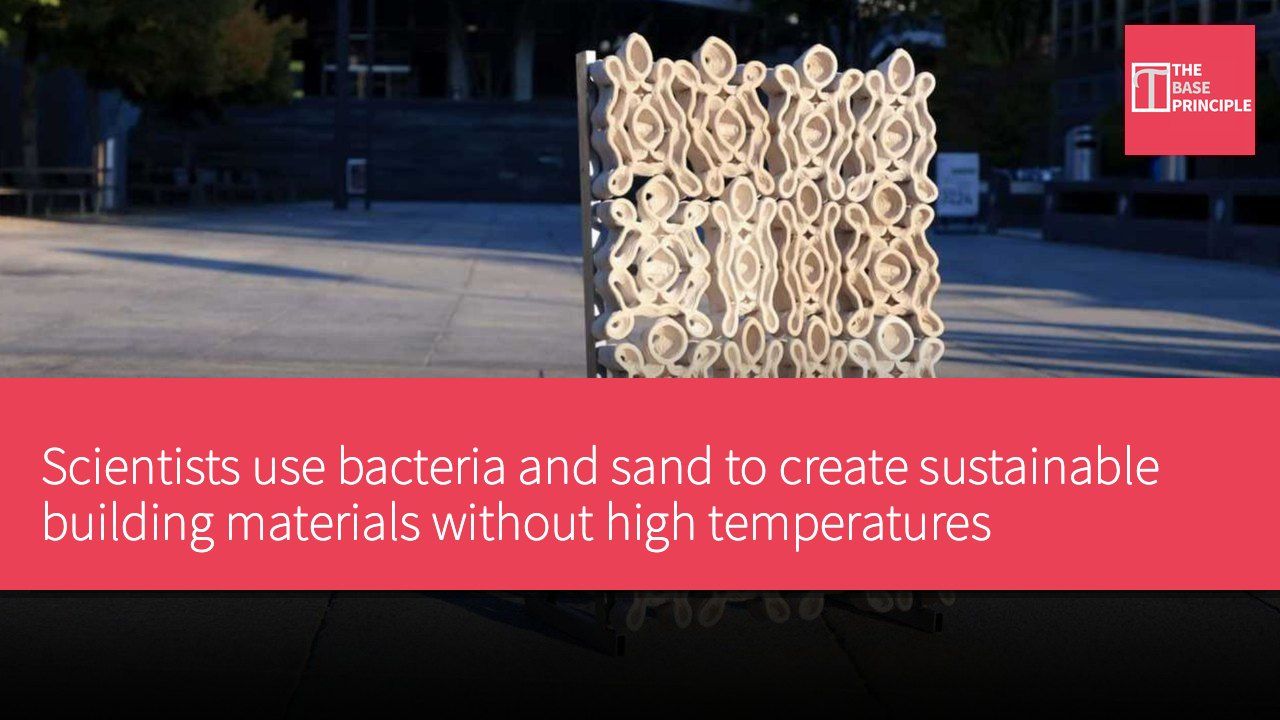
- Scientists create building materials using bacteria and sand without high temperatures.
- Sporosarcina pasteurii can produce a mineral adhesive that helps bind sand.
- The bio-cement currently has a strength comparable to mortar, suitable for non-load-bearing structures.
- Chemical byproduct ammonia needs to be safely managed, affecting sustainability.
To build sustainable cities, scientists at ETH Zurich are turning to some of the smallest organisms on Earth. Architect and researcher Karen Antorveza Paez combines biology with digital manufacturing, utilizing live bacteria, sand, and robotic technology to create sturdy building components without burning any fossil fuels. This development addresses one of the largest environmental culprits globally. Cement production accounts for about 8% of global carbon emissions, primarily because key ingredients must be fired in massive kilns at extremely high temperatures.
Antorveza Paez recruits soil bacteria—Sporosarcina pasteurii—that can produce a “mineral glue” without the need for heat treatment. She explains, “We use bacteria to produce a mineral adhesive.” A robotic arm repeatedly applies the bacteria, the substances needed for crystallization, and sand to a surface, allowing it to grow layer by layer.
How Bacteria Facilitate Building Material Production
The microbial-induced precipitation of calcium carbonate allows live bacteria to bind sand and loose particles into solid structural components without the need for high-temperature processing. While the idea is not new, experts have previously considered the possibility of using this method to construct structures on Mars. Bacteria produce carbonate ions in the mixture by breaking down urea through a natural enzyme. When these ions interact with calcium chloride, microscopic limestone crystals form, mechanically interlocking sand grains at room temperature, thereby solidifying the material. Antorveza Paez explains, “It’s a bit like baking a cake; the dough you have is still very malleable and fragile, only the oven can turn it into a solid substance.
” In her work, the bacteria act as the oven.
Challenges and Applications of Bio-Cement
The team developed two digital manufacturing methods to create bio-cement building elements. Researchers used a custom bio-ink, composed of water, natural gum, sand, and live bacteria, to develop a 3D bioprinting process. After printing, the structure undergoes a mineralization bath lasting two to five days, with daily updates to provide necessary nutrients. Like an oven, the bacteria solidify the material at room temperature, leaving behind fully cured, inactive mineral components after drying.
However, strength challenges remain. The second method involves using a robotic arm to alternately spray sand, bacteria, and mineralizers onto a surface, inspired by natural microbial rock structures like stromatolites. She states, “As an architect, you usually don’t know exactly what materials contain—they are made elsewhere.” She is fascinated by how nature finds ways to produce highly complex materials and hopes to leverage this to address current issues. This is a promising approach, but bio-cement is not yet ready to replace structural concrete.
Currently, its strength is closer to that of mortar, making it more suitable for non-load-bearing elements, such as partition walls or facade panels. Additionally, ammonia, a pollutant byproduct released during the chemical reaction, must be safely managed or recycled. Antorveza Paez adds, “Unless we consider the handling of this chemical byproduct, using bio-cement for construction is unfortunately not sustainable.”
At the 2025 Venice Architecture Biennale, a six-month installation showcased a bio-cement structure growing in real-time before visitors, demonstrating the potential of automated construction. Scientists have already proven that bacteria can grow building materials. Now, the challenge is to make these materials strong enough to support our cities.
Development and Challenges of Bio-Cement Technology
This research demonstrates the potential of using bacteria and sand to create building materials, particularly in contributing to reduced carbon emissions. Although bio-cement has not yet reached the strength level of structural concrete, its application in non-load-bearing elements remains attractive. Furthermore, the issue of managing chemical byproducts highlights the complexities in the development of sustainable building materials. As technology advances, more innovative solutions may emerge, driving the construction industry toward a more environmentally friendly direction.