
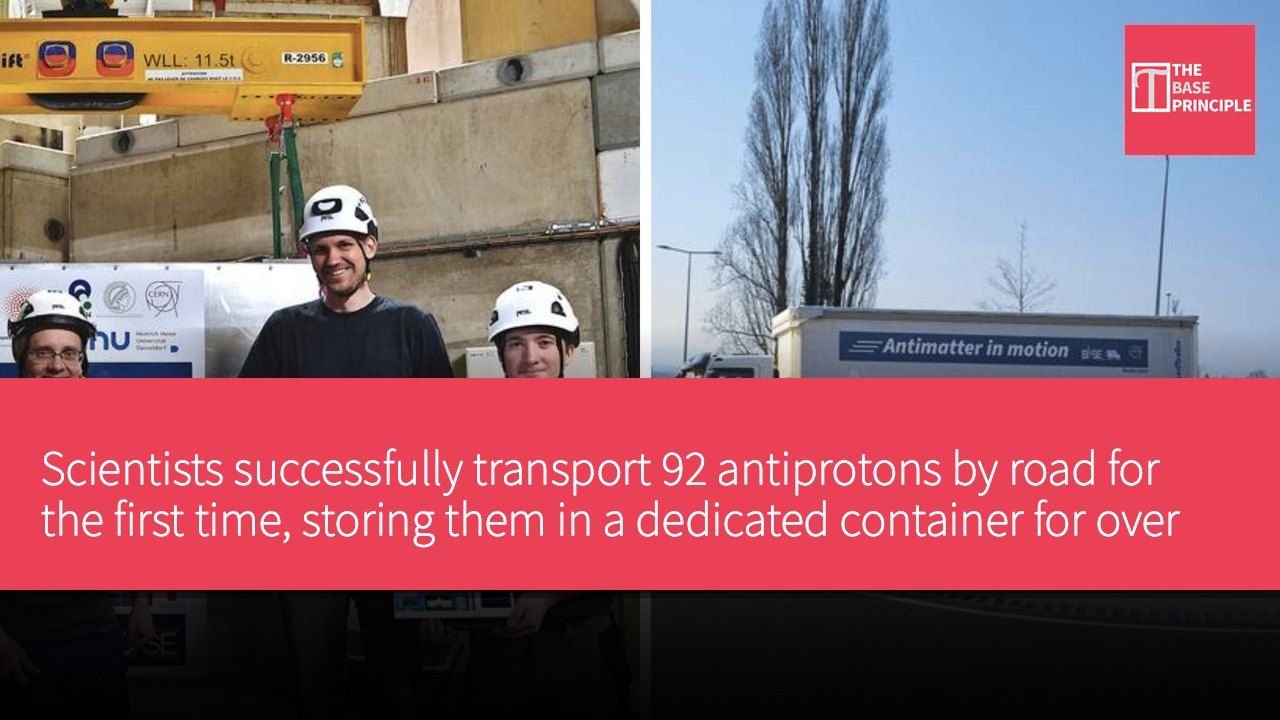
- Scientists successfully transported 92 antiprotons, setting a new record.
- The antiprotons were stored in a mobile container for more than a month with no particle loss.
- The BASE-STEP trap is located at CERN's antimatter factory and is designed for high-precision measurements.
- The scientists plan to transport the antiprotons to a higher-precision laboratory for comparative measurements.
Scientists have, for the first time, successfully transported antiprotons in a specially designed vehicle. In an experiment carried out by the BASE collaboration, the antiprotons were stored in a mobile transport container for more than a month, setting a new record. The team noted that comparing protons (the positively charged components of atomic nuclei) with antiprotons (their antimatter counterparts) is one of the most promising approaches to uncovering differences between matter and antimatter. Any discrepancy in mass or magnetic moment could point to the potential origin of the matter–antimatter asymmetry observed in the universe.
This time, 92 trapped antiprotons were transported. The so-called ultra-high-vacuum Penning trap enables high-precision measurements of trapped protons and antiprotons. The BASE (Baryon-Antibaryon Symmetry Experiment) research collaboration designed and operates a trap of this kind known as BASE-STEP, which is located at the European Organization for Nuclear Research (CERN) — more specifically, within its Antimatter Factory (AMF). According to a press release, the AMF is the world's only facility capable of producing, storing and studying low-energy antiprotons.
Stefan Ulmer, professor of quantum technologies and fundamental symmetries at HHU, said: "In recent years, we have carried out precise measurements of the intrinsic magnetic moments of both particles — to 0.3 ppb in the case of the proton and 1.6 ppb for the antiproton." Ulmer is the founder and spokesperson of BASE and a co-author of the new study, published in the journal Nature. The research demonstrated road transport of antiprotons trapped in BASE-STEP, with 92 trapped antiprotons transported along a 7.5-kilometer route from the Antimatter Factory, with no particle loss or measurable degradation of the vacuum.
A new era of precision antiproton measurements
The achievement marks the beginning of a new era of precision antiproton measurements, carried out in dedicated, low-noise, off-line laboratory environments.
Plans for a future high-precision laboratory
Dr. Christian Smorra, principal investigator of BASE-STEP and corresponding author of the study, said: "We can't improve measurement precision any further at the AMF, because facility operations cause magnetic field fluctuations that affect our measurement devices." The scientists will move the antiprotons to another high-precision laboratory. "We can only find better conditions outside CERN. That's where the idea of a mobile, open BASE-STEP trap came from: we will transport the antiprotons to another high-precision laboratory to achieve at least a factor of 100 improvement in precision."
One destination for the stored antiprotons is the high-precision laboratory currently being established at HHU by Ulmer's team, where comparative measurements of protons and antiprotons will be carried out.
Dr. Smorra said: "We carried out a successful rehearsal in March, proving that our idea is feasible. Our next goal is to make the trap sufficiently autonomous to enable transport from Geneva to Düsseldorf, with a journey time of up to ten hours."
The importance of antiproton transport for matter research
This successful antiproton transport experiment not only marks a major breakthrough for scientists in antimatter research, but also provides a new method for exploring differences between matter and antimatter. By precisely measuring the magnetic moment of the antiproton, scientists hope to uncover the potential reasons behind the matter–antimatter asymmetry in the universe. As transport technology advances, future high-precision laboratories will further improve measurement accuracy, with profound implications for understanding the fundamental laws of physics and the nature of the universe.