
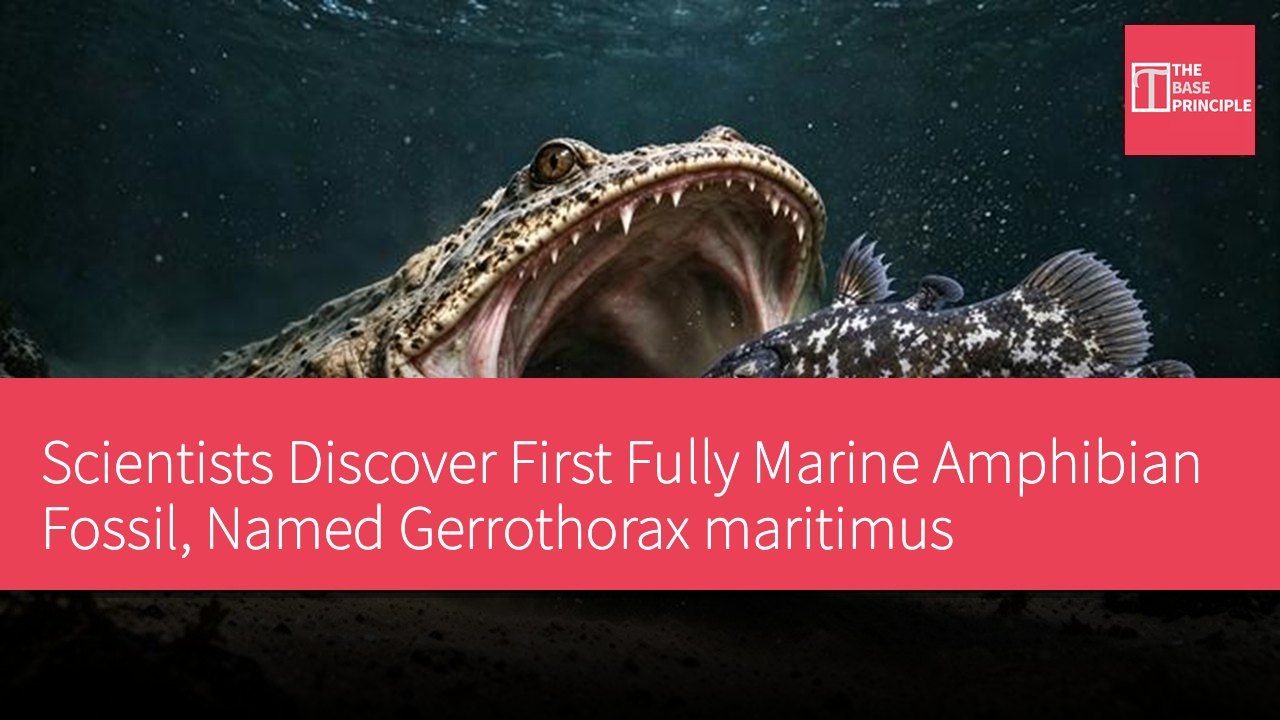
- Scientists have discovered the first fully marine amphibian fossil, named Gerrothorax maritimus.
- Currently known modern amphibians cannot live entirely in the ocean, highlighting the uniqueness of this discovery.
- Gerrothorax maritimus may have overcome the limitations of marine life through its bony armor.
- The fossil was found in deep-sea sediments, supporting evidence of its marine existence.
Researchers have uncovered a fossil that is said to be the first fully marine amphibian: an armored, flat creature roughly the size of a giant salamander, living on the ocean floor about 237 million years ago. A team from the University of California, Davis, Peking University, and the Guizhou Geological Museum named this animal Gerrothorax maritimus. The species description is based on two nearly complete skeletons unearthed in Guizhou Province, China, from the Late Triassic period, when the area was once an ocean, hundreds of miles from large landmasses.
Limitations of Modern Amphibians
Why is this discovery surprising? There are currently over 8,000 known modern amphibian species, yet none live in a fully marine environment, and fewer than 2% show tolerance to saltwater. Researchers point out that this phenomenon is quite strange, as other tetrapods, including mammals, reptiles, and birds, have species capable of surviving without land-based food or water. To date, there is also no evidence of fully marine amphibians in the fossil record.
This robust armored bottom-dweller had well-preserved bones, allowing the team to reconstruct the animal's body. Its shape is flat and disc-like, nearly 3 feet (0.9 meters) long, covered in bony armor, which may have served as defense against predators like ichthyosaurs. The study's lead author, Motani, a professor of Earth and Planetary Sciences at the University of California, Davis, noted that this is quite large for an amphibian. He pointed out that its weight is similar to that of a giant salamander, but its form is bulkier, as giant salamanders have a more elongated body. Based on the shape of the armor and skull, researchers speculate it was a benthic feeder, staying on the ocean floor to capture passing prey.
Motani compared it to modern benthic carpet sharks.
Significance of the Fossil Discovery
Modern amphibians cannot live in the ocean due to their permeable skin. They rely on their skin for breathing and moisture absorption, making them dependent on freshwater. Some animals, like the crab-eating frog, can tolerate some salinity but lose weight in saltwater and must recover in freshwater. Researchers propose that Gerrothorax maritimus may have overcome this limitation through its bony armor and more fish-like biological features. This armor could prevent moisture from seeping through the skin, meaning the animal might have needed to drink seawater through its mouth and absorb it through its digestive tract.
The gill structures of the genus may have helped filter out salt.
The fossils were found in deep-sea sediments. Motani stated that these nearly complete skeletons also point to a marine lifestyle. Corpses floating on the sea surface typically dry out and lose limbs before sinking, but these animals still retained their digits, suggesting they may have died close to their living location. Chemical tests further support this. The strontium isotope ratios in the fossils closely match those of the Late Triassic ocean. Motani noted that this discovery is an unusual addition to the ecosystem they are reconstructing, which has so far been primarily composed of marine reptiles and fish.
This discovery has been published in the journal Nature Ecology & Evolution.
Ecological Significance of Gerrothorax maritimus
The discovery of Gerrothorax maritimus challenges current understandings of amphibians, as modern amphibians generally cannot survive in marine environments. This fossil not only reveals the diversity of ancient life but may also provide valuable insights into early ecosystems. The researchers' findings suggest that this animal may have possessed unique physiological traits that enabled it to adapt to a marine environment, which is significant for understanding the evolution of amphibians and their environmental adaptability.