
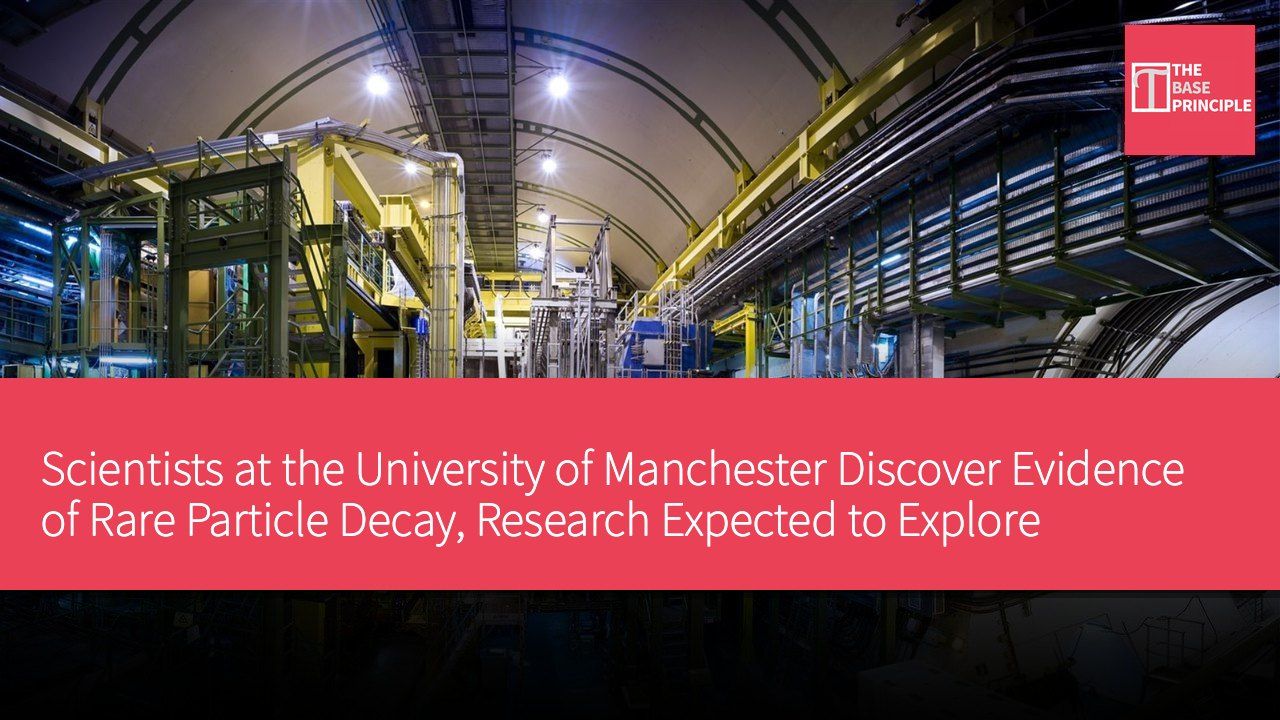
- The University of Manchester has discovered a rare particle decay, opening new directions for future research.
- The beauty quark has an extremely short lifespan, making its decay process difficult to observe.
- The statistical significance of this decay is 3.2 sigma, below the threshold for a significant discovery.
- The research may reveal new physical phenomena that the Standard Model cannot explain.
Researchers at the University of Manchester have discovered evidence of a rare particle decay that occurs only once in every billion particles. This decay was observed following significant upgrades to the LHCb experiment at CERN, opening new directions for future research at the zeptometre scale. Unlike the ATLAS and CMS detectors, the LHCb experiment is a forward spectrometer. LHCb focuses on the forward region of the beam to study the behavior and decay of beauty quarks and charm quarks, rather than searching for decay evidence in all directions.
The beauty quark is heavier than the up quark and down quark, and is produced in large quantities at the LHC. However, its lifespan is only one trillionth of a second before it decays.
Upgrades and Contributions of the LHCb Experiment
Researchers at the University of Manchester participated in the upgrade of the LHCb experiment, which has increased the data collection rate to five times that of previous levels. Precise measurements of beauty quark decays allow scientists to detect the potential effects of new particles that may be too small to be detected at the LHC. If the decay is rare, the effects of new particles may be more sensitive. The UK's contribution to the LHCb upgrade is a Vertex Locator, a silicon pixel detector positioned just five millimeters from the beam, enabling scientists to accurately determine the location of particle production and decay.
The research team detected the decay of "Bd to mu mu," where a beauty quark decays into two muons, which are particles similar to electrons but slightly heavier. It is estimated that this decay occurs only once in every billion beauty quarks, so its absence from previous observations is not surprising.
Statistical Significance and Implications of the Decay
Chris Parkes, head of the Department of Physics and Astronomy at the University of Manchester, stated, "This decay is extremely unlikely to occur; the probability is about the same as finding the perfect partner among everyone on Earth on a first date." The statistical significance of this discovery is 3.2 sigma, below the 5 sigma threshold required for a significant physical discovery. Nevertheless, it opens new channels for physicists to explore particles and natural forces hidden in the zeptometre scale, a distance referred to as the zeptoverse.
The measurements from this experiment remain consistent with the Standard Model of physics. However, further research into the zeptoverse may help scientists uncover new physical phenomena that the Standard Model cannot explain.
Conor Fitzpatrick, deputy physics coordinator of the LHCb collaboration, stated at a press conference, "The results of this experiment expand our understanding of nature at its most fundamental level. We are excited to finally see this elusive signal and look forward to more discoveries from our data in the future." Even though the upgraded experiment will continue to collect data until early 2030, further upgrades could increase data collection by an order of magnitude, revealing more information about particles and forces in the zeptoverse.
Impact of This Discovery on Future Physics Research
This groundbreaking discovery not only highlights the complexity of particle physics but also provides the potential for exploring physical phenomena at even smaller scales. With the upgrades to the LHCb experiment, scientists are able to measure particle behavior more precisely, which is crucial for understanding the fundamental composition of the universe. While current results still align with the Standard Model, future data collection may reveal new physical phenomena, challenge existing theories, and drive further advancements in physics.