
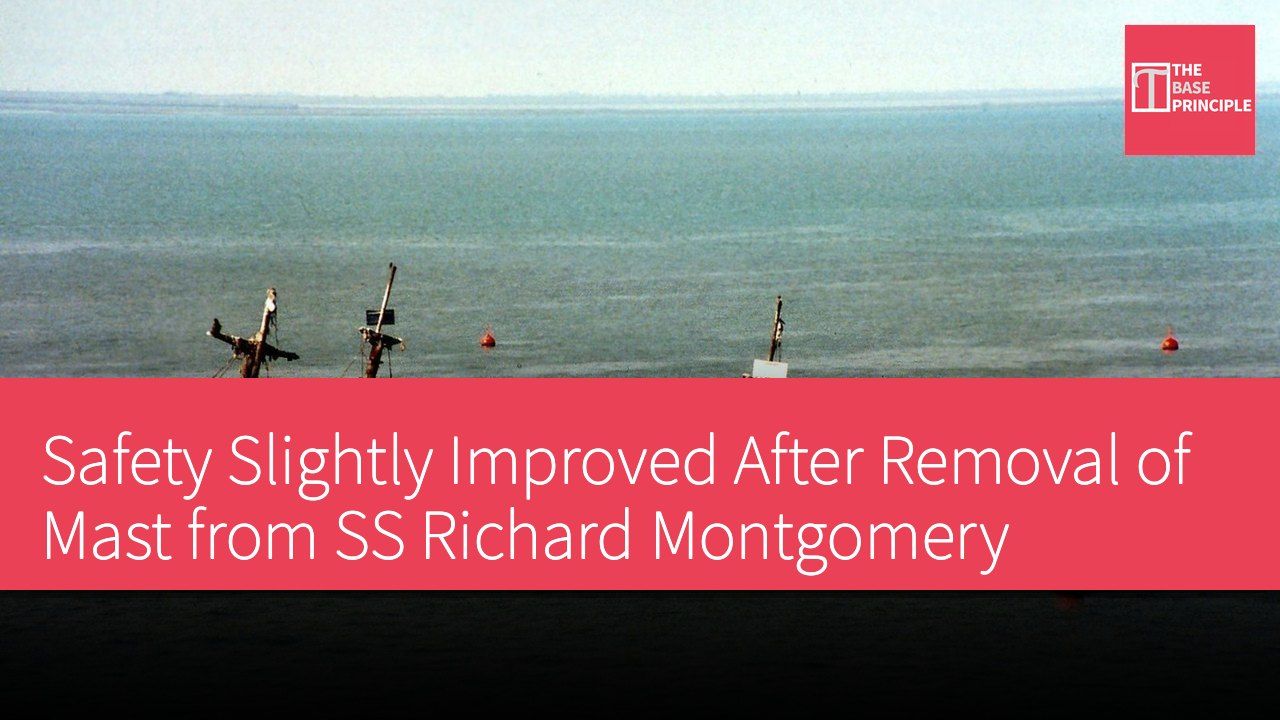
- The SS Richard Montgomery wreck contains about 1,400 tons of unexploded ordnance, posing a potential danger.
- Engineers removed the mast to reduce risks, as it could collapse and trigger an explosion.
- Experts have differing views on the explosion risk of the wreck, affecting the safety of surrounding communities.
- The UK government has designated the area as a shipping exclusion zone and continues to enforce a no-fly zone.
The SS Richard Montgomery, a sunken American ship, is considered a potential time bomb due to approximately 1,400 tons of unexploded ordnance remaining on board, which has not been safely addressed for eighty years. Recently, engineers removed three masts from the fragile wreck to reduce potential risks, as experts feared these masts could someday collapse and trigger an explosion. Nolan, an architect from the marine salvage company Resolve Marine Group, stated, "The ship has begun to list and deteriorate, so they can see some of the structures around the mast starting to collapse."
The masts have been visible above the water near Sheerness, about 50 miles (80 kilometers) east of London, since the ship sank in 1944. Nolan added, "There were concerns that the mast could fall onto the cargo, causing it to detonate." Before the operation, his team conducted extensive surveys of the wreck site using radar, magnetometers, and sonar systems. They then used specialized tools for this delicate operation, taking extra care to avoid vibrations that could trigger an explosion of the unexploded ordnance while approaching the wreck.
Safety Measures for Mast Removal
Divers carefully used diamond wire to cut the masts, taking turns working on the fragile deck. Although the masts were well-preserved, officials stated that the surrounding steel structures had become "as thin as paper." It remains unclear what munitions are still aboard the vessel, known as Monty. A report from a defense agency predicts that over 2,000 cluster bombs, white phosphorus smoke shells, and about 300 bombs weighing nearly 2,000 pounds (900 kilograms) each still remain. Nevertheless, the wreck still poses a potential hazard to nearby communities, and experts have differing views on the possible consequences of an explosion.
A report from 2004 indicated that an explosion could trigger a small tsunami, propelling debris nearly 1.8 miles (3 kilometers) into the air and "destroying almost all the windows in Sheerness," causing devastating effects on the town. However, David Alexander, an emergency planning expert at University College London, noted in a 2019 paper that there remains considerable uncertainty regarding the actual risks posed by the wreck.
Historical Significance and Impact of the Masts
Due to their historical significance, the removed masts have been transferred to the Chatham Dockyard in Kent, a maritime museum. UK Maritime Minister Gill Mattheis welcomed the operation, stating that the masts imposed a "significant load" on the structure, and their removal reduced risks and supported long-term safety management in the area. The World War II cargo ship was built in 1943 in Jacksonville, Florida, while carrying about 7,000 tons of munitions to the UK. It was meant to anchor near Sheerness after passing through the Thames Estuary but ran aground on a sandbank due to dragging anchors.
Although the crew unloaded about half of the cargo, cracks in the hull ultimately led to the ship sinking, leaving thousands of tons of explosives on the seabed.
In addition to the mast removal, the UK government has long designated the area surrounding the American cargo ship as a shipping exclusion zone. Since last year, the government has also issued a no-fly zone for the area, stating that these restrictions will remain in effect.
Potential Risks and Community Safety Connections
The situation of the SS Richard Montgomery highlights the potential threat of unexploded ordnance to surrounding communities. While the removal of the masts has reduced structural risks, attention must still be paid to the condition of the munitions inside the wreck. Experts have varying assessments of the potential impacts of an explosion, indicating that careful handling of such historical sites is necessary. The government's exclusion zone measures reflect a commitment to public safety; however, effectively managing these potential dangers over time remains a significant challenge.