
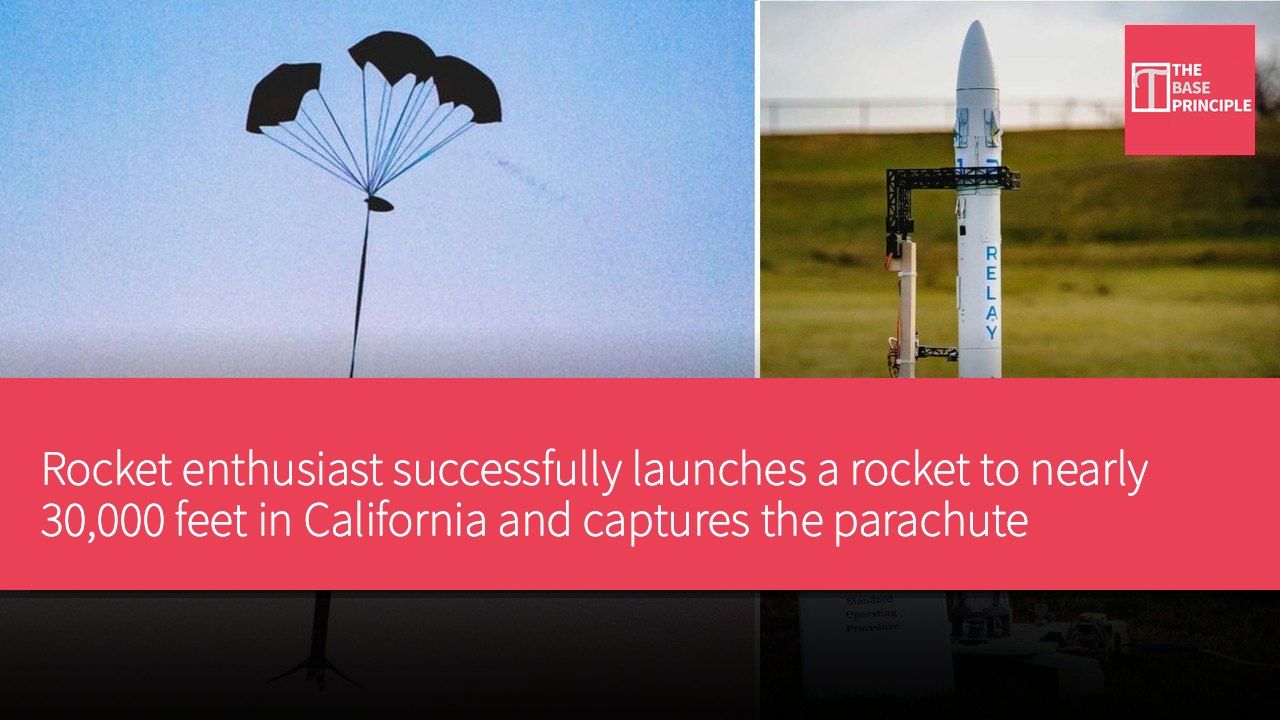
- Rocket enthusiast Joe Barnard successfully launched a rocket to nearly 30,000 feet.
- Barnard designed the rocket to reach speeds of Mach 2 using a powerful engine.
- He monitored the rocket's speed and altitude using an independent computer system called Fluctus.
- The recovery system Repris successfully captured aerial footage but failed to record the landing process.
Self-taught rocket enthusiast and YouTuber Joe Barnard has released a video on his YouTube channel showing the launch of a rocket to nearly 30,000 feet at supersonic speeds, releasing a small camera pod at the apex to capture the parachute deployment from the outside in slow motion. The rocket was launched near Randsburg, California, and the video was published on Thursday, November 5. According to Barnard, this perspective has never been achieved by amateur rocketry due to the need for precise timing, force, and recovery during the rocket's high-speed, turbulent flight.
Rocket Design and Technical Challenges
In terms of rocket design, Barnard specifically engineered the rocket and its remote operation system to achieve speeds of Mach 2. The upper section of the rocket was constructed using nine layers of fiberglass, a multi-layer material that enhances the rocket's strength to withstand pressure and speed during flight, even with a large opening for the camera pod. For this launch, he also reinforced the lower booster of the rocket with carbon fiber tubes and used a powerful pulse-class engine capable of providing an average thrust of 2300 Newtons (N). He also created his own rocket propellant mixture for the launch.
In addition to modifications to the vehicle design, Barnard utilized an independent computer system called Fluctus to monitor the rocket's speed, pressure, and altitude, determining the timing for releasing the camera pod and deploying the parachute during ascent.
He also made adjustments to the camera's fixed position to prepare for this challenging task. To ensure the lens was correctly positioned under such difficult conditions, he disassembled a GoPro Hero 12, inverted it, and placed it inside a 3D-printed housing. He added a sensor cable extension to capture the desired angle and upgraded the firmware to limit the recording rate to 240 frames per second. Another challenge was maintaining the camera's orientation after it left the safety zone of the launch vehicle. Once the camera pod was released, there was no rocket to stabilize it.
This position was ensured by a small battery triggered by a small pin during launch, powering the camera, a spinning motor wheel, and a gyroscope. The spinning gyroscope helped prevent the camera from rolling, allowing it to continuously align with the rocket and capture smooth footage of the parachute deployment.
Successes and Failures of the Recovery System
After recording was completed, Barnard created a recovery system called Repris, which consists of a decelerator to slow its descent and is equipped with a GPS tracker to help locate the camera pod after landing. The team successfully captured aerial footage from 30,000 feet but failed to record the landing process. During the testing phase, the recovery team found the upper section of the rocket and the camera pod about 350 meters from the launch pad. The camera pod remained intact and successfully captured aerial footage. However, when Fluctus misinterpreted pressure fluctuations as a crash landing, the flight system encountered a technical failure and prematurely declared an emergency apogee, assuming the rocket could not be recovered.
This signal triggered the release circuits for the camera pod and parachute while the rocket was still traveling at over 700 mph. The powerful aerodynamic forces tore the parachute apart, ripping it from the upper section of the rocket, eliminating any possibility of capturing slow-motion footage of the landing.
Item Specification Thrust 2300 Newtons (N) Speed Mach 2
Breakthroughs in Rocket Launch and Imaging Technology
Joe Barnard's successful launch showcases advancements in amateur rocketry, particularly in design and control systems. By utilizing multi-layer materials and powerful engines, Barnard not only enhanced the rocket's performance but also achieved unprecedented photographic perspectives. Although the recovery system faced technical challenges, it still captured significant aerial footage, demonstrating the potential for future amateur rocket launches to leverage precision technology to improve filming quality and success rates. These innovations hold important implications for the development of rocket enthusiasts and related fields.