
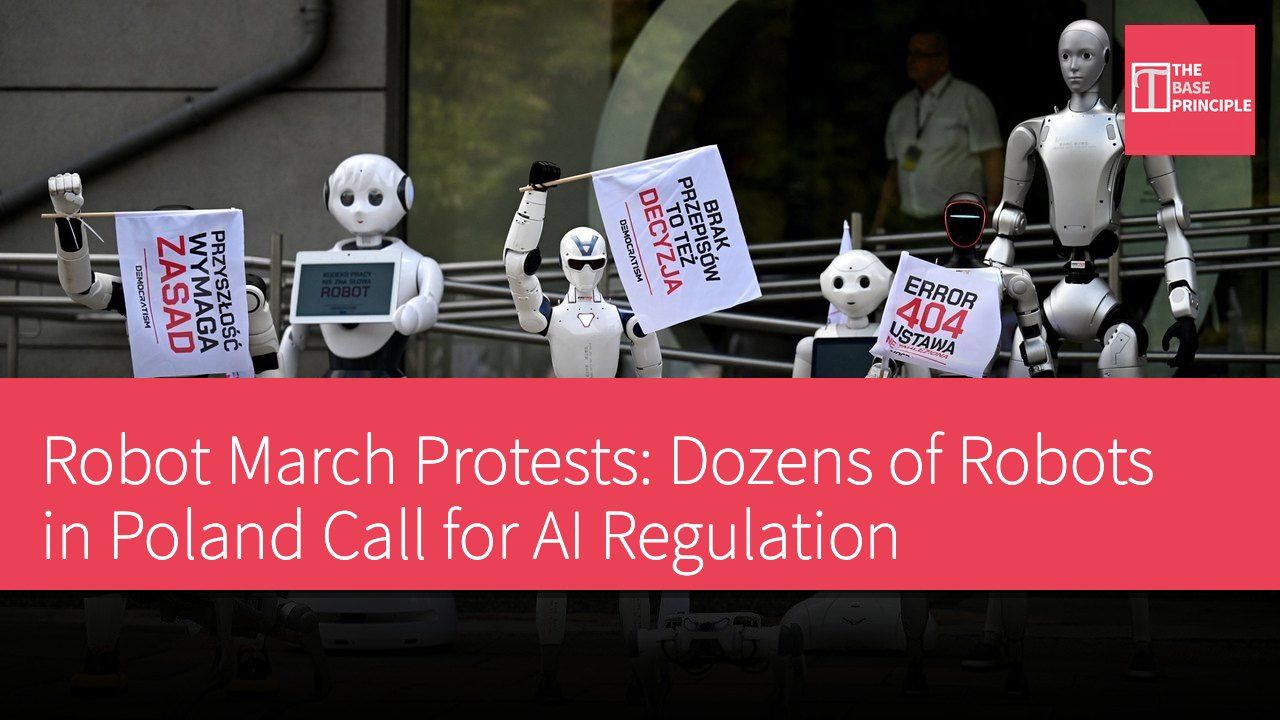
- About 30 robots marched in Warsaw to protest unregulated AI.
- Organizer Grzegorz Kulis highlighted the risk of humans being replaced by robots.
- The protest aimed to demonstrate the current capabilities of robots and the urgency of the issue.
- Poland's Minister of Digital Affairs stated that uncontrolled AI will pose significant problems.
About 30 robots marched in Warsaw on Monday, waving flags and playing chants outside the Polish Ministry of Digital Affairs, in what the event's organizers called a protest against unregulated artificial intelligence. The demonstrators ranged from bipedal humanoid robots to quadrupedal, dog-like machines, circling the ministry while loudspeakers played recorded chants such as "Defend Jobs" and "Don't Wait, Regulate." The protest was organized by the group Democratism, whose mission is to spark public discussion on how AI and robotics affect the labor market.
The Purpose of the Robot Protest
The humanoid robot Agibot A3, which participated in the event, told Agence France-Presse that the robots aimed to demonstrate that this technology is a reality. Grzegorz Kulis, the protest's organizer, pointed out that the demonstration specifically targeted the growing risk he mentioned of humans being replaced in cognitive work by humanoid robots and AI. Kulis, who serves as the Chief Information Officer of a robotics company and the Chief Executive Officer of an employment agency, has previously served two terms on the Labor Market Committee at the Polish Ministry of Family, Labor, and Social Policy.
Kulis stated that the choice to use actual robots as protesters was deliberate, aiming to demonstrate their current capabilities and emphasize the urgency of the issue. He noted that the robots present were already capable of autonomous movement, which, in his framework, meant that the robots were already able to protest for themselves. He told AFP, "If we do not react now, there may be problems in the future," and called for regulations that could protect workers from the rapid pace of technological change.
Government Response to the Protest
Poland's Minister of Digital Affairs, Krzysztof Gawkowski, visited the demonstration and spoke with Kulis. Gawkowski stated that uncontrolled AI models and robotics will continue to evolve, posing significant problems. The protest took place a few months after Polish President Karol Nawrocki signed legislation in July to implement the EU's AI Act domestically. The act establishes a national body with the authority to enforce the EU regulations that have officially come into effect.
Kulis stated that the demonstration reflected a broader sense of responsibility, aiming to inform the public about the rapid pace of technological change, which personally frightens him. This message was partly conveyed through robots designed to resemble the technology being protested, drawing the attention of passersby during the demonstration. The event highlighted tensions that are becoming increasingly evident across Europe. Although AI regulation has seen progress through legislation such as the EU AI Act, the pace of technological development still outstrips most public discourse.
The Social Significance of the Robot Protest
The robot protest reflects societal concerns about the development of AI, particularly its impact on the labor market. As technology advances rapidly, many fear that robots will replace human jobs, leading to unemployment and social instability. By involving actual robots in the protest, the organizers hoped to draw the attention of the public and policymakers, fostering discussion on relevant regulations. Despite legislative progress, the pace of technological development still outstrips society's ability to adapt, giving the protest a deeper social significance.